The Lebanese armed faction Hezbollah has drawn global attention by mentioning the possibility of a ceasefire negotiation without referring to the preconditions it had previously presented. While there is speculation that this is a compromise proposal emerging under pressure from Israel's offensive and expectations for a ceasefire are being stimulated, cautious views follow, noting that it is still uncertain whether actual negotiations will take place.
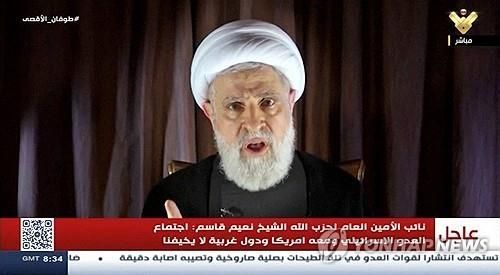
According to major foreign media on the 9th, Naim Qassem, the second-in-command of Hezbollah, said in a video speech the day before (local time) that he supports the political activities led by Nabih Berri, the Speaker of the Lebanese Parliament, under the name of a ceasefire.
Qassem also said, "If a ceasefire is achieved and a diplomatic platform opens, other details can be discussed."
This statement was interpreted as a reference to ceasefire negotiations, causing international oil prices, which had surged due to escalating tensions in the Middle East, to plummet.
Major foreign media interpreted Qassem's remarks as leaving room for ceasefire negotiations, although it is unclear whether his position has changed from the previous stance of not stopping military activities without a ceasefire in Gaza. They also noted that signs of a possible change in Hezbollah's position had been detected even before Qassem's remarks, analyzing that it might be due to the difficulty in coping with Israel's offensive.
An anonymous Lebanese government official told Reuters that Hezbollah revised its position because it was struggling to withstand the pressure from Israeli airstrikes, which caused a large number of refugees mainly in southern Lebanon, where Shiite communities reside.
Since last month, Israel has expanded the scope of airstrikes beyond the southern border area of Lebanon, where clashes had been ongoing, to areas near the capital Beirut and even the city center. It is also expanding ground operations by continuously deploying division-level troops in southern Lebanon, Hezbollah's stronghold.
Within Lebanese politics and Hezbollah itself, there are talks that Hezbollah has no choice but to explore the possibility of a ceasefire under pressure from Israel's power. According to major foreign media, Lebanese politician Suleiman Frangieh said, "The priority (of Hezbollah) is to stop Israel's offensive."
The U.S. government also pointed out that Hezbollah mentioning a ceasefire shows how much damage it has suffered. Matthew Miller, spokesperson for the U.S. State Department, said at a briefing that the mention of a ceasefire indicates that Hezbollah's position has become unfavorable.
However, since Hezbollah has not explicitly stated that it has changed its position, and Israel is not interested in a diplomatic solution, the possibility of immediate progress in ceasefire negotiations is low.
There are also criticisms that it is too late to create diplomatic momentum. A diplomat working in Lebanon pointed out that Israel's dominant logic is now more military than diplomatic. Mohannad Hage Ali, deputy director of the Carnegie Middle East Center, said that Israel was able to gain the upper hand by intensifying military pressure on Hezbollah, adding, "Hezbollah is trying to engage in politics, but it is not enough for Israel, and it will not work that way."
© The Asia Business Daily(www.asiae.co.kr). All rights reserved.
![Clutching a Stolen Dior Bag, Saying "I Hate Being Poor but Real"... The Grotesque Con of a "Human Knockoff" [Slate]](https://cwcontent.asiae.co.kr/asiaresize/183/2026021902243444107_1771435474.jpg)















