'Bangye' Revealing Upper Body by Taking Off Clothes
Complex Factors Including History, Superstition, and Individualism
Chinese Government Also Imposes Fines and Cracks Down
At a night market in Jeju Island, a man presumed to be a Chinese tourist was spotted wandering the streets shirtless, exposing his upper body covered in tattoos, sparking controversy. A post titled “Shock at the Arboretum Night Market Visit” uploaded on June 6 to a Jeju mom caf? described the man as “seeming to be Chinese” and noted that “it is unusual to see such behavior at a night market.”
In Chinese, the term ‘Guangbangzi (光膀子)’ refers to the act of taking off one’s shirt and exposing the upper body. It is especially common in summer and is done to cool down regardless of time or place. Men who practice Guangbangzi are called ‘Bangye.’ The meaning of Bangye is ‘father, old man.’ Most Bangye are middle-aged or older men.
Typical Bangye behavior includes gathering on streets or in parks to play xiangqi (Chinese chess) or chat. Instead of fully removing their shirts, some roll up the lower part of their clothing to the solar plexus, exposing only their stomachs. Western media have dubbed this look the “Beijing Bikini,” comparing it to women’s bikini swimsuits. Of course, Beijing is not the origin of Bangye, as this custom can be seen throughout China.
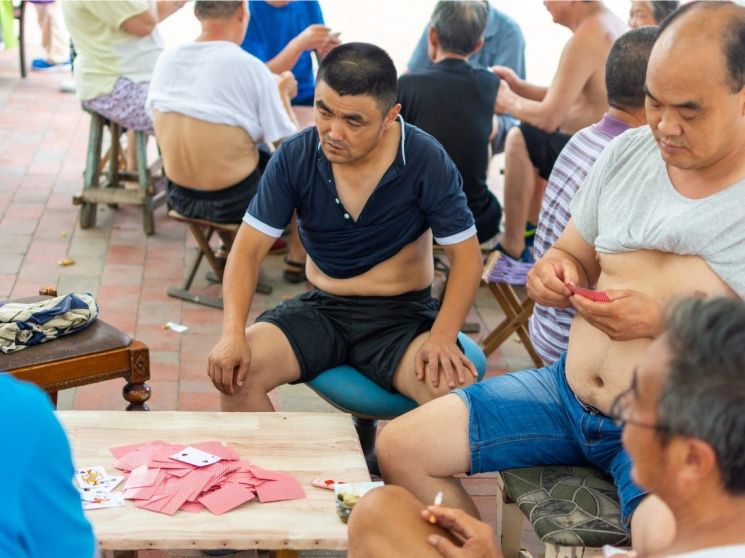
Pluralistic and Complex Culture Including Superstitions
The origin of the culture of Chinese men going shirtless is pluralistic and complex. Above all, it is the easiest and most primal way to cool down. A superstition also plays a role: the Chinese characters for ‘belly’ (腹) and ‘fortune’ (福) are pronounced the same, so exposing the belly is believed to bring good luck. There is also a claim based on traditional Chinese medicine that exposing the navel helps release qi (energy) around internal organs.
In Chinese history, it is also linked to male ‘spirit’ or ‘vigor.’ A famous anecdote involves the ancient calligrapher Wang Xizhi. During the Jin dynasty, the Grand Tutor Chi Gan was searching for a son-in-law among the sons of Prime Minister Wang Dao. Unlike his brothers who tried to show dignity, Wang Xizhi lay on his bed with his belly exposed, unconcerned about visitors, practicing calligraphy on his stomach with his finger.
Chi Gan chose Wang Xizhi as his son-in-law because of his focus on his own affairs. The phrase ‘Tanfu Dongchuang (坦腹東床)’ refers to this story, meaning ‘lying on the eastern bed with belly exposed.’ Today, it is used to mean an excellent son-in-law. Additionally, in the Romance of the Three Kingdoms, the shirtless duel between Ma Chao and Xu Zhu is depicted as a display of brave generals. Mao Zedong, the first Chairman of China, is said to have met Li Zongren, the first Vice President of Taiwan, shirtless after stopping swimming and coming ashore.
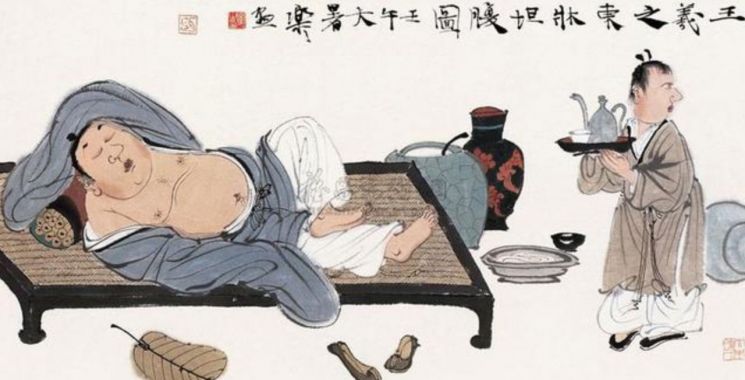 A painting depicting Wang Xizhi lying on his side on an eastern bed with his belly exposed
 [Photo source=Baidu]
The Strong Individualistic Tendencies of Chinese People Also Play a Role
The strong individualistic tendencies of Chinese people, who do not care about others’ opinions, also contribute. A study comparing individualism in China, Japan, Korea, and the Netherlands (Professor Yeon Myeong-heum, Inje University, 2010) provides clues to understanding Chinese individualism. The study categorized individualism into four factors: independent behavior, interests and decision-making, indifference to others, and personal will.
According to the survey, Chinese people agreed most with ‘independent behavior’ and ‘personal will.’ ‘Independent behavior’ includes items such as ‘If the group I belong to hinders my development, it is better to leave the group or work alone.’ ‘Personal will’ includes items like ‘No matter what others say, I do what I think is right.’ This suggests that Chinese individuals’ preferences are less influenced by external standards or trends.
Moreover, there is a saying in China: ‘Sabulgwan-gi Gogo-gwaegi,’ meaning ‘I never get involved in matters unrelated to me.’ The ‘Weikan (圍看)’ culture, which has become a social issue in China, is an extreme manifestation of this selfishness. ‘Weikan’ literally means ‘spectator habit.’ Chinese people have been reported in domestic media several times for merely watching without intervening when someone is sexually assaulted on the street or attempts suicide by jumping from a bridge.
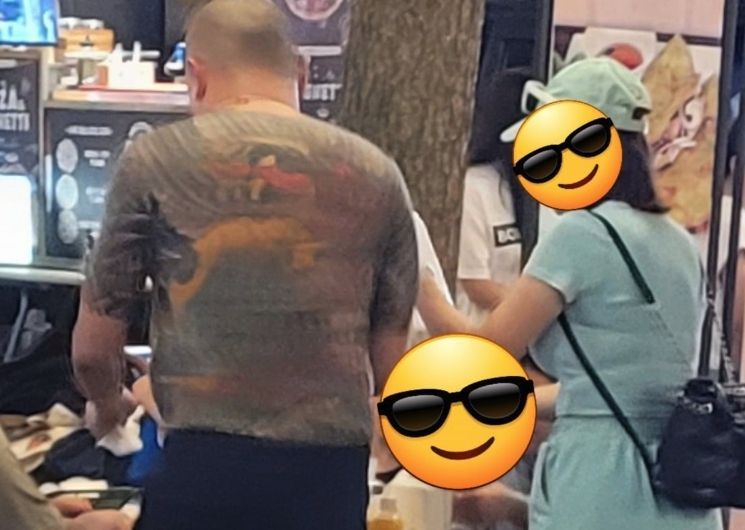 A post titled "Shock from Visiting the Arboretum Night Market" was uploaded on an online cafe in Jeju. The photo shows a Chinese man walking around the night market with his upper body exposed.
 [Photo by Jeju Mom Cafe]
Therefore, Bangye tend to be fundamentally unaware of their exposed state. Recent disorderly behaviors by Chinese tourists in Korea, such as defecating in public streets and smoking in indoor non-smoking areas, can be considered related to this tendency.
However, Bangye have largely disappeared in major Chinese cities. The Chinese government launched a massive crackdown to renew the national image while preparing for the 2008 Beijing Olympics. Still, some local governments, such as Tianjin, continue efforts to eradicate Bangye by imposing fines. This is because Bangye culture remains outside major cities.
© The Asia Business Daily(www.asiae.co.kr). All rights reserved.
![Clutching a Stolen Dior Bag, Saying "I Hate Being Poor but Real"... The Grotesque Con of a "Human Knockoff" [Slate]](https://cwcontent.asiae.co.kr/asiaresize/183/2026021902243444107_1771435474.jpg)

















