"A Bill Ignoring the Purpose and Principles of Medical Education Institution Evaluation and Accreditation"
The medical community strongly criticized the Ministry of Education, which is pushing for a plan to grant more than one year of remediation period when the Korea Institute of Medical Education and Evaluation (KIMEE) issues a 'medical school non-accreditation.'
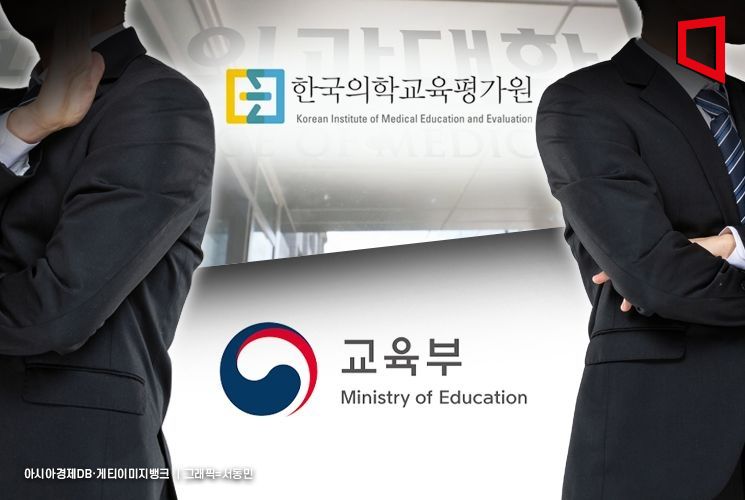
The Korean Medical Education Council issued a statement on the 7th demanding "the immediate withdrawal of the partial amendment to the 'Regulations on the Evaluation and Accreditation of Higher Education Institutions' attempted by the government," adding that "this bill ignores the purpose and principles of medical education institution evaluation and accreditation and clearly intends to exert undue pressure on KIMEE."
The statement was jointly signed by the Korean Academy of Medical Sciences, the Korean Medical Association, the Korean Hospital Association, the Korea Institute of Medical Education and Evaluation, the Korean Association of Medical Colleges and Medical Schools, the Korean Society of Medical Education, the Korean Association of Private Practitioners, the Korean Association of Basic Medical Sciences, the National Council of Medical School Professors, the Medical Education Training Institute, and the Association of Private University Medical Centers.
Earlier, on the 27th of last month, the Ministry of Education announced a legislative notice for a partial amendment to the 'Regulations on the Evaluation and Accreditation of Higher Education Institutions,' which includes granting medical schools a remediation period of more than one year before KIMEE issues a non-accreditation decision in cases where large-scale disasters disrupt normal academic operations.
The medical community stated, "This is a dangerous idea by the government to cover up the anticipated deterioration of medical education following the reckless large-scale increase in medical school quotas," and "We strongly condemn the intention to undermine KIMEE, the last bastion preventing the decline in the quality of medical education."
They continued, "The Ministry of Education's amendment aims to render KIMEE meaningless," adding, "Neglecting students despite inadequate educational conditions and allowing graduates from such environments to qualify for the national medical licensing examination creates a situation that endangers public health."
Furthermore, they emphasized, "The government should remember the Seonam Medical School incident, where the poor state of education was identified through KIMEE accreditation, leading to a belated suspension of new student admissions," and "Learning from this, the autonomy and independence of KIMEE must be respected, and the evaluation and accreditation process and results should be accepted."
© The Asia Business Daily(www.asiae.co.kr). All rights reserved.
![Clutching a Stolen Dior Bag, Saying "I Hate Being Poor but Real"... The Grotesque Con of a "Human Knockoff" [Slate]](https://cwcontent.asiae.co.kr/asiaresize/183/2026021902243444107_1771435474.jpg)















