'2024 Seoul International Didimdol Income' Forum Held
Near Double Increase in Exit Rate from Welfare in Second Year Experiment
Oh Se-hoon "Basic Income Uses Simplistic and Uninformed Logic"
Among the households receiving Seoul Didimdol Income support for the second year, the rate of those who no longer need to receive Didimdol Income nearly doubled. While overseas welfare and economic experts praised the achievements of the Didimdol Income experiment for its policy implementation based on meticulous research, Oh Se-hoon, the Mayor of Seoul who devised the Didimdol Income, criticized Lee Jae-myung, the leader of the Democratic Party of Korea, for his 'basic income' proposal.
On the 7th, Seoul City revealed the achievements of Seoul Didimdol Income at the '2024 Seoul International Didimdol Income Forum' held at DDP and engaged in policy discussions with domestic and international scholars in the fields of income disparity and inequality. Unlike basic income, which provides a fixed amount equally to all citizens, Didimdol Income supports a certain percentage of the household income shortfall relative to the median income, providing more support to those with lower incomes. Eligibility is maintained even if income exceeds the set standard, so benefits are automatically paid even if income suddenly decreases.
At the forum, Mayor Oh said, "When I ask Lee Jae-myung, the Democratic Party leader, 'Why should the same amount be distributed equally to all citizens?' he answers that giving the same amount to the wealthy is necessary so that they agree to the policy and benefits reach the poor," adding, "Such a simplistic and ignorant logic is being used by the basic income advocate who is currently the leader of our country's main opposition party."
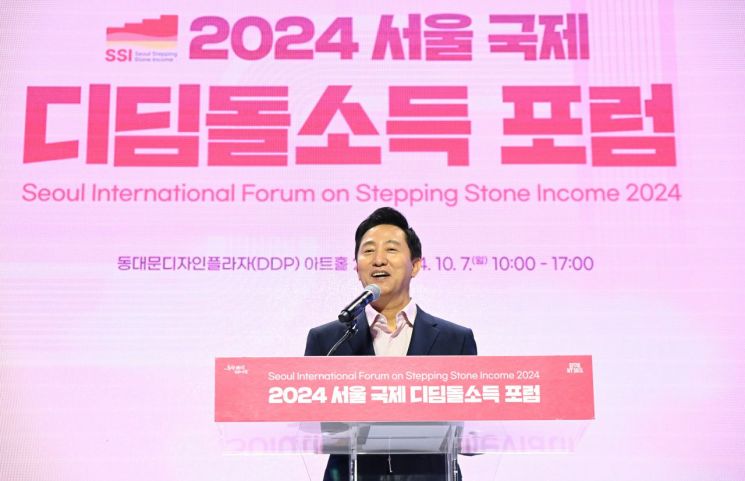 Seoul Mayor Oh Se-hoon is delivering a welcome speech at the opening ceremony of the '2024 Seoul International Didimdol Income Forum' held at DDP on the morning of the 7th.
 Photo by Seoul City
Didimdol Income Second Year Exit Rate 8.6%... 3.8%p Increase Compared to First Year
At the forum, Professor Lee Jung-min of Seoul National University’s Department of Economics shared the tangible achievements of Seoul Didimdol Income. The exit rate of recipients in the second year of Seoul Didimdol Income reached 8.6% (132 households), an increase of 3.8 percentage points compared to 23 households (4.8%) in the first year. This showed a higher exit rate compared to the current system.
31.1% (476 households) of the households receiving Didimdol Income also showed an increase in earned income. This was 9.3 percentage points higher than the 21.8% (104 households) in the first year, compensating for the current system’s weakness of low work incentives. Professor Lee explained, "Although the overall employment rate slightly decreased on average among all recipients, we found an effect of promoting employment compared to recipients of livelihood benefits under the National Basic Livelihood Security System."
The work incentive effect was also confirmed among 'non-working households' who were not employed before receiving support. Among households not working, the rate of those who started working after receiving Didimdol Income was 3.6 percentage points higher than the comparison group. Educational expenses, which serve as a 'social ladder' for children, were also confirmed. Long-term investments in human resources that can increase labor productivity rose, with education and training expenses being 72.7% higher than the comparison group.
The analysis covered 1,523 households in the first phase of Seoul Didimdol Income (below 50% of median income) (484 recipient households, 1,039 comparison households) and 3,588 households in the second phase (below 85% of median income) (1,100 recipient households, 2,488 comparison households). The scale and duration of the experiment increased compared to the first-year survey, enhancing the reliability of the experiment.
Scholars Positively Evaluate Didimdol Income as 'Research-Based Policy'... Nationwide Expansion Remains a Challenge
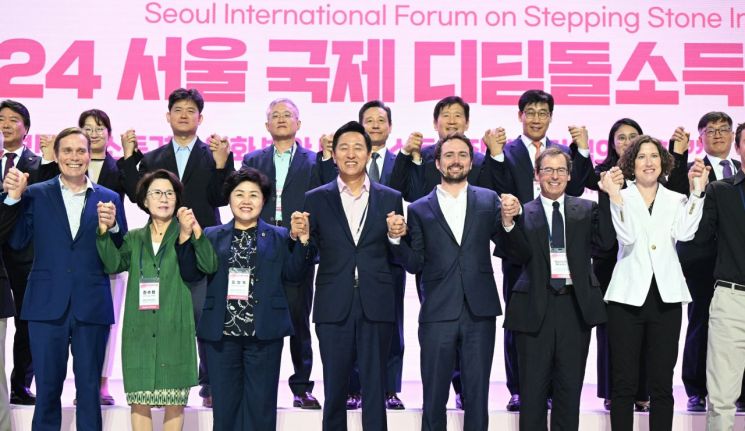 Seoul Mayor Oh Se-hoon is taking a group photo with attending guests at the opening ceremony of the '2024 Seoul International Didimdol Income Forum' held at DDP on the morning of the 7th. Photo by Seoul City.
At the forum, evaluations of the policy by world-renowned scholars were also conducted. The theme of this year’s forum was 'Exploring Measures to Alleviate Poverty and Income Disparity - Paradigm Shift in Income Security,' bringing together experts on income disparity from major advanced countries such as the United States and France to share insights.
Lucas Chancel, Director of the World Inequality Lab, positively evaluated the close relationship maintained between researchers and administrative agencies (policy) in Seoul Didimdol Income during his keynote speech. He said, "Accurate data and the exchange of various feedback between policy and research are very important, and this ensures the sustainability of the system. This aspect is hard to find in other income security systems, so I highly appreciate this part of Didimdol Income."
David Grusky, Professor of Sociology at Stanford University, described the second-year results of Didimdol Income as "comprehensive and scientific outstanding research outcomes," adding, "There is a tendency to find flaws, but none were found." He also suggested further examination of points such as 'network effects' in the research. Professor Grusky said, "Since this is a pilot project, the number of beneficiaries is small, so the likelihood of specific beneficiaries meeting other beneficiaries is low, which may suppress changes in the network. If it is expanded nationwide, we need to see how to evaluate network effects."
Pasi Moisio, Research Professor at the Finnish National Institute for Health and Welfare, advised that existing social service systems and employment policies should be considered when expanding Didimdol Income nationwide. Professor Moisio said, "What we realized 7 to 8 years after Finland’s basic income experiment was that support is needed not only for income but also for other services," adding, "We need to consider how to connect Didimdol Income, which has the character of a negative income tax, with other employment and social support services. I am curious about what results the next phase will bring in Korea."
Based on the results of this forum, Seoul City plans to seek future development plans through a detailed analysis of 'Seoul Didimdol Income,' a representative model of K-welfare. Mayor Oh mentioned in a special talk that regarding the expansion of Didimdol Income, "If existing cash support systems are integrated and linked with Seoul Didimdol Income to secure resources, the additional burden will not be significant," adding, "We are separately conducting a coherence study to prepare a restructuring plan by precisely analyzing the entire social security system and reviewing ways to secure the necessary funding."
Regarding funding measures, he said, "Currently, welfare expenditure is around 15% of GDP, but considering natural increases in 5 to 6 years, it will rise to 20%. Let’s align the scope of beneficiaries within that range," adding, "In the current Didimdol Income experiment, the threshold is set at 85% of median income, but when starting implementation, we plan to begin at 65% of median income and gradually raise it to the final goal of 85%, sequentially investing resources. This way, it can be raised to a manageable level according to the size of the country’s economy."
© The Asia Business Daily(www.asiae.co.kr). All rights reserved.


















