G20 Environment and Climate Ministers' Meeting Held on the 3rd
Payment for Ecosystem Services That Reward Environmental Protection Under Scrutiny
Environment Ministers Urge "Securing Funding from the International Community"
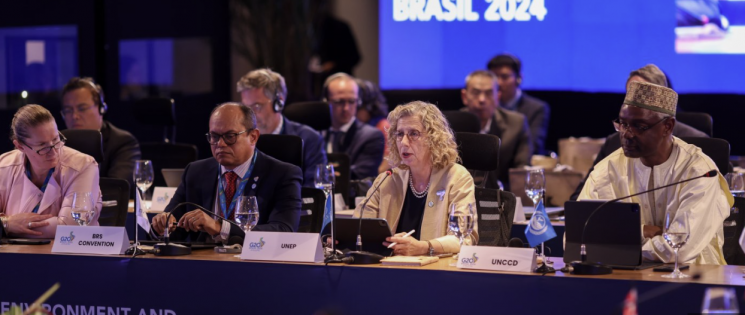 Inger Andersen, Executive Director of the United Nations Environment Programme (third from the left in the front row), delivering a speech at the 'G20 Environment and Climate Ministers Meeting' held on the 4th (local time) in Rio de Janeiro, Brazil. Photo by UN
Climate and environment ministers from the Group of Twenty (G20) successfully produced a declaration for the first time in three years. The declaration includes calls to secure funding to expand the dissemination of the ‘Payment for Ecosystem Services’ system and to increase environmental budgets on a country-by-country basis.
The Ministry of Environment announced on the 7th that a declaration was issued at the G20 Environment and Climate Ministers’ Meeting held on the 3rd (local time) in Rio de Janeiro, Brazil. This is the first time since 2021 that a declaration has come out of the related talks. The broad framework of the declaration is to revisit the spirit of the 1992 Rio Declaration on Environment and Development and to strengthen efforts at the G20 level.
In particular, there was a demand to establish sustainable funding measures to expand the ‘Payment for Ecosystem Services’ system. The Payment for Ecosystem Services system is a scheme that provides direct compensation to individuals or local governments that supply ecosystem services or improve the environment. It originated from the idea of not leaving environmental issues to conscience alone but creating a market to solve them.
The problem is the budget. The expansion of the Payment for Ecosystem Services system requires significant costs. If the support target expands to large areas such as tropical rainforests, the costs rise astronomically. In Korea’s case, although the Payment for Ecosystem Services system has been introduced, it has not been expanded due to a lack of secured budget. Developing countries with limited financial capacity are practically unable to implement the system. This is why there are calls to secure funding at the international community level.
Major countries’ environment ministers also urged that climate adaptation policies should be central when formulating economic and fiscal policies within member countries. They emphasized the importance of securing related funding as well. In the waste management and circular economy sectors, they called for the G20’s role in addressing plastic pollution and urged cooperation to successfully conclude a plastic treaty by the end of this year.
The international community welcomed the G20 declaration. In a speech on the 4th, Inger Andersen, Executive Director of the United Nations Environment Programme, said, “I welcome the G20 Environment and Climate Sustainability Working Group Ministers’ Declaration,” adding, “It is encouraging to see concrete commitments made on agendas including climate change adaptation, oceans, payment for ecosystem services, waste, and the circular economy.”
The Korean delegation, including the Ministry of Environment and the 2050 Carbon Neutral Green Growth Committee, highlighted the importance of technological innovation to drive the circular economy. They also introduced the government’s ongoing ‘Whole Lifecycle Plastic Measures’ and the regulatory sandbox system to encourage technological innovation in the circular economy. With the Plastic Pollution Response Treaty Negotiation Committee meeting scheduled to be held in Busan this November, they requested the interest and cooperation of member countries.
This declaration will be utilized as an outcome of the G20 Summit to be held in Rio de Janeiro, Brazil, on November 18?19. It may also influence the positions of the G20 at the Convention on Biological Diversity and the United Nations Framework Convention on Climate Change Conferences of the Parties.
© The Asia Business Daily(www.asiae.co.kr). All rights reserved.
![Clutching a Stolen Dior Bag, Saying "I Hate Being Poor but Real"... The Grotesque Con of a "Human Knockoff" [Slate]](https://cwcontent.asiae.co.kr/asiaresize/183/2026021902243444107_1771435474.jpg)
















