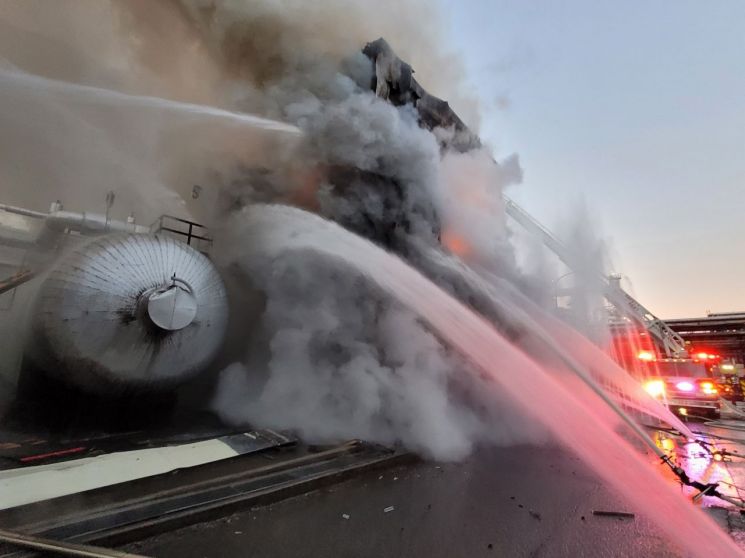
 A fire broke out at the Energy Storage System (ESS) of SK Energy's Ulsan plant, and the fire department is conducting suppression operations. 2022.1.12 [Provided by Ulsan Fire Department] [Image source=Yonhap News]
It has been found that 92% of energy storage system (ESS) fires occurred while the systems were in a standby state after being fully charged. Despite the government's measure to limit charging to 80%, this rule has not been properly followed on site.
According to data on 'ESS Facility Fire Occurrences' received on the 7th by Assemblyman Heo Seong-mu (Democratic Party), a member of the National Assembly's Industry, Trade, Energy, Small and Medium Enterprises Committee, from the Korea Electrical Safety Corporation, a total of 55 fires have occurred from 2017 to June 2024. By battery manufacturer, company L accounted for 26 cases, company S 23 cases, company A 1 case, and others 5 cases.
The fire occurrences by usage were 43 cases linked to renewable energy, 10 cases for peak reduction, and 2 cases for frequency regulation. By province, Jeonnam had the highest number with 14 cases, followed by Gyeongbuk with 7 cases, and Chungbuk, Chungnam, and Gyeongnam with 6 cases each. In contrast, Seoul, Busan, Gwangju, and Daejeon reported zero cases. By location, fires occurred 26 times in mountainous areas, 7 times along coastal areas, 10 times on factory sites, and 12 times in other areas (1 in commercial areas, 11 in flatlands). Regarding charging rates at the time of fire, 27 cases occurred while operating at 80-90%, 22 cases at 91-100%, and 6 cases during construction or repair.
As ESS fires continued, the Ministry of Trade, Industry and Energy and other government bodies conducted three joint public-private investigations starting in 2019, in 2020, and 2022. Especially after the second investigation in 2020, measures were taken to limit charging rates to 80% indoors and 90% outdoors.
Nevertheless, it has been identified that 92% (23 out of 25 cases) of ESS fires occurring from 2021 to this year happened while the systems were fully charged but not in operation. Due to violations of the charging rate limits, the Electrical Safety Corporation issued warnings about exceeding charging rates and enforced reductions in charging rates at 70 locations nationwide just this year.
Concerns are being raised that ESS operation and management remain complacent, and that the power authorities need to strengthen their management intensity. Assemblyman Heo Seong-mu stated, "Although the Ministry of Trade, Industry and Energy has established ESS fire countermeasures three times, the current sanctions for violating ESS charging rate limits are only at the notification level," adding, "We need to consider various improvement measures, including elevating the related notifications to higher-level laws."
© The Asia Business Daily(www.asiae.co.kr). All rights reserved.
![Clutching a Stolen Dior Bag, Saying "I Hate Being Poor but Real"... The Grotesque Con of a "Human Knockoff" [Slate]](https://cwcontent.asiae.co.kr/asiaresize/183/2026021902243444107_1771435474.jpg)















