The tension in the Middle East is intensifying as the one-year anniversary of the ‘10·7 Gaza Strip War’ approaches. Israel, which has expanded the frontlines over the past year from retaliating against the Palestinian militant group Hamas to the entire ‘axis of resistance’ including Lebanon’s Hezbollah, is expected to soon launch retaliatory strikes targeting Iran’s oil or nuclear facilities. While Israel has warned that it is "considering all options" for retaliation against Iran, Iran has also entered a state of highest alert.
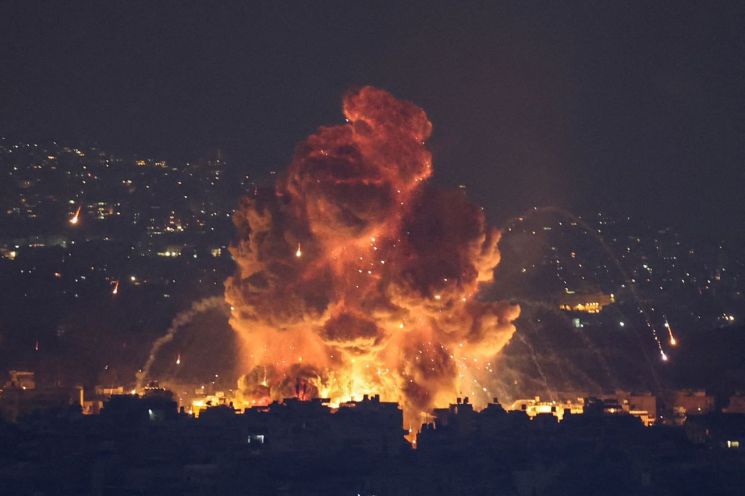
One Year into the War... Airstrikes Continue in Gaza and Lebanon
On the eve of the one-year anniversary of the war on the 7th (local time), Israeli authorities continued airstrikes targeting the Gaza Strip and Lebanon while preparing for possible terrorist attacks. Prime Minister Benjamin Netanyahu, after visiting military units near the Lebanese border on the 6th, stated in a video message, "One year ago, we suffered a terrible blow. Over the past 12 months, we have changed reality from start to finish," adding, "Israel will achieve victory."
The Israeli military confirmed that on the same day it attacked Hezbollah’s intelligence headquarters and weapons storage facilities in Beirut, Lebanon, as well as command centers and launch pads in the southern Bekaa region. Additionally, areas near the northern border such as Manara were designated as closed military zones, barring civilian access and expanding operational areas. These regions are near the ‘Blue Line,’ a kind of border established by the United Nations Security Council between Israel and Lebanon. In response, Hezbollah launched counterattacks targeting northern Israeli cities including Haifa. On the same day, the Israeli military also bombed areas such as Jabalia and Deir al-Balah in the Palestinian Gaza Strip, stating, "We have confirmed Hamas’s attempts to rebuild operational capabilities. A new ground operation will begin."
Cycle of Retaliation... Will Iran’s Nuclear Facilities Be Attacked?
With the one-year mark of the war, concerns about a full-scale war between Iran, which supports the ‘axis of resistance’ including Hamas and Hezbollah, and Israel are growing. Israeli Defense Minister Yoav Gallant said in an interview with CNN on the same day, "We will respond appropriately to Iran, which attacked Israel last week. We will not remain idle," and reiterated the warning of retaliation, saying, "We are discussing all options, including attacks on nuclear facilities." On the same day, during a visit to the Nevatim Airbase, which was targeted by Iranian missile attacks last week, he warned that Iran could become like Gaza or Beirut.
Judging that Israel’s counter-retaliation is imminent, the Iranian military has already entered the highest state of alert. Iranian authorities decided to suspend operations at some airports for nine hours from the night of the 6th to the morning of the 7th, but later lifted the suspension. However, some airspace will remain closed until the 9th under the pretext of military exercises. Foreign media including The New York Times (NYT) analyzed that Israel is likely to target Iran’s military, oil, and nuclear facilities in its attacks. Earlier this month, when Iran fired missiles at Israel, it also restricted passenger flights within its airspace and canceled all flights.
NYT also reported in another article that the whereabouts of the commander of the Quds Force within the Iranian Revolutionary Guard Corps are currently unknown. The Quds Force, an elite unit responsible for overseas operations, supports pro-Iranian armed groups operating in Iraq, Syria, and Lebanon with funding, weapons, training, and counterterrorism operations.
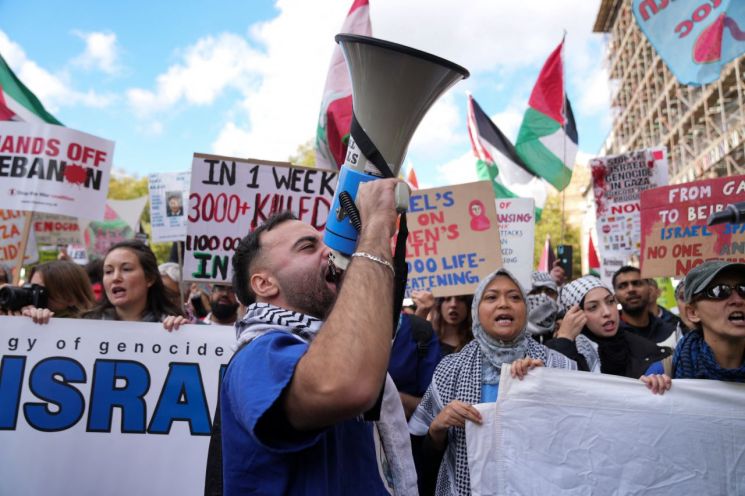
Anti-War Protests Continue Worldwide
Anti-war protests continued in the international community. On the 6th, a day before the one-year anniversary of the war, about 40,000 people gathered in central London to march and demand an end to the bloodshed in the Middle East. Thousands of people also held anti-war protests in New York, Paris, Rome, Sydney, and other cities.
Khalil al-Hayya, spokesperson for Hamas’s top leadership, reaffirmed Hamas’s basic stance on key issues related to the Gaza ceasefire negotiations in a speech commemorating the first anniversary of the airstrikes against Israel, stating, "What was rejected yesterday will not be accepted tomorrow."
According to the Gaza Strip Ministry of Health, at least 41,870 Palestinians have died due to Israeli military attacks since October 7 last year. The number of injured is estimated to be close to 100,000. The Lebanese Ministry of Health also reported that over 2,000 people have died in the past year, most of whom were killed in the recent two weeks when Israel’s attacks on Hezbollah intensified.
© The Asia Business Daily(www.asiae.co.kr). All rights reserved.
![Clutching a Stolen Dior Bag, Saying "I Hate Being Poor but Real"... The Grotesque Con of a "Human Knockoff" [Slate]](https://cwcontent.asiae.co.kr/asiaresize/183/2026021902243444107_1771435474.jpg)

















