Overall Increase in Seoul and Capital Area Narrows
Autumn Moving Season Kicks Off
Rental Market Volatility Expected to Rise
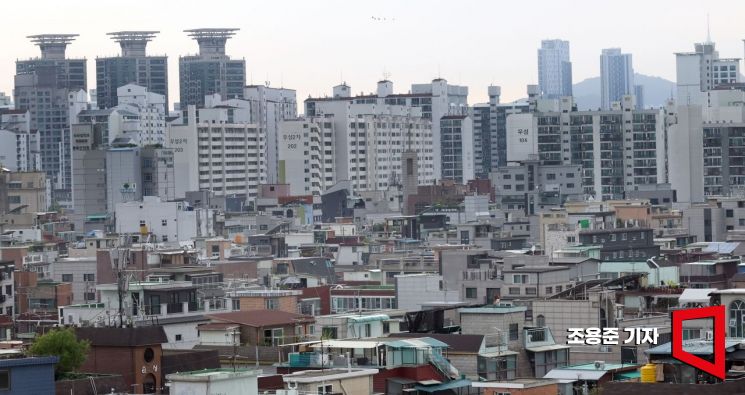 Seoul Walking Column - A residential complex in downtown Seoul where apartments and houses coexist. Photo by Yongjun Cho jun21@
Since September, the increase in household loans has slowed due to loan regulations such as Stress DSR Level 2. As a result, both sales and jeonse prices in the Seoul metropolitan area are showing signs of a slowdown in their rise.
According to Real Estate R114's 'Weekly Apartment Market Report for the Seoul Metropolitan Area in the First Week of October' on the 6th, the increase in household loans at the five major banks in August was a record high of 9.6259 trillion KRW, and the 5.6029 trillion KRW increase in September is still a considerable amount on a monthly basis. Therefore, loan regulation measures centered on major banks are expected to continue until the end of the year.
In the first week of October, apartment sales prices in Seoul rose by 0.01%, a smaller increase compared to the previous week (0.02%). Since the 6th of last month (0.03%), the upward trend has been slowing for 2 to 3 consecutive weeks. Both general apartments and reconstruction apartments increased by 0.01%.
On the other hand, new towns and Gyeonggi/Incheon areas remained flat (0.00%), showing limited movement. Among the 25 districts in Seoul, 16 remained flat, 7 rose, and 2 declined, with some areas turning weak.
Mapo (0.06%), Gwangjin (0.06%), Yangcheon (0.03%), and Gangnam (0.03%) increased, while Seodaemun (-0.02%) and Dongjak (-0.01%) decreased. In new towns, with the designation of the first-phase new town maintenance lead district imminent, Bundang rose by 0.02%, but all other areas remained flat (0.00%).
In Gyeonggi and Incheon, increases were seen in Hwaseong (0.04%), Ansan (0.02%), Uijeongbu (0.01%), Uiwang (0.01%), and Suwon (0.01%).
The jeonse market saw a slight decrease in the rate of increase this week. However, since it is a complex situation involving the autumn moving season, holidays, and loan regulations, it is necessary to observe whether there will be a change in the trend.
Seoul and Gyeonggi/Incheon rose by 0.02%, while new towns remained flat (0.00%). In Seoul, individual areas such as Gwangjin (0.07%), Dobong (0.06%), Nowon (0.05%), Gangnam (0.05%), Mapo (0.04%), and Gangdong (0.04%) increased.
In new towns, increases were mainly in Wirye (0.02%) and Pyeongchon (0.01%), while in Gyeonggi and Incheon, increases were centered in Incheon (0.10%), Osan (0.06%), Icheon (0.01%), Uiwang (0.01%), and Guri (0.01%).
A Real Estate R114 official explained, "Due to the comprehensive loan regulations, movements in both sales prices and jeonse prices are constrained. However, unlike the sales market, which includes both investment and actual demand, the jeonse and monthly rent market mostly consists of actual demand, so there are limits to suppressing it by regulations alone."
He added, "Especially as we enter the peak autumn moving season, various loan regulations have been implemented, reducing loan limits, and there are movements of jeonse demand switching to monthly rent. Since the monthly rent index of major price survey institutions including Real Estate R114 has been continuously hitting record highs in August and September, it is expected to influence jeonse prices with a certain time lag."
© The Asia Business Daily(www.asiae.co.kr). All rights reserved.
![Clutching a Stolen Dior Bag, Saying "I Hate Being Poor but Real"... The Grotesque Con of a "Human Knockoff" [Slate]](https://cwcontent.asiae.co.kr/asiaresize/183/2026021902243444107_1771435474.jpg)















