Population in their 60s ranks 2nd after 50s for the first time ever
Over 10 million aged 65 and older for the first time
The population of people in their 60s in South Korea has surpassed that of people in their 40s, becoming the second largest age group after those in their 50s.
On the 4th, Yonhap News Agency reported this citing the Ministry of the Interior and Safety's resident registration population statistics. According to these statistics, as of the end of last month, the nationwide population aged 60 to 69 was 7,770,242. This is 1,214 more than the population aged 40 to 49 (7,769,028).
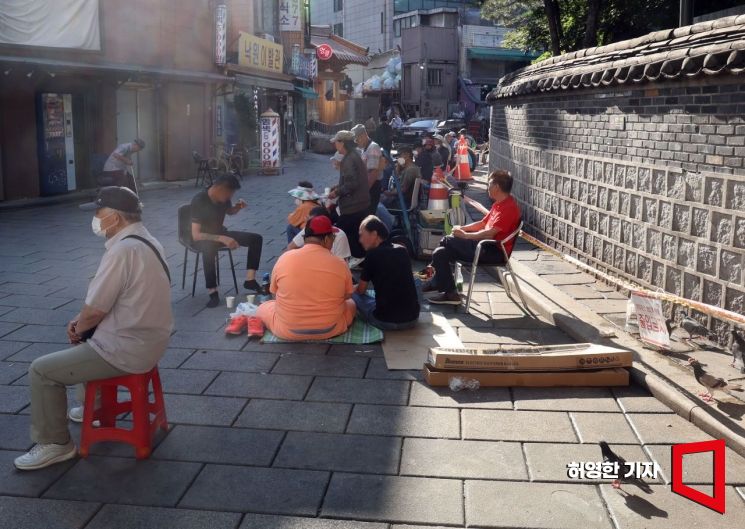 Elderly people are sitting in a line waiting for meal time in front of the free meal service at Wongaksa Temple behind Tapgol Park in Jongno-gu, Seoul. Photo by Younghan Heo younghan@
The largest age group by population is those in their 50s, with 8,722,766 people, about 950,000 more than those in their 60s. Looking at past population statistics, the population in their 50s has been the largest, followed by those in their 40s and then those in their 60s, but this time the order between the 40s and 60s has reversed. Since the Ministry of the Interior and Safety first compiled population statistics in 2008, this is the first time the number of people in their 60s has exceeded that of those in their 40s.
As Korean society ages, the registered population aged 65 and over exceeded 10 million for the first time in July. As of last month, the average age in South Korea was 45.2 years, which is 5.3 years higher than the average of 39.9 years ten years ago, and 0.6 years higher than the average of 44.6 years one year ago. When the proportion of the population aged 65 or older exceeds 20%, a society is classified as a super-aged society, and South Korea is expected to enter a super-aged society next year. Statistics Korea predicts that the proportion of the elderly population will surpass ▲25% in 2030 ▲30% in 2036 ▲40% in 2050, and will approach half by 2072.
Meanwhile, according to the '2023 Population and Housing Census Results' announced by Statistics Korea in July, the total population of South Korea as of November 1, 2023, was 51,775,000. This is an increase of 82,000 people (0.2%) compared to the previous year. The total population had decreased for two consecutive years since 2021 but returned to an increasing trend last year.
The reason for the increase in the total domestic population is the rise in the number of foreigners residing in the country. Last year, among South Korea's population, 49,839,000 (96.3%) were nationals, and 1,935,000 (3.7%) were foreigners. Compared to the previous year, the number of nationals decreased by 101,000 (-0.2%), while the number of foreigners increased by 183,000 (10.4%). The number of foreigners had decreased for two consecutive years since 2020 but shifted to an increasing trend after 2022.
© The Asia Business Daily(www.asiae.co.kr). All rights reserved.
![Clutching a Stolen Dior Bag, Saying "I Hate Being Poor but Real"... The Grotesque Con of a "Human Knockoff" [Slate]](https://cwcontent.asiae.co.kr/asiaresize/183/2026021902243444107_1771435474.jpg)















