Biden "Discussing Attacks on Israeli and Iranian Oil Facilities"
WTI and Brent Oil Prices Surge 5% in One Day
Iran's Strait of Hormuz Blockade Expected to Push Prices Over $100
US Administration Ahead of Election Likely to Focus on Preventing Sharp Oil Price Rise
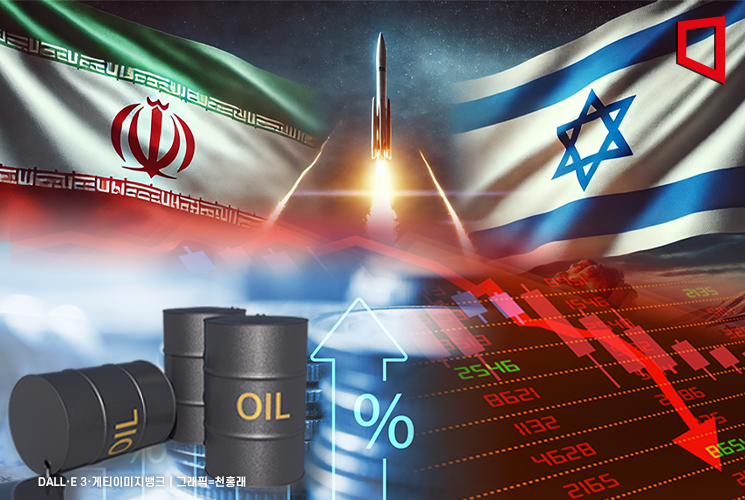
As tensions in the Middle East escalate with the looming threat of full-scale war between Israel and Iran, international oil prices surged by more than 5%. The fear of an 'oil shock' spread after U.S. President Joe Biden revealed that he is discussing retaliatory measures, including airstrikes on Iranian oil facilities, following a large-scale missile attack on Israel by Iran. If international oil prices race toward the $100 mark again, it could pose a significant challenge to the Biden-Harris administration, which faces the November presidential election in just over a month.
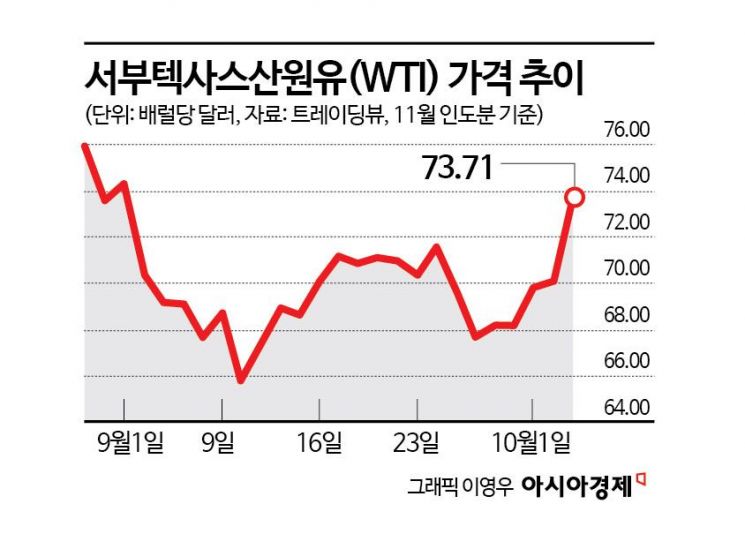
On the 3rd (local time), November delivery West Texas Intermediate (WTI) crude oil on the New York Mercantile Exchange closed at $73.71 per barrel, up $3.61 (5.15%) from the previous trading day. The global oil price benchmark, Brent crude for December delivery, ended the session at $75.64 per barrel, rising $3.72 (5.03%).
Oil prices soared after President Biden mentioned the possibility of Israel's retaliatory strikes against Iran. Before departing to visit hurricane-affected areas in Florida and Georgia, he told reporters that he is "discussing" whether to allow Israel to attack Iranian oil facilities, adding, "We are advising Israel, not authorizing." He further explained, "Nothing will happen today (the 3rd)," and said, "I will talk about it later."
Earlier, on the 1st, Iran launched about 200 ballistic missiles toward Israel in retaliation for the assassination of leaders of the Lebanese militant group Hezbollah and the Palestinian militant group Hamas. Israel immediately declared a counter-retaliation against Iran, pushing tensions in the Middle East to a peak. As Israel and Iran, which have so far refrained from direct conflict in the Middle East?home to one-third of the world's oil supply?face the risk of full-scale war, international oil prices surged sharply.
If Israel conducts airstrikes on Iran's oil facilities, supply disruptions are inevitable. According to Citigroup, if Israel's attacks are large-scale, global oil supply could decrease by 1.5 million barrels per day, about half of Iran's daily production of 3.3 million barrels. If Israel's attacks are limited, oil supply is estimated to drop by 300,000 to 450,000 barrels per day.
Experts predict that if the situation worsens, international oil prices could rise by an additional $10 to $30 per barrel. ClearView Energy Partners estimates a $12 increase if Israel attacks Iranian refining facilities. In the worst-case scenario, if Iran blocks the Strait of Hormuz, a major oil transit route, prices could jump by $28 per barrel. In that case, international oil prices would exceed $100 per barrel again, a level last seen after Russia's invasion of Ukraine in 2022.
The market is increasingly concerned that if the conflict between Israel and Iran intensifies, the resulting surge in oil prices could cause inflation?which has recently eased?to rebound. This would be a significant burden for the Biden-Harris administration, which has worked to keep oil prices stable ahead of the November election.
Some argue that since the Biden administration is focused on stabilizing oil prices before the election, it is unclear whether Israel would directly target oil facilities that could burden the U.S. government. To prevent inflation from rising due to soaring oil prices, the U.S. and major oil-producing countries are concentrating on blocking the possibility of an oil shock, and Israel is likely to consider this in its response.
Rebecca Babin, Senior Energy Trader at CIBC Private Wealth, said, "It is not surprising to the market that energy infrastructure is considered a potential target, but President Biden's remarks bring this closer to reality." However, she added, "With the election approaching, there are also skeptical views on whether Israel will actually attack Iran's oil facilities."
© The Asia Business Daily(www.asiae.co.kr). All rights reserved.
![Clutching a Stolen Dior Bag, Saying "I Hate Being Poor but Real"... The Grotesque Con of a "Human Knockoff" [Slate]](https://cwcontent.asiae.co.kr/asiaresize/183/2026021902243444107_1771435474.jpg)
















