Cesarean Delivery Rate 51% in 2019 → 67% This Year
Korea Ranks 2nd Among OECD Countries in Cesarean Delivery Rate
Over the past five years, the rate of natural births has sharply declined, with two out of three mothers giving birth via cesarean section.
On the 3rd, Kim Mi-ae, a member of the People Power Party on the National Assembly's Health and Welfare Committee, announced the results of an analysis of data submitted by the National Health Insurance Service. The results showed that from 2019 to last year, the number of natural birth patients decreased by 44.3%, from 145,325 to 81,002. In contrast, during the same period, the number of cesarean section patients only decreased by 4.3%, from 152,014 to 145,519, causing the proportion of cesarean deliveries in total births to steadily increase.
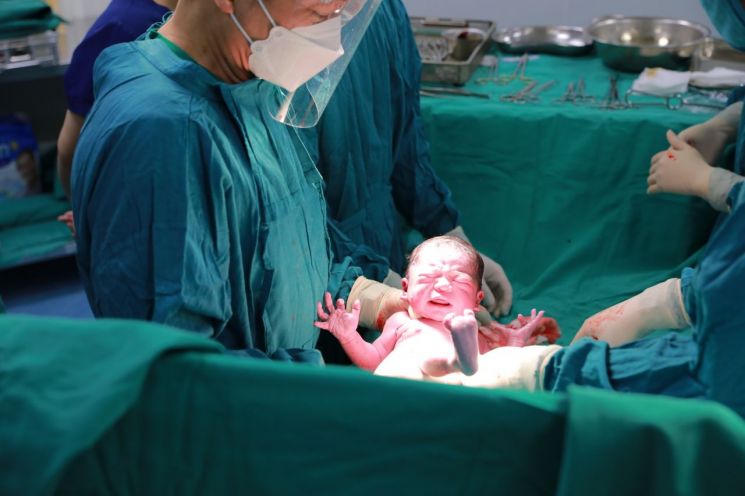
In 2019, there were 297,339 mothers who gave birth, with natural births accounting for 49.9% and cesarean sections 51.1%, roughly half each. However, as the years passed, the number of mothers choosing natural birth decreased, with the natural birth rate falling from 49.9% in 2019 to ▲45.8% in 2020 ▲42.9% in 2021 ▲38.4% in 2022, and dropping further to 35.8% last year.
Conversely, the cesarean section rate steadily increased from 51.1% in 2019 to ▲54.2% in 2020 ▲57.1% in 2021 ▲61.6% in 2022 ▲64.2% last year. In the first half of this year (January to June), the cesarean section rate rose even more, with 37,960 natural births and 77,102 cesarean deliveries, making the cesarean rate 67%. Notably, natural births have sharply declined over the past five years in all 17 metropolitan cities nationwide. In Seoul, the number dropped by half from 25,550 in 2019 to 13,769 last year, and during the same period, Busan also saw a reduction of more than half, from 7,154 to 3,461.
Rep. Kim stated, "A more precise assessment is needed to understand why natural births are continuously decreasing at such a large scale," adding, "We must analyze various causes and create a medical environment system that allows for safer and healthier childbirth."
According to the OECD's 'Health at a Glance 2023,' as of 2021, South Korea has the second highest cesarean section rate in the world, following T?rkiye. South Korea's cesarean section rate rose two ranks from 4th place globally in 2017. Following T?rkiye and South Korea, countries with high cesarean section rates include Mexico, Bulgaria, Romania, Poland, Ireland, Hungary, Switzerland, and Italy.
Globally, the cesarean section rate, which was only 5% in the 1990s, rose to 19% in 2014 and 21% in 2018. The World Health Organization (WHO) recommends that the ideal cesarean section rate should not exceed 10% to 15% in any region worldwide and advises that cesarean deliveries be performed only when medically necessary.
© The Asia Business Daily(www.asiae.co.kr). All rights reserved.
![Clutching a Stolen Dior Bag, Saying "I Hate Being Poor but Real"... The Grotesque Con of a "Human Knockoff" [Slate]](https://cwcontent.asiae.co.kr/asiaresize/183/2026021902243444107_1771435474.jpg)















