Driving in the wrong direction at 100 km/h at an intersection
50-year-old Japanese man dies instantly in the accident
A fatal accident occurred in Japan where a vehicle driving in the wrong direction at 100 km/h caused the death of a man in his 50s. Controversy has arisen as it was revealed that the driver of the wrong-way vehicle was a drunk Chinese man.
On the 30th of last month, Fuji News Network (FNN), TBS News, and others reported that around 6 a.m. the previous day, a vehicle driving against the one-way traffic at an intersection in Kawaguchi City, Saitama Prefecture, collided with a vehicle traveling normally. A Japanese man in his 50s died at the scene due to the accident.
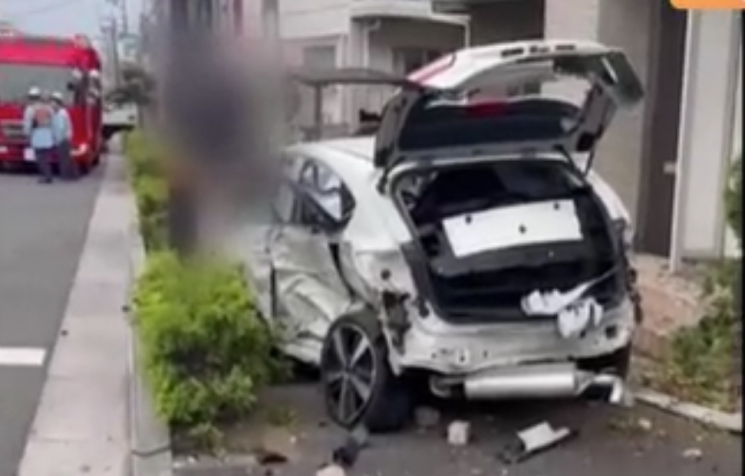 On the 30th of last month, Fuji News Network (FNN), TBS News, and others reported that around 6 a.m. the previous day, a vehicle driving the wrong way on a one-way street at an intersection in Kawaguchi City, Saitama Prefecture, collided with a vehicle traveling normally. A Japanese man in his 50s died at the scene due to this accident.
 [Photo by TBS News]
The driver of the wrong-way vehicle was identified as an 18-year-old Chinese man. He was arrested on the spot and reportedly stated that "he had been drinking." Video footage of the accident shows the wrong-way vehicle entering the intersection, where the speed limit is 30 km/h, at about 100 km/h. The vehicle then struck the left side of a vehicle going straight, and the impact caused the victim's vehicle to be thrown about 40 meters.
After the collision, the wrong-way vehicle only stopped after knocking down a streetlight. Three people got out of the vehicle, and two passengers, aside from the driver, fled in the opposite direction of the accident scene. A nearby resident told FNN in an interview, "There was an enormous noise like a plane flying by, which caught my attention, so I went outside and saw the streetlight had fallen, and a vehicle was severely damaged and stopped right in front of my house."
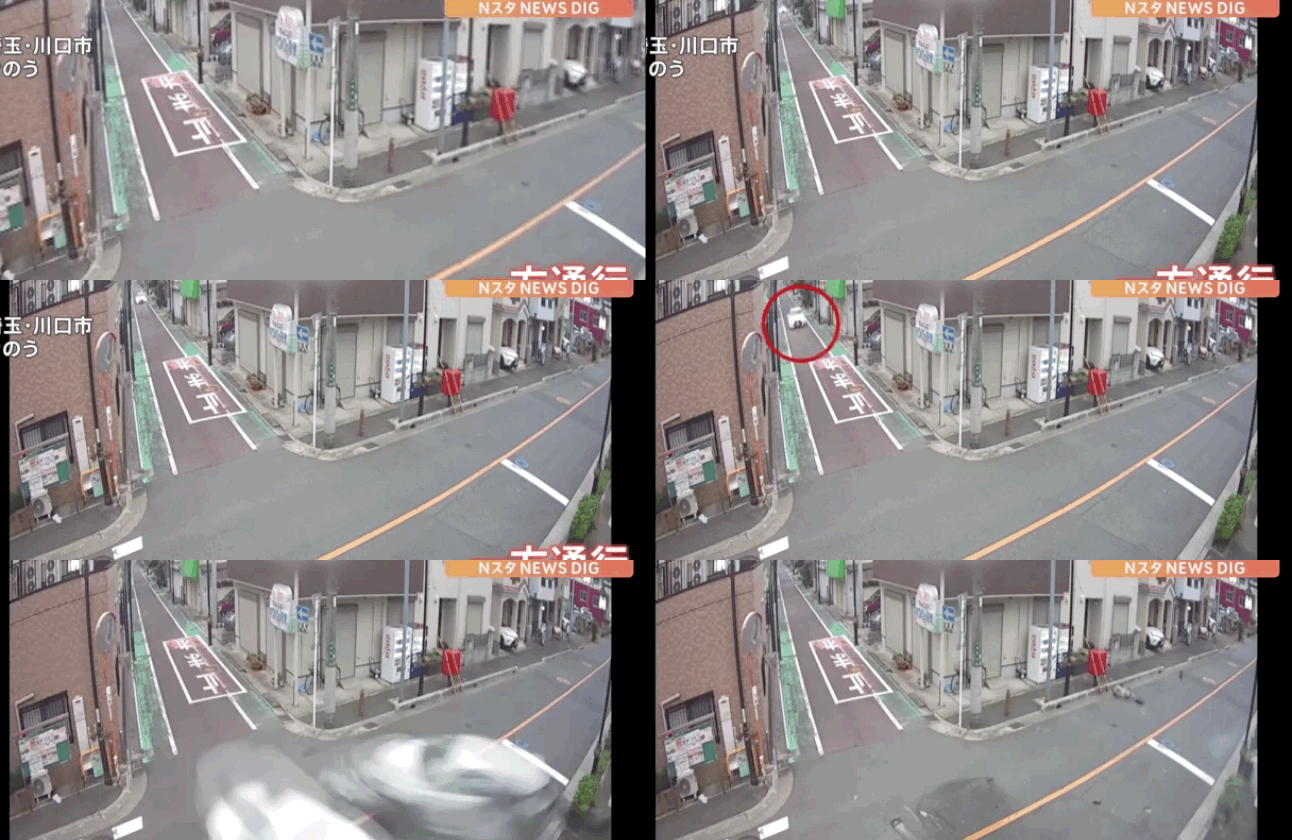 In the video capturing the accident at the time, the wrong-way vehicle entered the intersection with a speed limit of 30 km/h at approximately 100 km/h. It then collided with the left side of a vehicle going straight, and the impact caused the victim's vehicle to be thrown about 40 meters.
 [Photo by TBS News]
Local police are pursuing the whereabouts of the fleeing passengers. During the police investigation, the driver reportedly stated, "I thought the police shouldn't find out I was driving the wrong way, so I tried to pass through the one-way street at once," and "I had been drinking, but since several hours had passed, I thought it was okay to drive."
Japanese netizens expressed shock and anger over the accident. Above all, there were calls for severe punishment regardless of nationality. On X (formerly Twitter), Japanese netizens reacted with comments such as, "Japanese people, wake up. This kind of thing could happen right in front of our homes," and "Chinese people should be permanently expelled from Japan."
Will Chinese Driver’s Licenses Be Recognized Domestically? Police in Practical Talks
It has been confirmed that the police are conducting practical talks with Chinese authorities regarding mutual recognition of driver’s licenses. The aim is to allow driving in both countries with a driver’s license obtained in either Korea or China. However, there are many hurdles before the system can be implemented. Traffic regulations differ between the two countries, and public opinion opposing recognition of Chinese licenses domestically is strong.
On the 26th of last month, YTN reported that in May, then National Police Agency Commissioner Yoon Hee-geun visited China and met with Public Security Minister Wang Xiaohong to agree on resuming discussions on a mutual recognition agreement for driver’s licenses, which had been suspended due to COVID-19. According to the report, the talks are in the early stages. The biggest obstacle is that China is not a signatory to the "Geneva Convention on Road Traffic." Nationals of countries that have signed this convention can drive in other member countries with an international driver’s license. However, since China is not a member, Chinese nationals with Chinese licenses must obtain a Korean license to drive in Korea. Conversely, holders of only Korean licenses cannot drive in China.
China operates a "temporary driver’s license system" that issues short-term licenses valid for one year to foreign residents. Korea does not have such a system. Because of this, China has reportedly argued, "Shouldn’t there be a corresponding system for Korean nationals?" The police intend to first resolve the issue of driver’s licenses for Chinese nationals residing long-term in Korea. A police official explained, "There is some agreement on mutually recognizing licenses for long-term residents. The problem is short-term residents," and added, "We plan to organize our position on resolving the long-term resident issue first and submit it to China."
It seems difficult to reach a quick conclusion on whether to allow recognition of Chinese driver’s licenses domestically. Particularly, there is strong opposition to allowing Chinese tourists staying short-term for travel purposes to drive domestically. Above all, there are concerns that traffic accident risks will increase. Last year, about 1.75 million traffic accidents occurred in China. As of 2020, traffic accident deaths in China reached around 60,000. Compared to Korea, where 2,000 to 3,000 people die annually in traffic accidents, this number is considered excessively high even accounting for population differences.
Additionally, there are differences in traffic regulations. For example, in some parts of China, vehicles in the far-right lane are allowed to make left turns or U-turns. Meanwhile, the tourism industry welcomes the recognition of Chinese driver’s licenses. Recently, individual Chinese tourists have been increasing compared to group tourists, and this is seen as potentially helpful in promoting tourism. Previously, the government attempted to allow Chinese tourists to drive rental cars in Jeju Island in 2014, but the plan was scrapped due to opposition from Jeju residents.
© The Asia Business Daily(www.asiae.co.kr). All rights reserved.
![Clutching a Stolen Dior Bag, Saying "I Hate Being Poor but Real"... The Grotesque Con of a "Human Knockoff" [Slate]](https://cwcontent.asiae.co.kr/asiaresize/183/2026021902243444107_1771435474.jpg)
















