Cultural Heritage Committee Conditionally Approves This Agenda Item
Outdoor Exhibition Hall to Replace Replicas of Dabotap and Seokgatap Pagodas
The national treasure ‘Gyeongju Goseonsa Site Three-story Stone Pagoda’ is expected to be relocated.
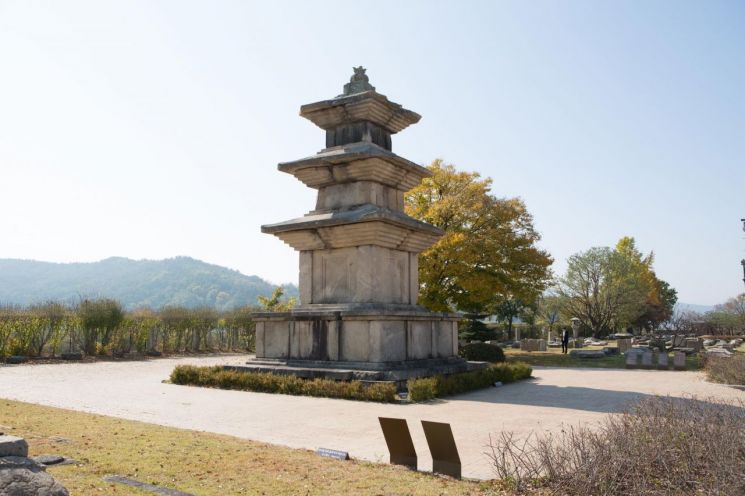
According to the Cultural Heritage Administration on the 2nd, the Cultural Heritage Committee recently discussed the agenda for relocation and preservation treatment and conditionally approved it. Relocation refers to the act of moving and reconstructing a building.
Currently, the Goseonsa Site Stone Pagoda is located near the Silla Art Gallery within the National Gyeongju Museum. The National Gyeongju Museum has sought permission from the committee to move it to the outdoor exhibition area where replicas of the Dabotap and Seokgatap pagodas are displayed. The intention is to place the Goseonsa Site Stone Pagoda instead of the replicas.
The replicas of Dabotap and Seokgatap were made in 1975 to commemorate the relocation of the museum to its current site. The monument erected at that time states, “The exquisite old appearance has been worn away by wind and rain, so President Park Chung-hee, having seen this, ordered the creation of two new pagodas in advance, worrying about the distant future.”
The Goseonsa Site Stone Pagoda, which will replace these, is a work from the Unified Silla period with a history of 1,300 years. It is evaluated as showing the typical form of stone pagoda style of that time and was designated as a national treasure in 1962. However, it is located away from the museum entrance and main exhibition halls, so many visitors have passed by without knowing of its existence.
A museum official explained, “We have been preparing to relocate the stone pagoda since 2017 to restore its status as a national treasure,” adding, “We plan to move the replicas of Dabotap and Seokgatap to another site within the museum and relocate the Goseonsa Site Stone Pagoda to the center of the outdoor exhibition area.”
The relocation is expected to take at least four years. This is because dismantling the components for investigation and preservation treatment requires considerable time. The process of investigating the site to move the replicas of Dabotap and Seokgatap is also challenging.
The Cultural Heritage Committee, considering these circumstances, requested the submission of a detailed plan. They emphasized, “While promoting the relocation, it is necessary to review the detailed plan again.” It can be seen that they recognized the necessity and validity of relocating the stone pagoda.
The Goseonsa Site Stone Pagoda was originally built at the old site of Goseonsa Temple, where the famous monk Wonhyo Daesa, known for attaining enlightenment after drinking water collected in a skull, served as the head monk. However, when Deokdong Dam was completed in the eastern part of downtown Gyeongju in 1975, the temple site was submerged underwater and, along with several cultural heritages, was moved to the National Gyeongju Museum.
© The Asia Business Daily(www.asiae.co.kr). All rights reserved.
![Clutching a Stolen Dior Bag, Saying "I Hate Being Poor but Real"... The Grotesque Con of a "Human Knockoff" [Slate]](https://cwcontent.asiae.co.kr/asiaresize/183/2026021902243444107_1771435474.jpg)















