Financial Supervisory Service to Quickly Clean Up Non-Performing Loans
"Will Monitor PF Light Auctions Regardless of Interest Rate Changes"
Savings Banks to Jointly Sell NPLs in November Amid Continuous Pressure
As the evaluation of real estate project financing (PF) first-phase projects and the collection of restructuring plans are completed, and restructuring is set to intensify from this month, financial authorities are also stepping up post-management efforts. They plan to encourage faster restructuring and cleanup of distressed projects by receiving weekly reports on foreclosure and auction statuses from financial institutions.
Additionally, a daily and weekly continuous communication system has been activated to actively manage non-performing loans (NPLs). The savings bank sector, a representative of community finance, plans to jointly sell individual NPLs in the fourth quarter of this year as well.
According to financial authorities on the 2nd, although expectations for a cut in the base interest rate in Korea are rising following the US rate cut, the Financial Supervisory Service (FSS) intends to strengthen post-management to ensure that real estate PF foreclosures and auctions proceed steadily amid future financial market volatility.
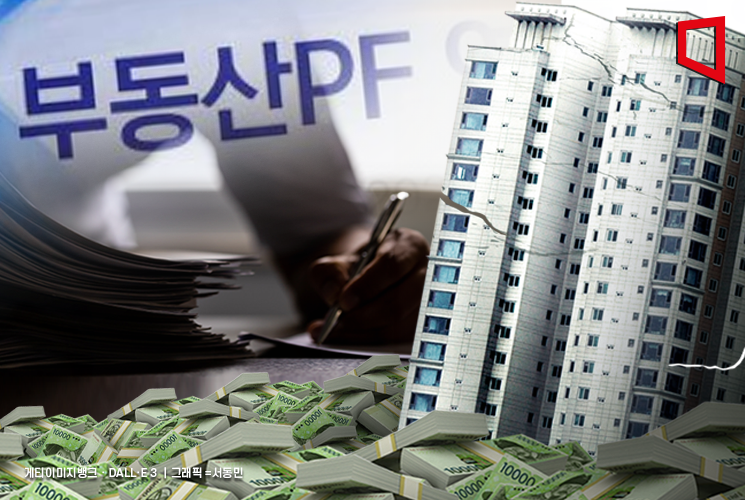
A senior official from the Financial Supervisory Service told Asia Economy in a phone interview, “We will monitor to ensure that real estate PF foreclosures and auctions proceed well regardless of interest rate fluctuations.” Furthermore, the inspection cycle for real estate PF foreclosure and auction performance across all financial sectors will be strengthened from a monthly to a weekly basis. The inspection targets include the status of foreclosure and auction initiation, first and second auction operation status, and final winning bid prices.
For financial institutions with high risk of insolvency, the FSS plans to meet directly with major shareholders. The FSS will soon hold meetings with major shareholders of savings banks that have been subject to management evaluations due to deteriorating soundness, demanding the sale of non-performing loans and capital expansion.
This is interpreted as an intention to swiftly resolve insolvency while maintaining consistency in the direction of restructuring distressed projects. It also reflects a determination not to miss the 'golden time' to prevent soundness issues in some sectors such as savings banks and mutual finance from spreading to the entire financial sector. In fact, FSS Governor Lee Bok-hyun recently mentioned in an executive meeting that the golden time for resolving PF NPLs is October to November.
According to the Bank of Korea’s Financial Stability Report, the total amount of fixed and substandard loans across all financial sectors due to PF project viability reassessment is estimated at 24.3 trillion won. Looking at the fixed and substandard loan ratios by sector, savings banks saw the largest increase from 10.9% at the end of last year to 29.7% at the end of the first half of this year, while mutual finance rose from 5.1% to 19.7%.
A financial sector official said, “Foreclosure and auction are the fastest and most certain ways to clean up distressed projects,” adding, “Although there is room for projects currently halted to resume due to interest rate cuts, the FSS’s intention is clear: do not wait for interest rate cuts or project viability recovery, but promptly resolve insolvency.”
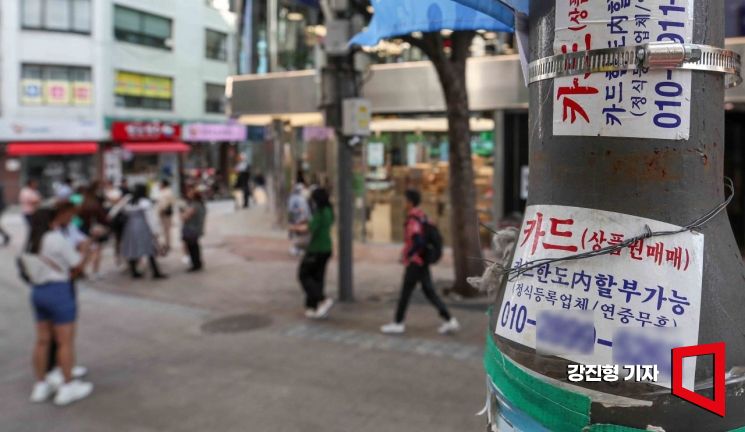 Amid the economic downturn, as the loan threshold of first-tier financial institutions such as banks has risen, the scale of card loans and cash services has reached an all-time high. On the 30th, advertisements related to card loans were posted on Myeongdong Street in Jung-gu, Seoul. Photo by Kang Jin-hyung aymsdream@
Individual credit loan defaults are also considered an indicator to watch closely. According to an analysis by NICE Credit Rating of borrowers at 14 coverage savings banks including SBI, Korea Investment, and Aequon, 42.4% of borrowers are multiple debtors using five or more financial institutions. About 20% of borrowers have borrowed from seven or more financial institutions. Multiple debtors are typically classified as high-risk borrowers due to the risk of loan default from borrowing from multiple sources.
Under continuous pressure from the FSS to improve soundness, the savings bank sector is jointly selling individual NPLs. The Korea Federation of Savings Banks plans to promote the fourth joint sale of individual and individual business NPLs in November. This is in line with the Federation’s policy to shift the joint NPL sale cycle from semiannual to quarterly starting from the third quarter of this year.
Previously, the savings bank sector, centered on the Federation, conducted joint sales of NPLs totaling 320 billion won. At the end of last year, 12 savings banks sold about 100 billion won of individual unsecured NPLs. Since the beginning of this year, with the possibility of selling individual business secured NPLs to NPL investors, 18 savings banks sold 136 billion won of NPLs by the end of the first half of this year, and 12 savings banks cleaned up about 90 billion won of distressed loans at the end of last month.
Despite this, as the delinquency rate continues to rise, the savings bank sector plans to keep focusing on joint NPL sales centered on the Federation. According to the FSS, the delinquency rate of savings banks was 8.36% at the end of the first half of this year, up 1.81 percentage points from the end of last year. For individual business loans, since borrowers mostly work in economically sensitive sectors such as food and lodging, the delinquency rate could rise further if economic recovery slows.
A Korea Federation of Savings Banks official said, “Since the third-quarter joint NPL sale was successfully completed, if member companies request, we will proceed with the fourth-quarter joint sale as planned,” adding, “Because joint sales are conducted quarterly, the scale of NPL cleanup in the fourth quarter may be relatively small.”
© The Asia Business Daily(www.asiae.co.kr). All rights reserved.
![Clutching a Stolen Dior Bag, Saying "I Hate Being Poor but Real"... The Grotesque Con of a "Human Knockoff" [Slate]](https://cwcontent.asiae.co.kr/asiaresize/183/2026021902243444107_1771435474.jpg)

















