Statistics Korea, September Consumer Price Trends
 As concerns over a kimchi crisis due to soaring cabbage prices become a reality, packaged kimchi sales are also facing an emergency. On the 26th, a citizen is taking photos to compare packaged kimchi at a large supermarket in Seoul. Photo by Jo Yongjun jun21@
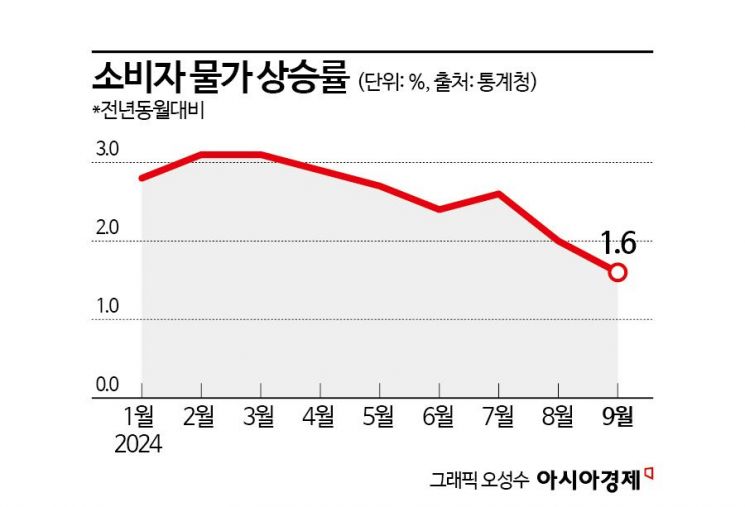
Last month, the consumer price inflation rate dropped to 1.6%, falling into the 1% range. This is the lowest increase in 3 years and 7 months.
According to the 'September Consumer Price Trends' released by Statistics Korea on the 2nd, the consumer price index last month rose by 1.6% compared to the same month last year. The consumer price inflation rate had remained in the 2% range for five consecutive months since April (2.9%) but fell to the 1% range. This is the lowest inflation rate since February 2021 (1.4%), marking 3 years and 7 months.
The core inflation index, which excludes agricultural products and petroleum, rose 1.8% compared to the same month last year. The index excluding food and energy increased by 2.0% compared to the same month last year.
The living cost index rose by only 1.5% compared to a year ago. The living cost index peaked at 4.6% in October last year, fluctuated in the 3% range this year, and then slowed to a 2.1% increase last month.
The living cost index is compiled by selecting 144 items that consumers frequently purchase and spend a large portion of their budget on, making them sensitive to price changes. Among these, food prices rose 2.6% compared to a year ago, showing a slowdown in the increase, while non-food items rose 0.8%, bringing the inflation rate below 1%. The living cost index including rent and lease increased by 1.3%.
The fresh food index rose 3.4% compared to the same month last year, slightly increasing from the previous month’s rise of 3.2%. Fresh fruits fell by 2.9%, while fresh vegetables and fresh fish increased by 11.6% and 0.8%, respectively.
By item, napa cabbage recorded the largest increase at 53.6%, influenced by the heatwave. Other vegetables such as radish (41.6%), lettuce (31.5%), and green chili peppers (27.1%) also showed significant increases. Pears (25.8%), imported beef (6.0%), and pork (2.9%) rose, while peaches (-20.3%), tomatoes (-10.1%), chicken (-5.7%), and domestic beef (-2.3%) declined.
© The Asia Business Daily(www.asiae.co.kr). All rights reserved.
![Clutching a Stolen Dior Bag, Saying "I Hate Being Poor but Real"... The Grotesque Con of a "Human Knockoff" [Slate]](https://cwcontent.asiae.co.kr/asiaresize/183/2026021902243444107_1771435474.jpg)
















