Mass Appointment of Defense Minister Veterans
'Moderate' Historical Awareness... Emphasis on Cooperative Korea-Japan Relations
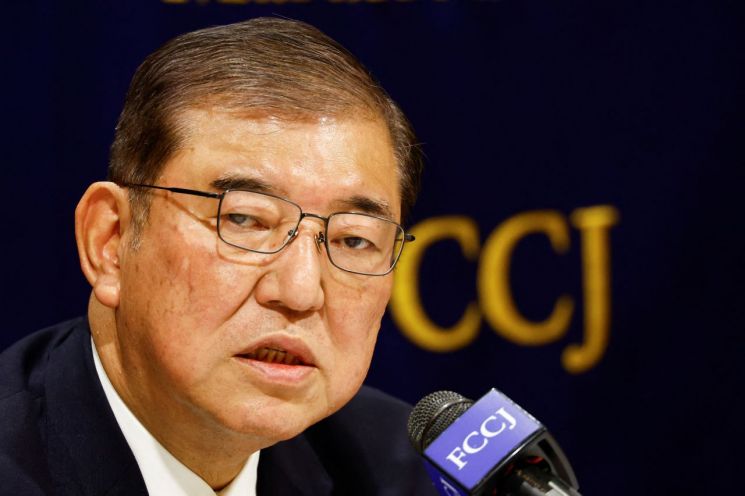
Shigeru Ishiba, the 67-year-old leader of Japan's ruling Liberal Democratic Party, was elected prime minister on the 1st. He is the 102nd prime minister since Japan introduced the cabinet system in 1885.
Newly appointed Prime Minister Ishiba secured a majority vote in the prime minister designation elections held in the House of Representatives (lower house) and the House of Councillors (upper house) plenary sessions that afternoon, ascending to the prime minister position. He is a 12-term lawmaker who has served as Minister of Agriculture, Forestry and Fisheries, Minister in charge of Regional Revitalization, and Minister of Defense, among other roles.
Prime Minister Ishiba is classified as a "moderate" regarding historical awareness. He has not visited Yasukuni Shrine, where Class-A war criminals from the Pacific War are enshrined, and after the South Korean government's decision to terminate the General Security of Military Information Agreement (GSOMIA) in August 2019, he posted on his blog referencing Germany's postwar reflection, stating, "One of the root causes of many problems is that our country (Japan) did not face its war responsibility head-on after defeat." He belongs to the non-mainstream faction of the Liberal Democratic Party that opposed the late former Prime Minister Shinzo Abe.
The new cabinet he has formed consists of close associates and non-faction members. Of the 20 ministers including himself, 12 do not belong to any existing faction. Lawmakers from the largest faction, the "Abe faction," which was involved in the Liberal Democratic Party's "slush fund scandal" that broke out at the end of last year, were all excluded from ministerial positions. Additionally, 13 of the ministers have no prior ministerial experience.
Having served as Minister of Defense himself, Prime Minister Ishiba appointed many individuals with defense minister experience. He appointed former Defense Minister Takeshi Iwaya, who was the election campaign headquarters chief for the party leadership election, as Foreign Minister, and former Defense Minister Gen Nakatani as Defense Minister. Before stepping down as Defense Minister in September 2019, Foreign Minister Iwaya emphasized that "although Japan and South Korea face various diplomatic issues, the trilateral security alliance among Japan, South Korea, and the United States is extremely important." He was also involved in a controversy within Japan for shaking hands with a smiling face at the Japan-South Korea defense ministerial meeting in June 2019, a time when Japan-South Korea relations were strained.
For the government spokesperson position of Chief Cabinet Secretary, Ishiba retained Yoshimasa Hayashi, who supported him in the final round of the party leadership election and was his former rival from the "Kishida faction."
With the launch of the cabinet, Japan's political sphere will fully shift into election mode. The most recent general election was held three years ago, in October 2021, during the Kishida administration. At a press conference the day before, Prime Minister Ishiba stated, "It is important for the new administration to be judged by the people as soon as possible," and announced plans to dissolve the House of Representatives early and hold a general election on the 27th.
© The Asia Business Daily(www.asiae.co.kr). All rights reserved.
![Clutching a Stolen Dior Bag, Saying "I Hate Being Poor but Real"... The Grotesque Con of a "Human Knockoff" [Slate]](https://cwcontent.asiae.co.kr/asiaresize/183/2026021902243444107_1771435474.jpg)















