Temperature-Responsive Material Inside Cells
Blocking Reaction Pathway in Early Heating Stage
"Visible Results Quickly Applicable to Mass Production"
LG Chem has developed a new material that suppresses thermal runaway to prevent battery fires at an early stage.
On the 1st, LG Chem announced that a research team at the Basic Technology Research Institute under the Chief Technology Officer (CTO) has developed a 'safety-enhancing functional layer' that suppresses thermal runaway. The material analysis was conducted through joint research with the battery engineering research team led by Professor Lee Mina of Pohang University of Science and Technology, and safety verification was carried out in collaboration with LG Energy Solution.
The results of this research were published online in the September issue of the world’s top academic journal, Nature Communications.
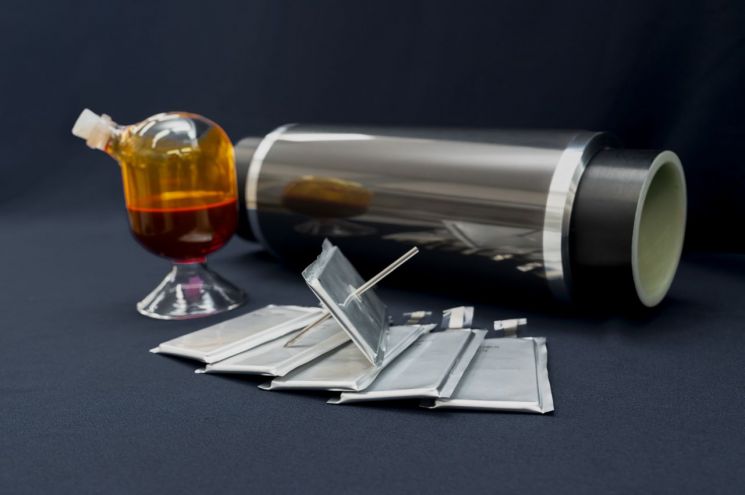
The thermal runaway suppression material developed by LG Chem is a composite substance whose electrical resistance changes according to temperature, acting as a fuse that blocks electrical flow in the early stage when the temperature rises.
The research team created the thermal runaway suppression material as a thin layer with a thickness of 1㎛?about 1/100th the width of a hair?between the battery’s cathode layer and current collector. When the battery temperature exceeds the normal range of about 90 to 130 degrees Celsius, the material reacts to the temperature, changing its bonding structure and suppressing the flow of current.
Thermal runaway, the cause of electric vehicle battery fires, is known to start when the cathode and anode inside the battery unintentionally come into direct contact, causing short circuits and heat generation. In actual battery impact and penetration tests, batteries equipped with the thermal runaway suppression material either did not catch fire or the flames were extinguished immediately after ignition, preventing thermal runaway from occurring.
LG Chem has completed safety verification tests of the thermal runaway suppression material for mobile batteries and plans to continue safety tests for large-capacity electric vehicle batteries by next year.
CTO Lee Jong-gu said, "This is a tangible research achievement that can be applied to products in mass production processes in the near future," adding, "We will advance safety enhancement technology so that customers can use electric vehicles with peace of mind and contribute to strengthening competitiveness in the battery market."
© The Asia Business Daily(www.asiae.co.kr). All rights reserved.
![Clutching a Stolen Dior Bag, Saying "I Hate Being Poor but Real"... The Grotesque Con of a "Human Knockoff" [Slate]](https://cwcontent.asiae.co.kr/asiaresize/183/2026021902243444107_1771435474.jpg)















