The Proportion of Self-Employed Workers Among This Year's Employed Falls Below 20% for the First Time Since 1963 Statistics
Average Monthly Rate from January to August at 19.7%...Non-Wage Workers 22.8% · Wage Workers 77.2%
Three out of Four Self-Employed Earn Less Than 1 Million Won per Month
Over 200,000 Business Owners Earn Less Than Their Employees
As self-employed businesses face a crisis, with some owners poorer than their employees, the proportion of self-employed workers among all employed persons has fallen below 20%. With the economic downturn causing consumers to tighten their wallets, self-employed sales have also declined, leading to a surge in 'bosses' earning less than 1 million won per month.
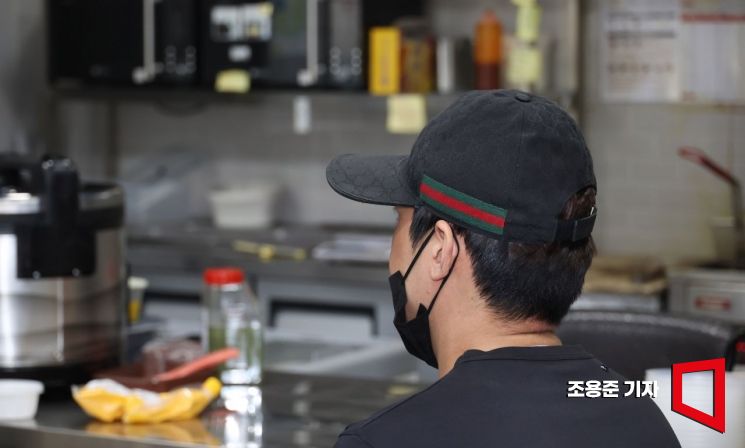 A self-employed person running a delivery business is expressing their difficulties. Photo by Jo Yongjun jun21@
According to an analysis of Statistics Korea data by Yonhap News Agency on the 30th, the average monthly number of self-employed persons from January to August this year was 5,636,000, accounting for 19.7% of the total employed population (28,544,000). Yonhap noted, "Although four months remain in the year, if there are no major changes in the labor market, the annual proportion falling below 20% appears to be a foregone conclusion."
The proportion of self-employed workers has been on a continuous downward trend from 37.2% in 1963, breaking the 30% mark in 1989 (28.8%), and barely holding the 20% line at 20.0% last year. Unpaid family workers numbered 882,000, accounting for 3.1% of total employment. Unpaid family workers refer to family members or relatives who work in self-employed businesses without receiving wages. Combining self-employed persons and unpaid family workers, non-wage workers totaled 6,518,000, representing 22.8% of all employed persons.
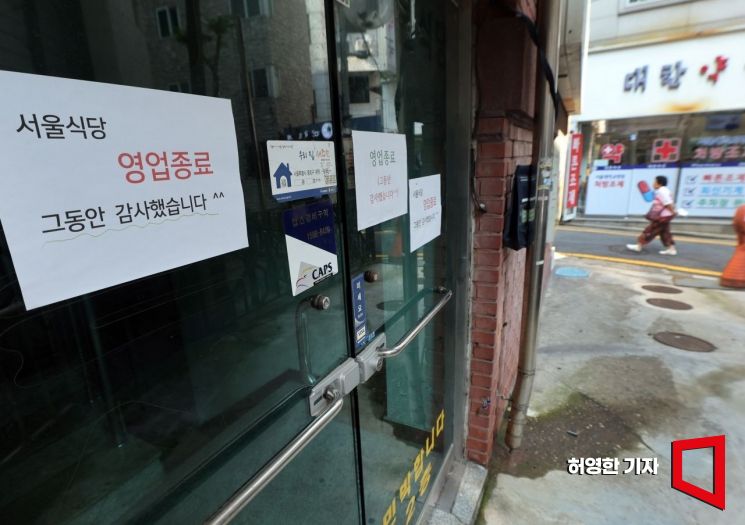 As the prolonged conflict between the government and the medical community causes many hospitals to face financial difficulties, pharmacies and small business owners in the commercial areas around hospitals are also struggling. A closure notice is posted in front of a restaurant on a street near Seoul National University Hospital in Jongno-gu, Seoul, where pharmacies and restaurants are located. The owner said that this restaurant, which had been in business for 41 years, is closing due to the inability to withstand the recession. Photo by Heo Younghan younghan@
An analysis of 11,464,368 personal business comprehensive income tax filings in 2022 revealed that 8,609,018 cases (75.1%) reported monthly incomes below 1 million won (12 million won annually). This means that three out of four personal business owners earn less than 1 million won per month (based on comprehensive income tax filings). This proportion has steadily decreased from 68.5% in 1963 to a record low of 22.8% this year, shrinking to about one-third of the level seen over 60 years ago.
According to data submitted by the National Tax Service to Park Seong-hoon, a member of the People Power Party, three out of four personal business owners reported monthly comprehensive income tax filings below 1 million won. This is less than half of the monthly minimum wage of 2.06 million won applied this year. Among them, 944,250 cases (8.2%) reported zero income. The closure rate of personal businesses is also rapidly increasing. According to data on the 'Status of Personal Businesses in the Last 10 Years' obtained by Ahn Do-geol from the Democratic Party from the National Tax Service, while about 1,147,000 personal businesses opened last year, 910,000 (79.4%) closed. This means that for every 10 stores that opened, 8 closed. The closure rate is the highest in 10 years since 2013 (86.9%).
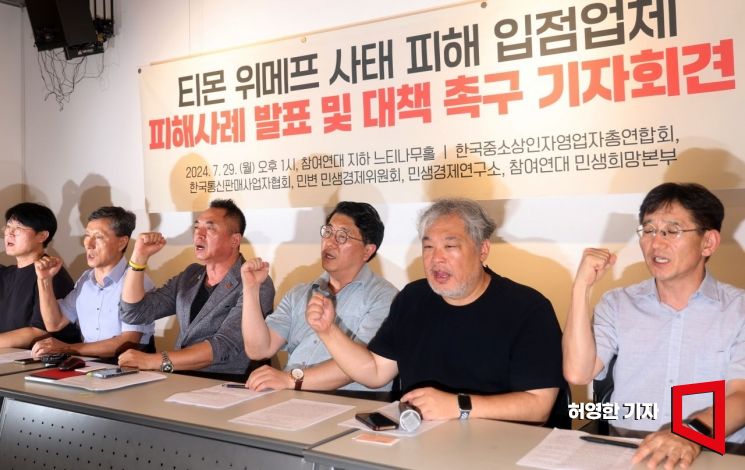 The Korea Federation of Small and Medium Business Owners and other representatives of tenant companies affected by the TMON and WEMAKEPRICE incidents held a press conference on July 29 at the People's Solidarity for Participatory Democracy in Seoul to announce cases of damage. The attending representatives are shouting slogans urging countermeasures. Photo by Huh Younghan younghan@
The number of self-employed persons earning less than their employees is also increasing. According to data received by Heo Seong-moo, a member of the National Assembly's Industry, Trade, Energy, Small and Medium Business Committee from the National Health Insurance Service, among 971,000 workplaces subject to year-end tax settlement in 2022, 212,000 workplaces nationwide imposed health insurance premiums based on the highest-paid employee's salary, with 227,000 self-employed persons included. According to Article 38 of the Enforcement Decree of the National Health Insurance Act, if the employer's (self-employed person's) salary is lower than that of the employee, the health insurance premium is calculated based on the highest-paid employee. This means that even if the boss earns less than the employee, they pay the same level of health insurance premiums. However, if the business income amount is zero or less, the average monthly salary, not the highest-paid employee's monthly salary, is applied when calculating the health insurance premium.
The total annual health insurance premiums for self-employed persons calculated based on the highest-paid employee's salary amounted to 222.294 billion won, nearly double the 124.3 billion won based on the income they actually reported. Self-employed persons subject to the highest-paid employee salary standard paid more than their reported income-based premiums by ▲298,000 won in 2018, ▲319,000 won in 2019, ▲366,000 won in 2020, ▲393,000 won in 2021, and ▲431,000 won in 2022. Representative Heo said, "Despite health insurance being the social insurance with the greatest burden on all citizens, the government has failed to fulfill its duty to accurately assess incomes and is shifting responsibility onto small business owners struggling due to COVID-19 and the economic downturn," adding, "I will thoroughly point this out at the National Assembly audit targeting the Ministry of SMEs and Startups."
© The Asia Business Daily(www.asiae.co.kr). All rights reserved.
![Clutching a Stolen Dior Bag, Saying "I Hate Being Poor but Real"... The Grotesque Con of a "Human Knockoff" [Slate]](https://cwcontent.asiae.co.kr/asiaresize/183/2026021902243444107_1771435474.jpg)


















