The Korean Medical Association (KMA) demanded that the government guarantee discussions including reductions in medical school admissions in 2026 if the educational collapse caused by the increase in medical school admissions in 2025 cannot be avoided.
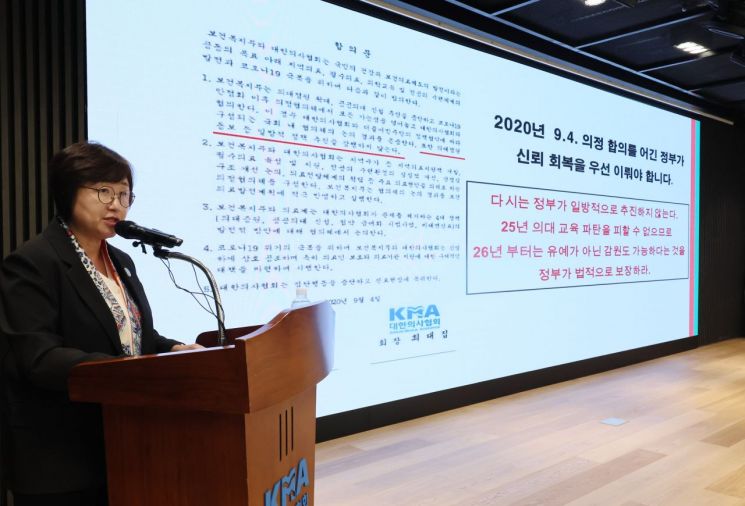
On the 30th, the KMA held a briefing on current issues at the KMA Hall in Yongsan-gu, Seoul, and announced this.
At the government briefing that day, Anna Choi, spokesperson for the KMA, criticized Health and Welfare Minister Kyo-hong Cho's repeated statement that "the 2025 medical school quota is not open for discussion," saying, "The government says let's discuss without limiting the agenda, but also says the increase next year cannot be withdrawn. Please clarify whether there is an agenda limitation or not." She then demanded, "If the collapse of medical education in 2025 is now unavoidable, please guarantee that reductions from 2026 are also possible."
When asked whether the KMA had given up on re-discussing the 2025 increase, which is a condition for demands to the government, she said, "The KMA believes re-discussion is possible even now, but the government says no. Then the education of 7,500 students next year is confirmed," adding, "We are asking for an answer on how to handle the educational collapse and healthcare system breakdown expected next year."
Regarding Minister Cho's apology to residents at the briefing, she said, "I don't think it was a sufficient apology," but added, "It is a positive change that the government, which has been focused on demonizing doctors, expressed regret to residents for the first time."
At the briefing, Minister Cho apologized, saying, "It is very regrettable and I feel sorry for the residents who have temporarily put aside their dreams of dedicating themselves to essential medical care and are now reconsidering their career paths during the medical reform process."
However, the KMA drew a line by stating that it will "not participate under the current circumstances" in the Medical Workforce Supply and Demand Forecast Committee announced by the Presidential Office and the government.
Spokesperson Anna Choi said, "The government's announced plan is not a decision-making body but an advisory body that intends to have a majority of medical personnel," and set conditions for participation, saying, "As a decision-making body, the committee's composition and operation must be thoroughly expert-centered, and the discussion process must be transparently disclosed to the public." She emphasized, "If doctors participate only in an advisory body and their opinions are submitted to the Medical Policy Deliberation Committee (Bojeongsim) for final decision, there is absolutely no reason for us to join again."
The government’s position is that the final decision on medical workforce supply and demand will be made through deliberation by the Medical Policy Deliberation Committee (Bojeongsim), the highest statutory decision-making body on health and medical policy.
The KMA also stated regarding the stalled ruling and opposition party medical council, "Even if discussions take place, we will only participate if there is trust that the discussions will not be discarded and can be applied, like the September 4, 2020 medical agreement." The 'September 4 medical agreement' refers to the agreement to suspend discussions on increasing medical school admissions and establishing public medical schools until the COVID-19 situation stabilizes, and then to re-examine from the beginning.
Meanwhile, at the briefing, the KMA rebutted the government and Presidential Office’s statement on the 26th that Korea ranks last among OECD member countries in the number of clinical doctors per 1,000 population, citing statistics as clear evidence that "increasing medical school admissions is not a choice but a necessity."
Spokesperson Choi said, "Austria has the highest number of doctors per 1,000 people at 5.4, and Norway has 4.9, but the number of outpatient visits per person in Korea is 17.5, overwhelmingly higher than Norway’s 3 visits," questioning, "Is this possible if there is a shortage of doctors?" She continued, "The per capita healthcare expenditure in Korea is even lower than the OECD average. With less medical spending, the public has been able to access better healthcare more easily."
© The Asia Business Daily(www.asiae.co.kr). All rights reserved.
![Clutching a Stolen Dior Bag, Saying "I Hate Being Poor but Real"... The Grotesque Con of a "Human Knockoff" [Slate]](https://cwcontent.asiae.co.kr/asiaresize/183/2026021902243444107_1771435474.jpg)















