KDCA, Annual Average per Person Reduced from 0.45mSv to 0.37mSv
Last year, the annual average radiation exposure dose of medical radiation workers such as radiologic technologists and doctors decreased by more than 17% compared to four years ago.
The Korea Disease Control and Prevention Agency (KDCA) announced on the 30th that it has published the "2023 Annual Report on Individual Radiation Exposure Dose of Medical Radiation Workers," which analyzed the individual radiation exposure doses received by radiation-related workers employed at medical institutions over the course of a year.
Radiation-related workers refer to people who mainly work at places where diagnostic radiation-generating devices are installed and are engaged in radiation-related tasks such as management, operation, and manipulation of diagnostic radiation-generating devices. Since they are at high risk of occupational radiation exposure, they must comply with radiation safety management rules, such as properly wearing personal dosimeters and radiation protection equipment, and exercise caution when handling diagnostic radiation-generating devices.
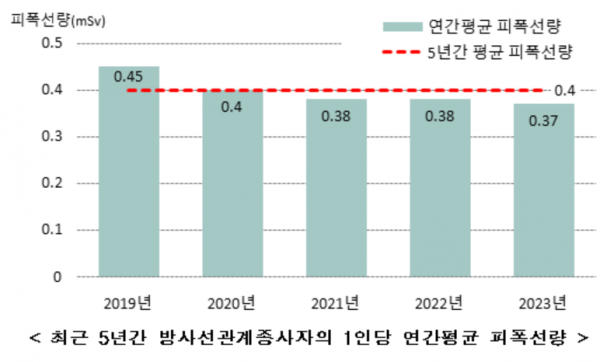
Last year, the number of radiation-related workers in South Korea was 109,884, continuously increasing over the past five years, which is about a 16.4% (15,509 people) increase compared to 2019. Among them, radiologic technologists, doctors, and dentists accounted for more than 72%.
Despite the annual increase in the number of radiation-related workers, the annual average radiation exposure dose per person has steadily decreased over the past five years, dropping from 0.45 mSv (millisieverts) in 2019 to 0.37 mSv in 2023, a 17.8% reduction.
By occupation, radiologic technologists had the highest annual average radiation exposure dose at 0.77 mSv, with radiologic technologists in their 20s having the highest average exposure dose of 1.31 mSv.
The KDCA explained that it is making efforts to manage and reduce radiation exposure doses by operating an education system for diagnostic radiation safety managers to minimize radiation exposure of radiation-related workers. In particular, those exceeding 5 mSv per quarter receive a caution notice, and those exceeding 20 mSv undergo an on-site investigation followed by worker education and measures to prevent recurrence.
Especially, since 2023, as a result of conducting refresher training for diagnostic radiation safety managers and special training for medical institutions with inadequate safety management, the number of caution notice recipients exceeding 5 mSv per quarter decreased from 841 in 2022 to 744 in 2023.
Ji Young-mi, director of the Korea Disease Control and Prevention Agency, emphasized, "To reduce the radiation exposure dose of radiation-related workers, it is important to improve workers' awareness and comply with safety rules."
© The Asia Business Daily(www.asiae.co.kr). All rights reserved.
![User Who Sold Erroneously Deposited Bitcoins to Repay Debt and Fund Entertainment... What Did the Supreme Court Decide in 2021? [Legal Issue Check]](https://cwcontent.asiae.co.kr/asiaresize/183/2026020910431234020_1770601391.png)














