Scientific Presentation of the Need for Management of Medium and Large Marine Plastics
The Korea Institute of Ocean Science and Technology (KIOST) has discovered highly toxic benthic microalgae, which inhabit tropical and subtropical regions, on floating marine plastic debris. By utilizing a closed ecosystem, the research team revealed the regrowth and reattachment characteristics of these microalgae on plastic materials and published their findings in an international scientific journal.
A closed ecosystem refers to an ecosystem that is maintained without the inflow or outflow of substances from the outside. Depending on its scale, it can be classified as a microcosm, mesocosm, or megacosm. A microcosm is a miniature version of a real ecosystem, typically referring to a small-scale artificial ecosystem maintained in a laboratory setting.
The research team led by Dr. Baek Seungho at the KIOST South Sea Research Institute focused on the fact that household waste originating from land, as well as marine debris discarded during fishing activities in rivers or at sea, can enter the ocean and serve as a vector for the movement of invasive species across maritime borders. The team collected and analyzed vinyl and PET bottles, categorized as medium to large marine plastics, from the sea in front of the pier at the South Sea Research Institute located in Jangmok-myeon, Geoje City.
As a result, they discovered dinoflagellates, which mainly inhabit tropical and subtropical regions and are one of the causes of "Ciguatera," a fish toxin, on the collected plastics.
Ciguatera fish poisoning (CFP) is caused by highly toxic dinoflagellates that attach to seaweed and coral reefs in tropical and subtropical regions. These dinoflagellates are consumed by small organisms, which are then eaten by larger fish, leading to toxin accumulation through the food chain. When humans consume fish with accumulated ciguatera toxin, it can cause neurological disorders, making management essential.
Dinoflagellates are marine attached microalgae capable of swimming with two flagella.
Notably, the study shows that benthic dinoflagellates living in tropical and subtropical seas can use plastic as an artificial habitat, hitching a ride on plastic particles via ocean currents and potentially entering local waters.
Lee Heeseung, President of KIOST, stated, "KIOST is leading global research in the assessment of marine microplastic input, occurrence, and risk. We will continue to conduct studies to quantitatively evaluate the influx characteristics, environmental behavior, and risk levels of marine plastics to establish a scientific foundation for the management of marine plastic pollution."
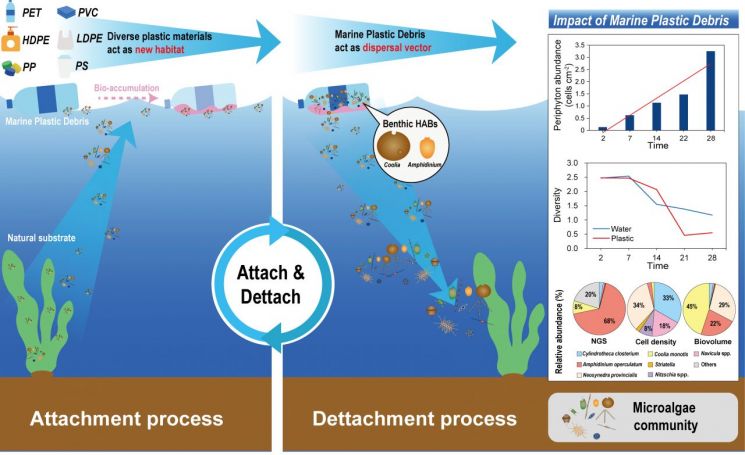 The process in which highly toxic benthic dinoflagellates attaching to coral reefs use marine plastics as a medium to attach, detach, and move through space.
© The Asia Business Daily(www.asiae.co.kr). All rights reserved.
![Clutching a Stolen Dior Bag, Saying "I Hate Being Poor but Real"... The Grotesque Con of a "Human Knockoff" [Slate]](https://cwcontent.asiae.co.kr/asiaresize/183/2026021902243444107_1771435474.jpg)















