Reconstruction of 1st Generation New Towns, Bundang Consent Rate Averages 90.7%
Additional Public Contribution Items Beyond Resident Consent Rate Are Key
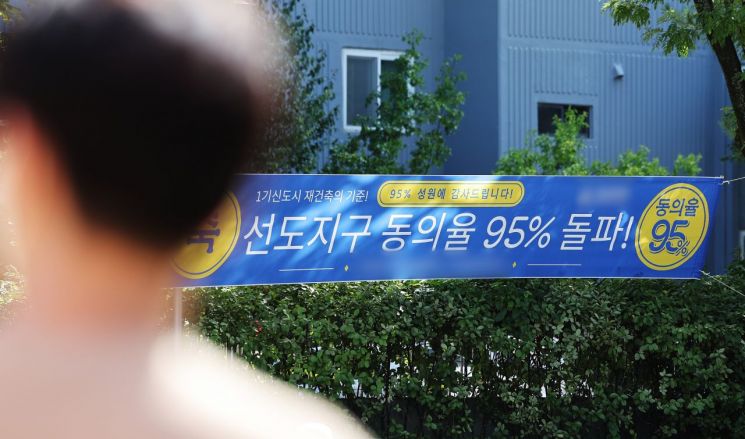
As a result of receiving applications for the first-generation new town reconstruction pilot districts, it was found that the average consent rate among Bundang residents was 90.7%. Given the high resident consent rate, additional public contributions and the resulting bonus points became the key factor in selecting the pilot districts.
The Ministry of Land, Infrastructure and Transport and the local governments responsible for the first-generation new towns announced the results of the pilot district application submissions on the 28th. In Bundang, 47 out of 67 special maintenance planned zones, accounting for 70%, applied.
The resident consent rates in the Bundang districts that submitted proposals ranged from a minimum of 71.2% to a maximum of 95.9%, with an average of 90.7%. In Bundang, the evaluation score out of 100 points allocates the highest weight to 'resident consent,' with a maximum of 60 points. If the consent rate is below 50%, 10 points are given; if it is 95% or higher, 60 points are awarded. For consent rates below 95%, 1.11 points are deducted per percentage point.
Considering the fierce competition, Bundang made the evaluation criteria more complex than those of Ilsan, Pyeongchon, Jungdong, and Sanbon. Evaluation items such as public contributions and inconvenience to firefighting activities were subdivided, and bonus points were to be given if reconstruction was pursued through trust or public implementation methods.
Above all, it appears that Bundang is striving to secure additional points through extra public contributions. It was judged that it would be difficult to increase discrimination through quantitative evaluations such as resident consent rates and the number of integrated reconstruction households, so they are trying to gain additional points.
Among the evaluation items, up to 15 points can be earned under the 'Need for Urban Function Revitalization' category. Additional public contributions can earn up to 6 points, formalizing the district including neighborhood commercial zones can earn up to 2 points, and certification of long-life housing can earn up to 3 points.
A resident representative of a Bundang pilot district application complex said, "I understand that quite a few complexes have added public contributions and some have even added long-life housing."
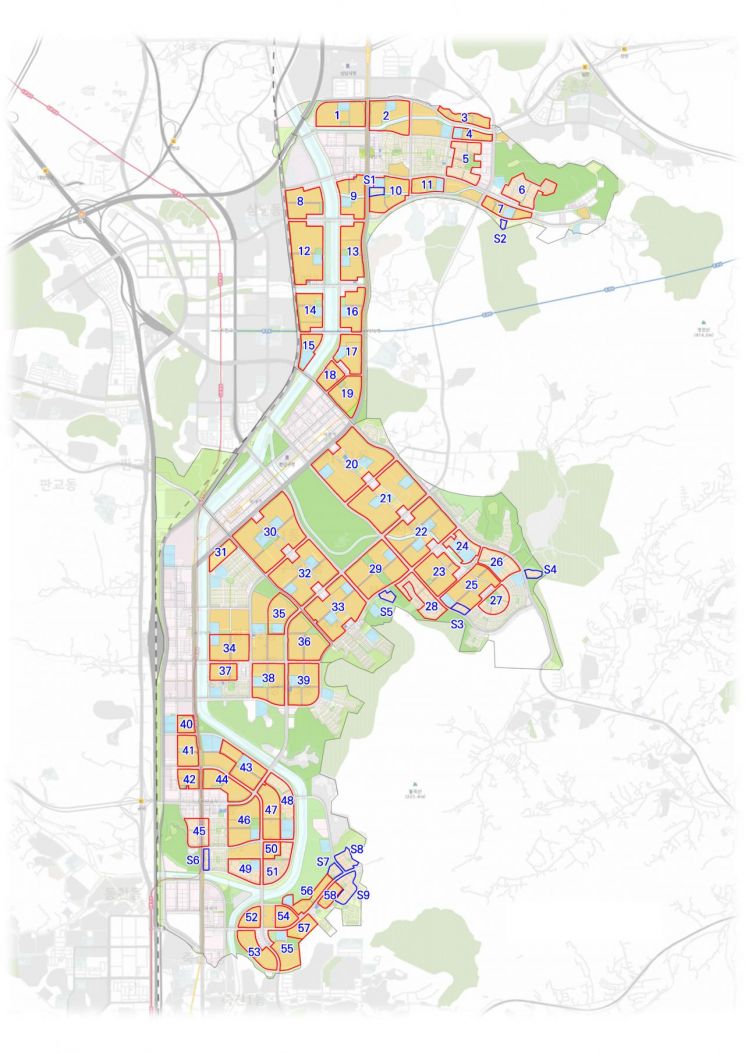 Special Maintenance Planned Area subject to the pilot district contest within Bundang New Town. [Image provided by the Ministry of Land, Infrastructure and Transport]
The score for the number of households participating in integrated reconstruction was also set higher at 15 points compared to the Ministry of Land, Infrastructure and Transport’s standard of 10 points. A perfect score is given if 3,000 or more households participate in integrated reconstruction. Meanwhile, the score for the number of housing complexes participating in integrated reconstruction was lowered to 4 points from the Ministry’s 10 points. Four or more complexes pursuing integrated reconstruction earn 4 points. More emphasis was placed on the number of households rather than the number of complexes.
There are also large complexes pursuing integrated reconstruction with small-scale villas. Seongnam City awards up to 2 points in its own evaluation criteria if integrated reconstruction is conducted with independent complexes or small-scale row houses within a 2 km radius. The pilot complexes Samsung Hanshin in Seohyeon-dong and Woosung·Hyundai in Seohyeon-dong applied for the pilot district by combining with villas under 200 households or small complexes.
Some complexes have chosen the public implementation method. Korea Land and Housing Corporation (LH) is promoting reconstruction through public implementation in four locations: Parktown and Pureunmaeul in Sunae-dong, Mujigaemaeul 11 and 12 complexes in Gumi-dong, and Jangantown villas.
Seongnam City will begin the verification process for the contents of the proposals, including consent rates. The total evaluation score, including bonus points, is 102 points. The breakdown is ▲resident consent rate 60 points ▲need for urban function revitalization 15 points ▲urgency of residential environment improvement 6 points ▲ripple effect of maintenance project promotion 19 points ▲feasibility of the project 2 points (bonus). After consultation with the Ministry of Land, Infrastructure and Transport, the pilot districts, with a scale of 8,000 to 12,000 households, will be announced in November.
Meanwhile, in regions other than Bundang, the resident consent rate is crucial. The average consent rates by region based on the submitted proposals are ▲Ilsan 84.3% ▲Jungdong 80.9% ▲Sanbon 77.6% ▲Pyeongchon 86.4%.
© The Asia Business Daily(www.asiae.co.kr). All rights reserved.
![Clutching a Stolen Dior Bag, Saying "I Hate Being Poor but Real"... The Grotesque Con of a "Human Knockoff" [Slate]](https://cwcontent.asiae.co.kr/asiaresize/183/2026021902243444107_1771435474.jpg)
















