Smuggling Fish by Boat from Vietnam for Sale
"I Didn't Know It Was Illegal in Hong Kong," Claim
Three members of a Vietnamese family who illegally entered Hong Kong, opened an unlicensed restaurant, and sold dog and cat meat dishes were sentenced to prison.
On the 29th (local time), Hong Kong daily South China Morning Post (SCMP) and Vietnamese media VN Express reported that the Hong Kong court sentenced Tran Quang Tan (51) and Le Thi Oanh (44), a married couple, and their son-in-law Nguyen Minh Dat (26), all three of whom operated an unlicensed dog and cat meat restaurant, to prison terms. The total combined prison time for the three is 17 months and 2 weeks.
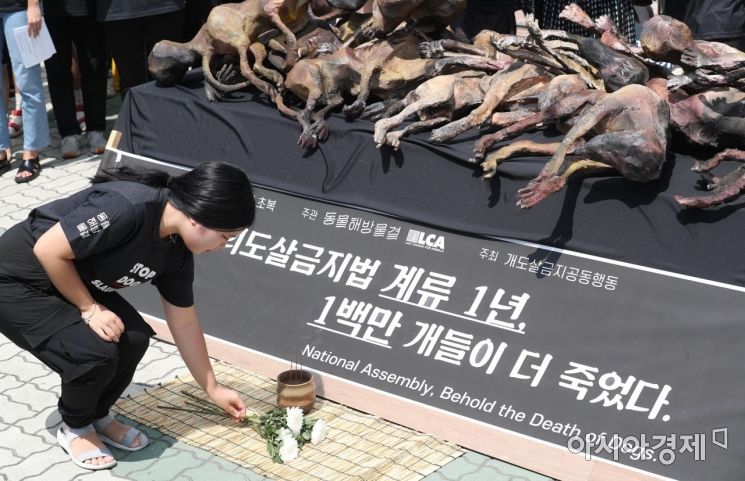 At the 'Boknal Memorial Action' rally held in front of the National Assembly in Yeouido, Seoul in 2019, a participant is placing chrysanthemums in memory of dogs sacrificed on Boknal. Photo by Mun Ho-nam munonam@
These illegal immigrants opened an unlicensed restaurant in an apartment in the bustling Mong Kok area of Hong Kong, where they sold dog and cat meat dishes. In February, after receiving information about their illegal activities, Hong Kong authorities raided the site and found 34 bags containing animal meat. The bags contained approximately 5.4 kg of dog meat and about 4 kg of cat meat. Additionally, Vietnamese menus listing dog and cat dishes and business records related to the restaurant were seized at the scene.
Authorities believe they smuggled dog and cat meat by boat from Vietnam. While admitting to selling dog and cat meat, they claimed they came from Vietnam, where consuming dog and cat meat is permitted, and were unaware that selling such meat was illegal in Hong Kong. In Hong Kong, slaughtering and selling dog and cat meat for consumption is prohibited, and violators can face up to six months in prison.
Vietnam is a major consumer of dog meat. As of 2020, Vietnam's annual dog meat consumption was estimated at 5 million dogs, ranking second in the world after China (10 million annually). However, authorities are making efforts to reduce dog meat consumption. In 2018, Hanoi, the capital city, recommended citizens to "refrain from consuming dog and cat meat" to improve the city's image and prevent the spread of rabies. Furthermore, Hoi An, a famous tourist destination in central Vietnam, has been gradually reducing the distribution and sale of dog and cat meat since 2021. Thanks to these efforts, the number of dog and cat meat shops has significantly decreased.
 Park Beom-su, Vice Minister of the Ministry of Agriculture, Food and Rural Affairs, announced the "Basic Plan to End Dog Meat Consumption" on the morning of the 26th at the Government Complex Sejong, containing specific solutions by sector to end the consumption of dog meat by 2027.
 [Photo by Yonhap News]
Meanwhile, South Korea is also aiming to end dog meat consumption by 2027. The Ministry of Agriculture, Food and Rural Affairs announced a 'Basic Plan to End Dog Meat Consumption' containing specific solutions. According to the 'Special Act on Ending the Breeding, Slaughter, and Distribution of Dogs for Food Purposes,' enacted in February, from February 7, 2027, breeding, slaughtering, distributing, or selling dogs for food purposes will be prohibited. Additionally, businesses operating for dog meat consumption must close or cease operations by the prohibition date.
This basic plan presents concrete implementation measures based on ▲ incentives for early closure or cessation by industry ▲ establishment of a seamless implementation system ▲ expansion of social consensus. Dog breeding farm owners will receive closure promotion support funds, with higher amounts provided for early closure or cessation. Farm owners will receive up to 600,000 KRW per dog based on the average annual number of dogs reported to local governments.
Moreover, when farm owners and slaughterhouse operators close their businesses, they will receive support for the residual value of facilities based on appraisals, and if they switch to agriculture, they will be provided with low-interest loans for related facilities or operating funds. Distribution merchants and food service operators who close will receive up to 4 million KRW for store demolition costs and up to 1.9 million KRW for reemployment success bonuses, linked to the Small and Medium Venture Business Administration's support programs for closed small business owners. Authorities plan to expand social consensus through campaigns and education to ensure the stable settlement of ending dog meat consumption and will strictly crack down on violations after 2027.
© The Asia Business Daily(www.asiae.co.kr). All rights reserved.
![Clutching a Stolen Dior Bag, Saying "I Hate Being Poor but Real"... The Grotesque Con of a "Human Knockoff" [Slate]](https://cwcontent.asiae.co.kr/asiaresize/183/2026021902243444107_1771435474.jpg)

















