Victory in Japan's Ruling LDP Presidential Election
Shigeru Ishiba (67), former secretary-general of the Liberal Democratic Party (LDP), who won the ruling LDP presidential election in Japan and will become the next prime minister, has been known for his 'dovish' stance on the Korea-Japan historical issues. He has been at the forefront of criticizing factional politics within the party and has shown a progressive historical awareness, emphasizing that Japan must face its war responsibilities. As a result, it is analyzed that there will be relatively fewer additional conflicts in Korea-Japan relations.
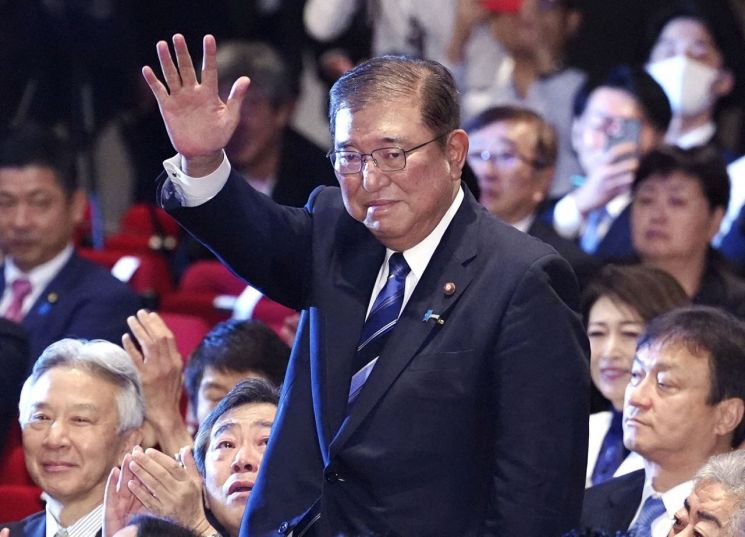
Ishiba's Dramatic Comeback in Runoff Vote... "I Will Build a Country Where People Can Feel Secure"
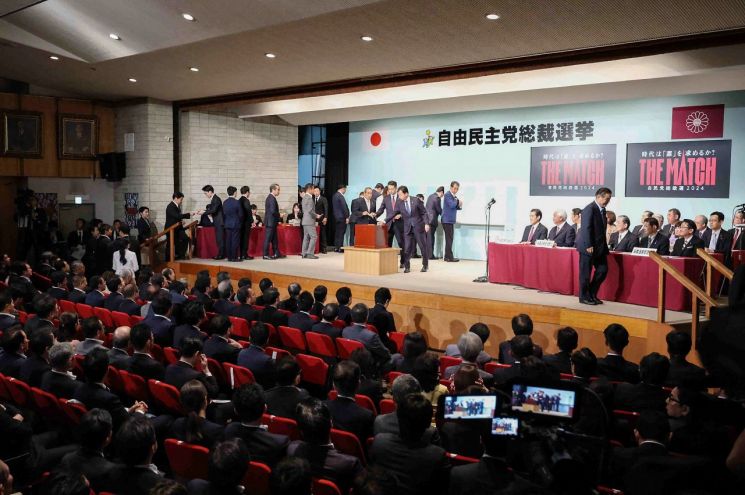
On the afternoon of the 27th, the LDP announced that in the runoff vote held at the Tokyo party headquarters, former secretary-general Ishiba won a total of 215 votes, defeating Sanae Takaichi, Minister in charge of Economic Security, who received 194 votes, and was elected as the 28th party president.
In this presidential election, which saw a record nine candidates, no candidate secured a majority in the first round, leading to a runoff between the top two candidates, former secretary-general Ishiba and Minister Takaichi. Ishiba received 154 votes in the first round, trailing Minister Takaichi's 181 votes, but succeeded in overturning the result in the runoff. Consequently, Ishiba will become Japan's prime minister after his 'fourth attempt in five tries.'
In his speech on the day, Ishiba referred to the situation when the LDP regained power in 2012, saying, "We regained power with the determination to make the LDP a party where free and active discussions can take place, a fair and just LDP, and a humble LDP. I want to return to that time once again." He emphasized, "I will trust the people, speak the truth with courage and sincerity, and build a safe and secure country where everyone can live with a smile."
He also highly praised Prime Minister Fumio Kishida, who took responsibility for the LDP faction slush fund scandal and decided not to seek re-election, saying, "He made a decision to regain the trust of the people once again," and added, "We must also be part of that effort." Prime Minister Kishida said, "This presidential election showed the people's determination that the LDP will change," and stated, "Ishiba must form a strong cabinet with execution power, decisiveness, and policy capability to deliver results."
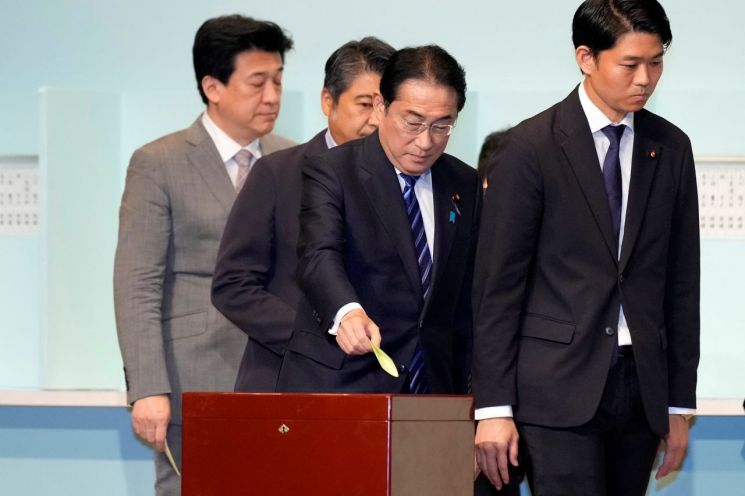
The runoff vote was conducted with a total of 415 votes, combining 368 votes from Diet members and 47 votes from local organizations. Compared to the first round, the proportion of Diet member votes increased. Specifically, Ishiba received 189 votes from Diet members and 26 from local organizations. Minister Takaichi received 173 votes from Diet members and 21 from local organizations.
Veteran Politician with 12 Terms... Voices Different from Right-Wing on Korea-Japan Historical Issues
Born to a politician grandfather and father, Ishiba entered politics in 1986 at the age of 29 when he was elected as the youngest member of the House of Representatives from Tottori Prefecture. He is regarded as a veteran politician with 12 terms and a policy expert within the LDP, having served twice as party secretary-general. He first joined the cabinet as Director-General of the Defense Agency under the Koizumi Cabinet and has been recognized for his expertise in defense issues, having served as Minister of Defense. In this election, he proposed numerous security policies, including the establishment of an Asian NATO.
Ishiba has consistently ranked first or second in domestic opinion polls when naming candidates for the next party president. However, despite his high public recognition and strong support from party members, he has been considered relatively weak in factional battles within the party. He challenged the party presidency four times?in 2008, 2012, 2018, and 2020?but was defeated by opponents such as Shinzo Abe, Yoshihide Suga, and former Prime Minister Kishida.
As a result, Ishiba has built an image as the 'opposition within the party' who is willing to speak harsh truths. Although he participated in the cabinet during the early Abe administration, since 2016 he has stepped back and consistently expressed critical views of the administration. He has openly pointed out problems with factional politics within the LDP. This has reportedly led to somewhat strained relations with figures like Deputy President Taro Aso.
In the 2012 presidential election, his second attempt, Ishiba led the first round but lost to former Prime Minister Abe in the runoff where factional power was strongly exercised. Recognizing his weak support among Diet members, he formed his own faction, which was later dissolved six years afterward.
Moreover, Ishiba is well known in Korea for his 'dovish' historical perspective, which differs from the right-wing faction within the LDP. He is negative about visits to Yasukuni Shrine, where Class A war criminals of the Pacific War are enshrined. He has also shown active willingness to improve Korea-Japan relations even when they deteriorated. After the South Korean government's decision to terminate the General Security of Military Information Agreement (GSOMIA) in August 2019, he criticized the Japanese government on his blog by referring to Germany's post-war reflection.
Likely to Emphasize US-Japan and Korea-US-Japan Alliances
It is assessed that the possibility of further deterioration in Korea-Japan relations under the Ishiba administration is relatively low. Ishiba's stance toward Korea is distinctly more dovish compared to the other two leading candidates in this election?the 'right-wing' Sanae Takaichi, Minister in charge of Economic Security, and former Environment Minister Shinjiro Koizumi.
However, since his basic historical awareness is not expected to deviate from the LDP's position, even if the Ishiba government takes office, no progressive moves regarding 'past reflection' are anticipated. In terms of diplomacy and security, he is expected to continue the policy line of emphasizing the US-Japan and Korea-US-Japan alliances, similar to the Kishida administration. Also, given his advocacy for constitutional recognition of the Self-Defense Forces and strengthening defense capabilities, there remains potential for conflicts with neighboring countries.
In Japan's parliamentary system, the prime minister is the president of the ruling party, which holds the majority. The new party president is scheduled to hold a press conference at 6 p.m. on the same day. He will be nominated as Prime Minister at the extraordinary Diet session starting on the 1st of next month. A new cabinet is also expected to be announced on the same day.
© The Asia Business Daily(www.asiae.co.kr). All rights reserved.
![Clutching a Stolen Dior Bag, Saying "I Hate Being Poor but Real"... The Grotesque Con of a "Human Knockoff" [Slate]](https://cwcontent.asiae.co.kr/asiaresize/183/2026021902243444107_1771435474.jpg)

















