Future Agricultural Direct Payment Budget Expanded to 5 Trillion Won
Disaster Recovery Costs to Increase by 23%
Comprehensive Introduction of Income Stabilization Insurance from Next Year
The People Power Party and the government announced on the 27th that they will expand the budget for the public interest direct payment, a subsidy provided to farmers, by 300 billion KRW to a total of 3.4 trillion KRW, and plan to increase the agricultural direct payment budget to 5 trillion KRW in the future. Along with this, they intend to increase disaster recovery costs by 23% and fully introduce 'income stabilization insurance' from next year, which guarantees income reduction by crop type, thereby ensuring income stability for farming households.
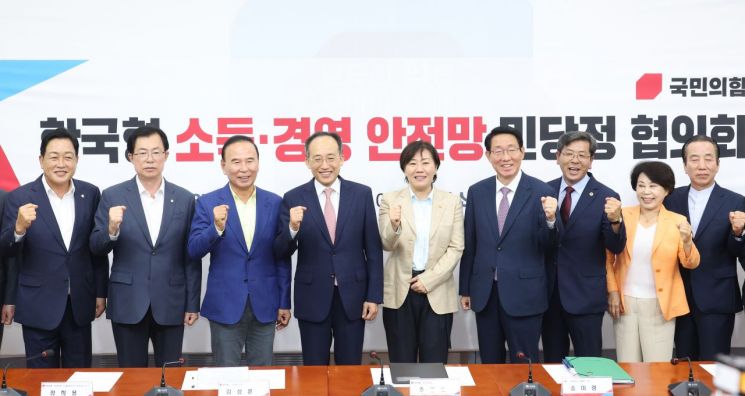
Kim Sang-hoon, Chairman of the Policy Committee, made this announcement after the ruling and opposition parties' consultation meeting held at the National Assembly in the morning on the topic of a Korean-style income and management safety net. The ruling party and government decided to establish a safety net for farmers' income and management after holding a consultation meeting on June 21 regarding rice price stabilization and income and management stabilization for farmers. The government formed a public-private-academic consultative body and held a total of 21 meetings until last month.
The ruling party and government will increase the budget to 5 trillion KRW to expand various agricultural direct payment systems, including the public interest direct payment.
Regarding the basic direct payment unit price, they plan to reduce the gap between paddy fields and dry fields and raise the unit price. The payment for paddy fields will increase from a maximum of 1.78 million KRW per hectare to 1.87 million KRW, and for dry fields from 1.34 million KRW to 1.5 million KRW.
Additionally, the area eligible for strategic crop direct payments, which are provided when cultivating major food crops, will be expanded and the unit price will be increased.
To sufficiently compensate for increased costs due to environmental and ecological conservation activities, the upper limit for livestock and crop direct payments will be raised, and the support volume for low-carbon agriculture programs will also be increased. Furthermore, they plan to support income stability for young and elderly farming households through young farmer settlement support and farmland transfer retirement direct payments.
The unit price for disaster recovery cost support will also be increased by an average of 23%, considering the risk of crop disasters, and agricultural machinery and equipment have been included in the support targets.
The agricultural income stabilization insurance, which compensates up to 85% of income losses caused by natural disasters or market price declines, will be fully introduced from next year.
Until now, when natural disasters occurred, compensation was only provided for yield reductions through disaster insurance, but from next year, income reductions due to price declines will also be compensated. The insurance coverage will expand from 9 items piloted this year to 15 items next year, and will gradually increase to 30 items.
Income by crop is calculated by multiplying the standard price by the yield per farm, and depending on the method of calculating the standard price, the insurance products will operate in three types: past income type (based on average price), expected income type (partially reflecting price increases during harvest), and actual income type (based on actual received price).
The ruling party and government will also promote proactive supply and demand management to stabilize agricultural product prices. For rice, which is in a structurally oversupplied state, a cultivation area reporting system and regional reduction area allocation will be introduced to reduce production volume. For horticultural products, cooperation in supply and demand adjustment will be strengthened with producer organizations, local governments, and the NongHyup (National Agricultural Cooperative Federation), and the price difference compensation function of the vegetable price stabilization system will be transferred to income stabilization insurance, reorganizing the system to focus on supply and demand management functions.
For livestock products, a separate supply and demand alert system will be established based on current situations and future outlooks, and incentives and penalties will be given to farms depending on their participation in supply and demand management measures.
People Power Party floor leader Choo Kyung-ho said, "We hope that the layered safety nets?expansion of the public interest direct payment system for income stability, reform of the policy insurance system responding to disasters and price fluctuations, and proactive supply and demand management measures for price stabilization of agricultural products?will become a tight safety net protecting farmers." He added, "With the attitude that agriculture, which is responsible for the nation's food, is the foundation of the country, the People Power Party will take the lead in taking care of it."
Chairman Kim also explained, "We have established a management risk system through a policy insurance method that does not distort the market," and "a foundation for stable supply of agricultural products will be created."
© The Asia Business Daily(www.asiae.co.kr). All rights reserved.
![Clutching a Stolen Dior Bag, Saying "I Hate Being Poor but Real"... The Grotesque Con of a "Human Knockoff" [Slate]](https://cwcontent.asiae.co.kr/asiaresize/183/2026021902243444107_1771435474.jpg)















