7-Day Reverse Repo Rate 1.7% → 1.5%
The People's Bank of China, the country's central bank, has implemented the previously announced cuts to the reserve requirement ratio (RRR) for commercial banks and the policy interest rate.
On the 27th, the People's Bank of China announced it would lower the reserve requirement ratio by 0.5 percentage points and adjust the 7-day reverse repurchase agreement (reverse repo) rate from 1.7% to 1.5%.
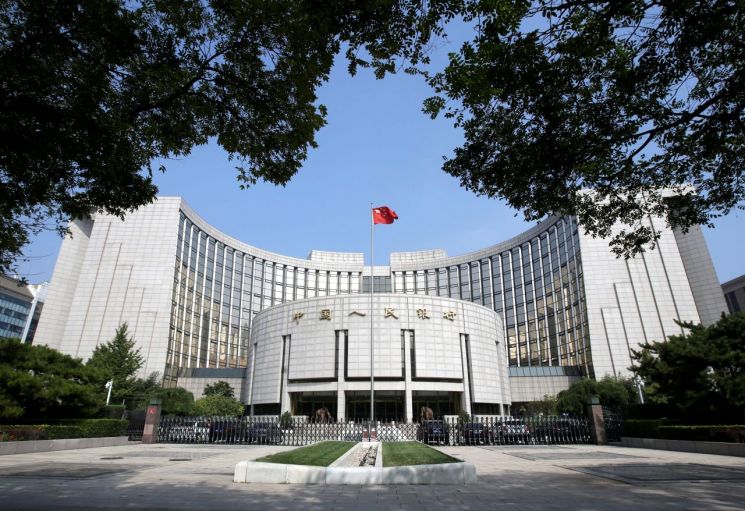
This follows the joint press conference held on the 24th by Governor Pan Gongsheng and the heads of three financial regulatory authorities, where they announced plans to lower the RRR to inject 1 trillion yuan (approximately 189 trillion won) of long-term liquidity into the financial market. The RRR is the proportion of deposits that banks are required to hold at the central bank. Lowering the RRR increases liquidity in the market.
The People's Bank of China stated, "We will maintain a supportive monetary policy stance, enhance the intensity and precision of monetary policy regulation, and create a favorable monetary and financial environment for stable economic growth and high-quality development in China." It also noted that with this RRR cut, the weighted average reserve requirement ratio for Chinese financial institutions will be about 6.6%. Financial institutions already operating with a 5% RRR are excluded.
Additionally, it said, "To strengthen countercyclical monetary policy adjustments (measures that adjust the economy in opposition to the business cycle) and support stable economic growth, the 7-day reverse repo rate has been adjusted from the previous 1.7% to 1.5%, effective today."
This adjustment of the RRR and policy interest rate comes ahead of China's largest holiday, the National Day holiday (October 1?7). It is a move to stimulate the economy amid prolonged domestic demand stagnation.
The day before, the Central Political Bureau of the Chinese Communist Party held an unusual meeting on the economic situation at the September session chaired by President Xi Jinping. Typically, economic issues are discussed only in April, July, and December, so addressing economic matters in September is exceptional. On the same day, the Chinese government announced plans to provide one-time support payments and subsidies to low-income groups in celebration of National Day, and the Shanghai municipal government announced plans to issue consumption coupons worth 500 million yuan (approximately 94.2 billion won).
Since Governor Pan stated at the press conference on the 24th that depending on market conditions within the year, the RRR could be further lowered by 0.25 to 0.5 percentage points, there is speculation that if the economy does not rebound in the fourth quarter, additional liquidity injections may follow.
© The Asia Business Daily(www.asiae.co.kr). All rights reserved.
![Clutching a Stolen Dior Bag, Saying "I Hate Being Poor but Real"... The Grotesque Con of a "Human Knockoff" [Slate]](https://cwcontent.asiae.co.kr/asiaresize/183/2026021902243444107_1771435474.jpg)















