Korea Zinc's Tender Offer Defined as a 'Hostile Takeover Attempt'
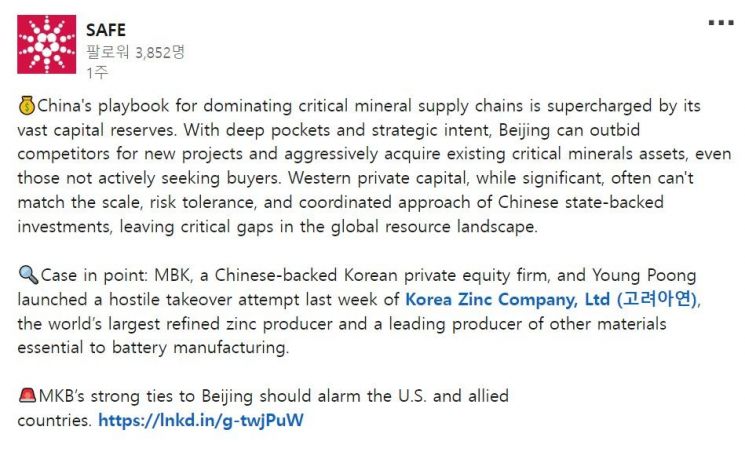 The U.S. energy security think tank SAFE (Securing America’s Future Energy) has classified MBK Partners' predatory tender offer attempt as a "hostile takeover attempt" and expressed concerns about the negative impact this incident could have on the global critical minerals supply chain. Photo by SAFE LinkedIn
SAFE (Securing America’s Future Energy), a U.S. energy security think tank, has classified MBK Partners' predatory tender offer attempt as a 'hostile takeover attempt' and expressed concerns about the negative impact this incident could have on the global critical minerals supply chain.
According to industry sources on the 27th, SAFE recently stated through its LinkedIn social network service (SNS) channel that "MBK, a private equity fund supported by China, has initiated a hostile takeover attempt of Korea Zinc, the world's largest zinc smelting company and a producer of essential battery materials," adding that "the strong ties between MBK and China are a matter that should serve as a warning to the United States and its allies."
SAFE is responsible for proposing comprehensive U.S. energy-related policies from an economic security perspective. It also serves as the de facto secretariat for the Critical Minerals Security Partnership (MSP), a multilateral cooperative body led by the U.S. Department of State aimed at building a de-China supply chain. Since July, Korea has been serving as the chair country of the MSP, following the United States.
SAFE views MBK's current hostile M&A attempt as coinciding with a period when China's refined zinc imports have increased due to supply shortages faced by Chinese smelters. Korea Zinc not only possesses zinc but also nickel refining technology, which is a core capability applicable to other critical minerals needed for producing advanced industry materials such as batteries and semiconductors. Therefore, this takeover attempt of Korea Zinc is analyzed as a move by China to dominate not only zinc but also the global supply chain of various critical minerals.
Currently, China supplies more than half of the world's refined zinc and controls 90% of the graphite supply chain necessary for producing anode materials for secondary batteries. In the case of nickel, which is required for cathode material production in secondary batteries, China has secured price competitiveness by importing raw materials cheaply through investments in Indonesia, monopolizing 90% of the global precursor market. However, with recent strengthening of raw material export bans by resource countries, China is shifting its focus from cheap sourcing to securing technological capabilities from a long-term perspective.
Korea Zinc has produced about 1.2 million tons annually of over ten types of non-ferrous metals including zinc, lead, and copper for 50 years, possessing world-class proprietary technology. Additionally, with the construction of a nickel refinery started last year, it is projected to produce a total of 65,000 tons of nickel annually by 2026.
Concerns continue domestically and internationally that if MBK sells Korea Zinc to China or other overseas entities, it could affect national core industries and future industries such as batteries and semiconductors from the perspective of the critical minerals supply chain.
Meanwhile, on the 24th, Korea Zinc applied to the government for a determination on whether its 'high-nickel precursor processing patent technology,' a secondary battery material it owns, qualifies as a national core technology. If this technology is designated as a national core technology, the government will have the authority to approve or disapprove mergers and acquisitions by foreign companies for reasons of economic security.
© The Asia Business Daily(www.asiae.co.kr). All rights reserved.
![Clutching a Stolen Dior Bag, Saying "I Hate Being Poor but Real"... The Grotesque Con of a "Human Knockoff" [Slate]](https://cwcontent.asiae.co.kr/asiaresize/183/2026021902243444107_1771435474.jpg)
















