MOU between the National Arboretum and DMZ Ecosystem Restoration
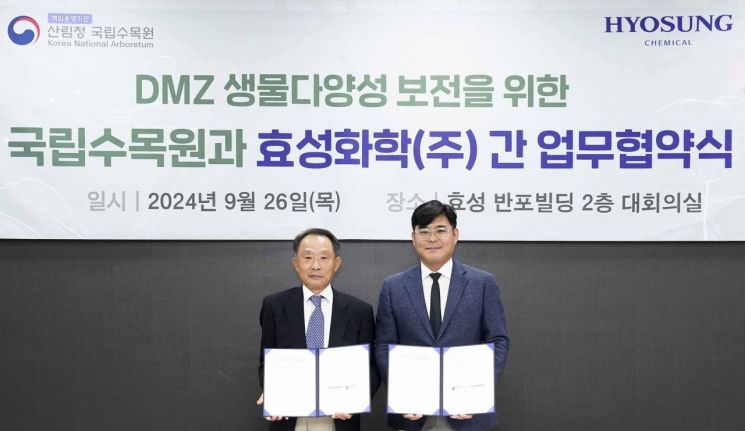 Lee Geon-jong, CEO of Hyosung Chemical (left), and Lim Young-seok, Director of the National Arboretum, are posing for a commemorative photo at the signing ceremony for the restoration of the DMZ ecosystem and the preservation of biodiversity held on the 26th. Photo by Hyosung
Hyosung Chemical is partnering with the Korea National Arboretum under the Korea Forest Service to engage in ecological environment improvement activities in the Demilitarized Zone (DMZ).
On the 26th, Hyosung Chemical signed a mutual cooperation agreement (MOU) with the Korea National Arboretum at Hyosung Chemical’s headquarters located in Seocho-gu, Seoul, to restore forest ecosystems and preserve biodiversity in the DMZ area. The signing ceremony was attended by Hyosung Chemical CEO Lee Geon-jong and Korea National Arboretum Director Lim Young-seok, among others.
This agreement was made as part of ESG (Environmental, Social, and Governance) management to participate in natural ecosystem protection and biodiversity preservation activities. Both parties will jointly promote ESG management practices including ▲restoration of ecosystems in barren lands and damaged forests in the DMZ ▲securing seeds of native plants for forest ecosystem restoration ▲building social consensus on the importance of biodiversity conservation.
Lee Geon-jong, CEO of Hyosung Chemical, stated, "As the importance of forest ecosystems increases due to climate change, we have decided to join forces with the Korea National Arboretum to actively participate in preserving the DMZ, a globally significant ecological treasure." He added, "We will continue to strengthen ESG management through various activities aimed at ecosystem and biodiversity conservation."
Meanwhile, Hyosung Chemical, along with its holding company and affiliates Hyosung Heavy Industries and Hyosung TNC, has continuously carried out projects for environmental protection and biodiversity preservation. Since 2022, they have been conducting conservation and coastal cleanup activities for Zostera marina, known as blue carbon, a carbon sink of marine ecosystems. They are also actively participating in building a healthy ecosystem for future generations through activities such as feeding and treatment support for winter migratory birds designated as endangered species and wetland conservation to protect their habitats.
© The Asia Business Daily(www.asiae.co.kr). All rights reserved.
![Clutching a Stolen Dior Bag, Saying "I Hate Being Poor but Real"... The Grotesque Con of a "Human Knockoff" [Slate]](https://cwcontent.asiae.co.kr/asiaresize/183/2026021902243444107_1771435474.jpg)
















