Daesin F&I Oversees Sale of Real Estate-Backed NPLs Worth 130 Billion KRW
3 Banks Show Rapid Increase in NPLs, 'Improving Soundness'
Prolonged Real Estate Downturn Leads to Increased NPL Sales and Securitization
IM Bank (formerly Daegu Bank), which has transitioned to a commercial bank, along with regional banks Jeonbuk Bank and Jeju Bank, raised liquidity by selling approximately 130 billion KRW worth of non-performing loans (NPLs) to the market. They accepted losses on the recovery of held bonds to reduce the increasing ratio of bad debts and secure cash liquidity. This measure aims to stably maintain the banks' asset soundness by selling rapidly increasing NPLs amid a downturn in the real estate market.
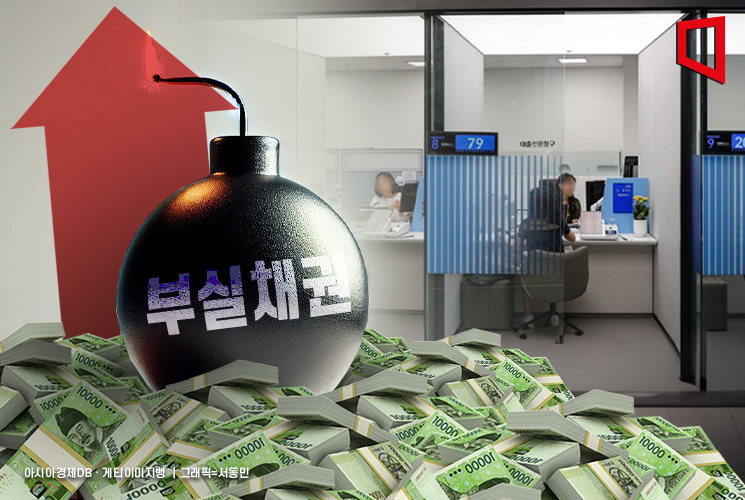
According to the investment banking (IB) industry on the 27th, IM Bank, Jeonbuk Bank, and Jeju Bank sold 130 billion KRW worth of held NPLs to a special purpose company (SPC) under the management of Daishin F&I, an NPL specialist company affiliated with Daishin Financial Group. The SPC issued 93 billion KRW worth of securitized bonds backed by the NPLs as collateral and paid the raised funds to the respective banks as payment for the NPL sales.
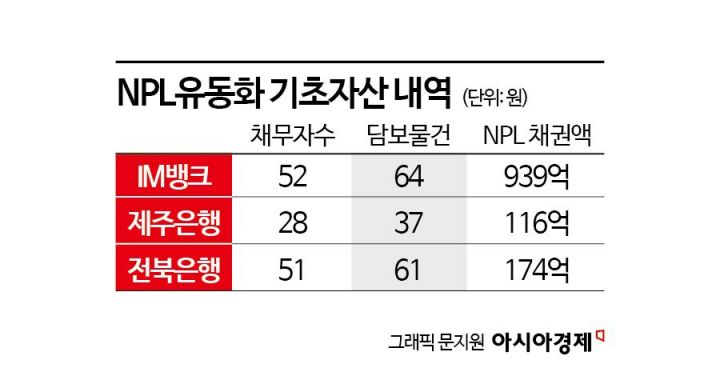
For NPL securitization, IM Bank transferred bonds worth 94 billion KRW lent to 52 debtors to the SPC. This volume accounts for more than 70% of the NPLs sold by the three banks, making it the largest amount of NPLs transferred as securitized assets. Jeju Bank and Jeonbuk Bank sold bond balances of 11.6 billion KRW and 23.4 billion KRW, respectively, lent to 28 and 51 debtors. Most of these are secured bonds lent with real estate as collateral. It is known that the collateral for the entire NPL consists of about 160 real estate properties.
Financial companies sell or securitize NPLs to reduce the bad debt ratio and improve asset soundness. IM Bank has recently seen a rapid increase in bad debts due to the downturn in the local real estate market. As of the end of June this year, the ratio of NPLs overdue by more than three months stands at about 0.8% of total assets, maintaining excellent soundness. However, NPLs have increased by 24% up to June this year, posing a burden on soundness.
An IB industry insider said, "Judging by the speed of NPL increase, NPLs likely increased significantly in the third quarter as well," and added, "NPL securitization was done to maintain asset soundness at a certain level as of the third quarter." The insider evaluated, "IM Bank has stably maintained its own soundness by raising 100 billion KRW in capital from DGB Financial Group through a paid-in capital increase in the first half of this year and sufficiently accumulating reserves."
Jeju Bank is also experiencing a steep increase in NPLs. The NPL ratio at the end of the first quarter this year was 1.3%, up 0.6 percentage points from 0.7% last year. In terms of amount, NPLs increased by more than 50% in one year. Jeonbuk Bank's NPL ratio increased by 0.1 percentage points during the same period, reaching 0.9% at the end of the first quarter.
An NPL industry official said, "As the downturn in the local real estate market prolongs, NPLs of regional banks continue to increase," adding, "Watch-list loans overdue between one and three months are also rapidly increasing, making it necessary to manage bad debt ratios through NPL sales or securitization." The official predicted, "The trend of increasing NPLs in financial companies will continue until the real estate and local economies recover."
© The Asia Business Daily(www.asiae.co.kr). All rights reserved.
![Clutching a Stolen Dior Bag, Saying "I Hate Being Poor but Real"... The Grotesque Con of a "Human Knockoff" [Slate]](https://cwcontent.asiae.co.kr/asiaresize/183/2026021902243444107_1771435474.jpg)
















