Some Opinions Say It Could Reach $3,000 Per Ounce
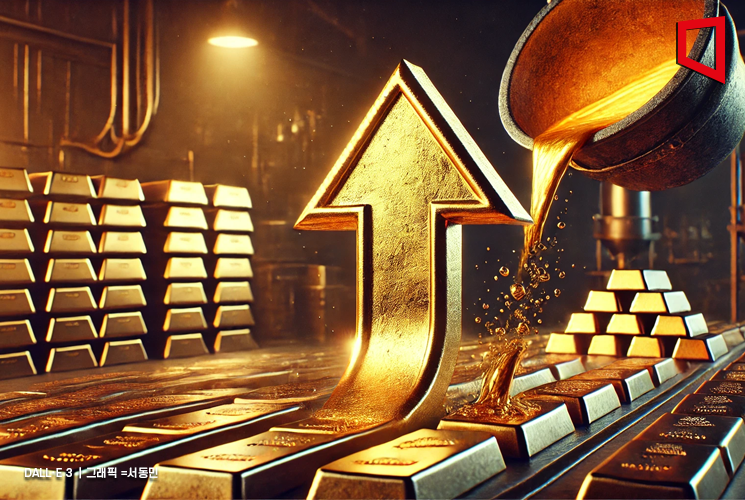
As the United States enters a rate-cutting cycle, gold prices are soaring to unprecedented heights, with the majority of global investment banks (IBs) forecasting that gold prices could rise further through next year.
According to Investing.com on the 26th, international gold futures prices reached an all-time high of $2,684.70 per ounce the previous day and continued to show a slight upward trend on the same day.
The year-to-date increase in gold prices recorded a 28% gain, surpassing the rise in the S&P 500 index. Since the U.S. Federal Reserve (Fed) implemented a big cut (a 0.50 percentage point reduction in the benchmark interest rate) on the 18th, gold prices have risen for six consecutive trading days. If this trend continues, this year is expected to be recorded as the year with the largest annual increase in gold prices since 2010.
While some voices criticize the gold price rally as excessive, major global IBs still believe that gold prices could continue their upward rally into next year.
Goldman Sachs expects gold prices to reach $2,700 per ounce by early next year, and UBS predicts this price will be reached by mid-next year.
JP Morgan and Citi analyzed that gold prices will rise to $2,775 and $2,875 per ounce, respectively, by next year.
Australia and New Zealand Banking Group and Mitsubishi UFJ Financial Group have a more optimistic outlook, expecting gold prices to reach $2,900 and $3,000 per ounce, respectively, by the end of next year.
Generally, gold becomes more attractive in a low-interest-rate environment where deposit interest rates decline. According to the FedWatch tool, there is a 60% chance that the U.S. will implement another big cut in November, so countries around the world are expected to maintain a rate-cutting stance for the time being. This is a major reason why IBs anticipate continued gold price increases.
Additionally, the ongoing weakness of the dollar is also enhancing gold's appeal. The U.S. Dollar Index is currently hovering around the 100 mark, which is the lowest level in 14 months. Holding dollars itself causes asset losses, so gold demand is increasing as a risk-hedging tool.
Moreover, the trend of major central banks around the world accumulating gold is also contributing to the positive outlook for gold prices. According to CNN, the central banks of China, India, and T?rkiye have purchased gold to reduce their dependence on the dollar. China, in particular, is more active in this movement as it is internationalizing its own currency, the yuan.
However, there are also opinions that gold prices are overheated in the short term and that profit-taking is necessary. Jonathan Krinsky, Chief Market Technician at BTIG, said, “While I have a positive view on gold prices over the next 6 to 12 months, recent daily charts show signs of fatigue in the rally, and weekly charts indicate an overbought zone. Tactical trading opportunities are emerging.”
© The Asia Business Daily(www.asiae.co.kr). All rights reserved.
![Clutching a Stolen Dior Bag, Saying "I Hate Being Poor but Real"... The Grotesque Con of a "Human Knockoff" [Slate]](https://cwcontent.asiae.co.kr/asiaresize/183/2026021902243444107_1771435474.jpg)
















