Operation of Special Livestock Infectious Disease Prevention Period
Focused Preemptive Blocking of Migratory Bird Virus Transmission
Establishment of Private-Led Autonomous Quarantine System
The government will operate a 'Special Livestock Infectious Disease Prevention Period' from next month until February next year to prevent the spread of highly pathogenic avian influenza (AI) and other livestock infectious diseases that are likely to occur during the winter season. A dedicated task force will be appointed to focus on managing high-risk farms and minimize the impact on egg supply. The livestock infectious disease risk assessment model will be advanced, and differentiated and precise quarantine measures will be implemented regionally according to risk levels.
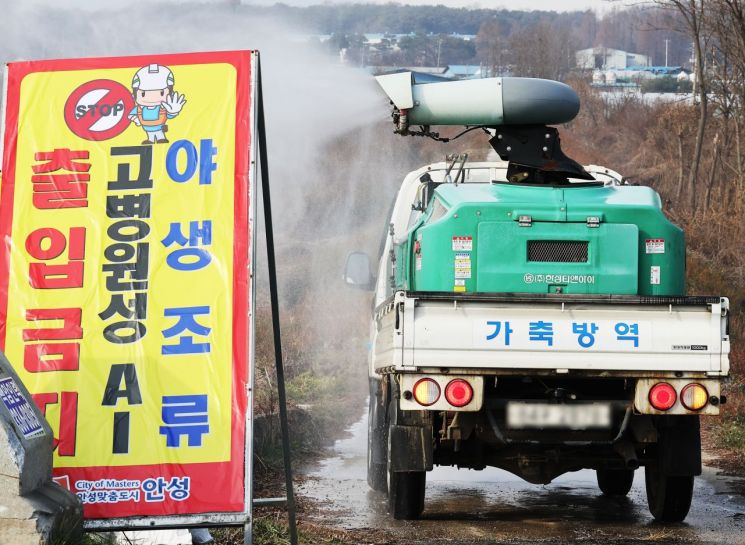 Last December, an Anseong Livestock Cooperative disinfection vehicle was conducting disinfection to prevent highly pathogenic avian influenza (AI) in the Anseong area of Gyeonggi-do. [Image source=Yonhap News]
On the 26th, the Ministry of Agriculture, Food and Rural Affairs announced the operation plan for the Special Livestock Infectious Disease Prevention Period at the 46th National Policy Issues Ministerial Meeting chaired by the Prime Minister. This winter, as in previous years, migratory birds infected with the H5N1 type highly pathogenic avian influenza are expected to move into the country, increasing the likelihood of virus introduction through vectors such as people and vehicles, so livestock infectious disease prevention management will be strengthened.
Prime Minister Han Duck-soo said at the meeting, "Livestock infectious diseases not only cause damage to livestock farms but also create instability in the supply of livestock products, affecting consumer food prices and causing social costs," adding, "We hope that the Ministry of Agriculture, Food and Rural Affairs and related ministries will work closely with local governments on the front lines of quarantine to thoroughly strengthen quarantine readiness."
Preemptive Virus Transmission Blocking... Promotion of Smart Quarantine
The Ministry of Agriculture, Food and Rural Affairs will maintain a triple quarantine approach to minimize damage from highly pathogenic avian influenza: ▲blocking the virus from migratory birds, the main transmission vectors ▲enhancing farm-level quarantine ▲preventing farm-to-farm transmission. At the same time, the special quarantine measures will focus on ▲intensive management of high-risk farms ▲establishing a private-led autonomous quarantine system ▲building a smart quarantine system.
First, virus transmission from migratory birds will be blocked in advance. In collaboration with the Ministry of Environment, the number of areas surveyed for migratory bird habitats will be increased, and surveillance activities will be intensified focusing on carcasses and captures where avian influenza detection rates are high. A total of 218 major migratory bird arrival sites will be designated, with control of people and vehicles and concentrated disinfection of nearby roads.
Additionally, quarantine management of high-risk farms will be strengthened, and horizontal transmission between farms will be prevented. In particular, to minimize the impact on egg supply caused by highly pathogenic avian influenza, joint dedicated officers from the Quarantine Headquarters and local governments will be appointed for laying hen farms with more than 100,000 birds (205 farms) and 10 laying hen dense complexes for special management.
A private-led autonomous quarantine system will also be established. All 76 livestock integration business operators will establish their own quarantine management plans and conduct quarantine education for contracted farms. The Ministry of Agriculture, Food and Rural Affairs plans to provide incentives such as awards to outstanding operators to encourage active participation.
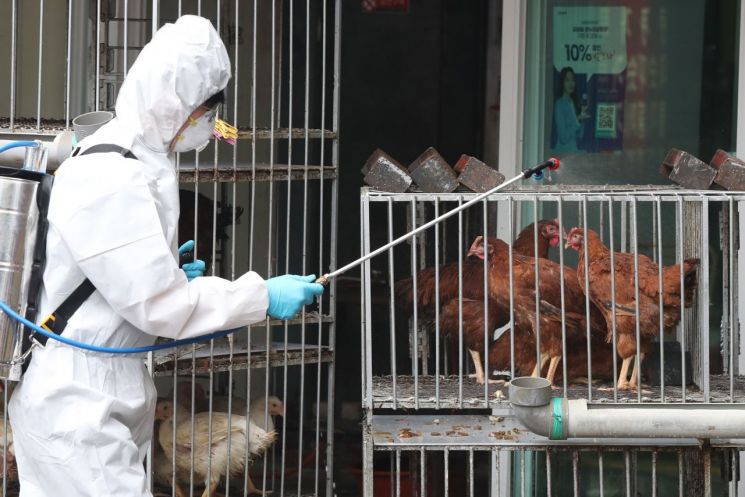 A disinfection operation is being conducted targeting chicken and duck vendors at Malbau Market in Buk-gu, Gwangju to prevent avian influenza (AI) [Image source=Yonhap News]
Smart quarantine using big data from the Korea Animal Health Integrated System (KAHIS) will also be promoted. A pilot avian influenza risk assessment based on past outbreak information, migratory bird distribution, and vehicle movement status will be conducted this year. Through this, disinfection resources will be concentrated on high-risk farms and regions.
Quarantine measures will be flexibly adjusted according to risk levels. Farms with excellent quarantine in laying hens will be allowed to ship eggs even during temporary movement suspension orders. Some farms within a 500m radius of avian influenza outbreak areas but with low risk will be excluded from preventive culling.
Kim Jong-gu, Director of Agricultural Innovation Policy at the Ministry of Agriculture, Food and Rural Affairs, explained, "Highly pathogenic avian influenza is transmitted through migratory birds, which are difficult to control, so thorough blocking quarantine efforts are necessary." He added, "We plan to operate this special quarantine measure without fail to prevent the spread of livestock infectious diseases," and emphasized, "Farm-level autonomous blocking quarantine is most important, so we ask for compliance with quarantine rules."
The Ministry of Agriculture, Food and Rural Affairs will also strengthen quarantine management for foot-and-mouth disease (FMD) and African swine fever (ASF), which can occur at any time during this special quarantine period.
Since vaccination management is important for foot-and-mouth disease, vaccination will be conducted after checking the situation of local governments and farms. Antibody tests will be conducted once or twice a year for cattle farms and four times a year for pig farms to verify vaccination status, and fines will be imposed on farms with low antibody positivity rates. Compensation for culling will also be fully cut.
For African swine fever, surveillance, testing, and quarantine facility inspections will be strengthened targeting pig farms in 12 cities and counties and the Gyeongbuk region. The Ministry of Environment will also manage wild boar populations, a major vector.
© The Asia Business Daily(www.asiae.co.kr). All rights reserved.
![Clutching a Stolen Dior Bag, Saying "I Hate Being Poor but Real"... The Grotesque Con of a "Human Knockoff" [Slate]](https://cwcontent.asiae.co.kr/asiaresize/183/2026021902243444107_1771435474.jpg)
















