The Proportion of Distressed Companies Unable to Repay Interest Properly Continues to Increase
Distressed Companies Hinder the Growth of Normal Companies
Calls for Continuous Restructuring
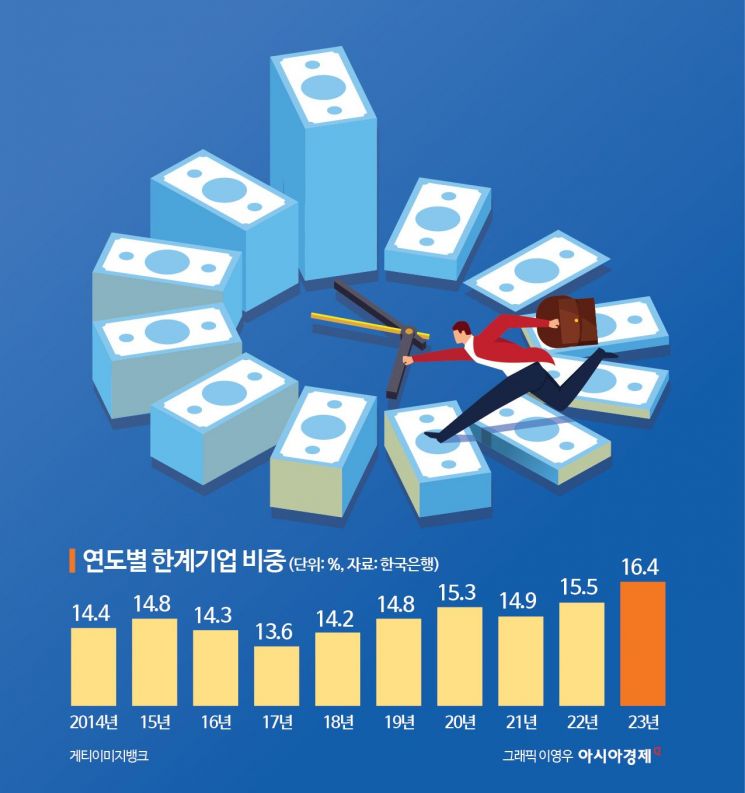
Among domestic companies, the proportion of marginal firms (zombie companies) that have been unable to even pay interest on the money they earn for several years has reached 16%. As the number of marginal firms increases, there are even phenomena that hinder the growth of normal companies, highlighting the need for active restructuring.
The Proportion of Marginal Firms in Korea Continues to Rise
According to the Financial Stability Report by the Bank of Korea on the 26th, the proportion of marginal firms among domestically externally audited companies reached 16.4% at the end of last year. This is the highest ever, surpassing 15.5% in 2022.
Marginal firms are companies whose interest coverage ratio?operating profit divided by interest expenses?has been below 1 for three consecutive years, indicating a prolonged weak ability to repay debt.
By company size, the proportion of marginal firms was 17.4% for small and medium-sized enterprises (SMEs) and 12.5% for large corporations. By industry, accommodation and food services (59.0%), transportation (49.2%), electricity and gas (46.1%), and real estate (43.8%) showed very high proportions of marginal firms. In contrast, industries such as aviation (0.2%), petrochemicals (4.1%), and electrical and electronics (11.3%) were below average.
Marginal firms tend to experience significant deterioration in most financial indicators two years before entering marginal status and fail to recover for a long time. In the first year of becoming marginal, the return on total assets and current ratio were 7.7 percentage points and 62.4 percentage points lower, respectively, compared to normal firms. Even after entering marginal status, lower levels of profitability and liquidity compared to normal firms persisted for more than five years.
Marginal firms showed a higher borrowing growth rate (+8.2 percentage points) compared to normal firms two years before entering marginal status. This combination of increased borrowing and declining profitability, along with higher debt dependency and debt ratios, is evaluated as reducing the stability of their financial structure.

Marginal Firms Lower Financial Sector Stability and Hinder Growth of Normal Firms
Marginal firms also reduce the stability of the financial sector. As of the end of last year, the credit extended (loans and corporate bonds) by deposit-taking institutions to marginal firms was dominated by banks at KRW 125.3 trillion, followed by mutual finance institutions at KRW 13.1 trillion and savings banks at KRW 3.9 trillion.
Although credit to marginal firms was mostly concentrated in banks, since 2021, exposure to marginal firms in credit extended by non-bank deposit-taking institutions such as mutual finance and savings banks has been increasing. Accordingly, the share of non-bank sectors in total credit extended to marginal firms expanded from 7.3% in 2020 to 11.9% last year.
At the end of last year, 8.5% of total corporate loans by deposit-taking institutions were credit extended to marginal firms. In particular, among vulnerable industries, the share of mutual finance and savings banks in credit extended to marginal firms in the real estate sector has steadily increased, raising concerns about growing default risks in that sector.
Marginal firms also hinder the growth of normal firms. The higher the proportion of marginal firms (based on borrowings), the more negative the impact on normal firms’ growth (sales growth rate), profitability (return on total assets), and cash flow (operating cash flow). When the proportion of marginal firms within an industry rises by 10 percentage points, the sales growth rate and return on total assets of normal firms decrease by 2.04 percentage points and 0.51 percentage points, respectively, and the operating cash flow ratio to total assets falls by 0.26 percentage points.
The negative external effects of marginal firms on normal firms are particularly pronounced among SMEs and in the service sector. The service sector has lower market entry barriers than manufacturing, making it easier for less competitive firms to enter, which can increase the number of marginal firms within the sector and negatively affect the business activities of normal firms. Additionally, compared to manufacturing, the service sector generally has less collateral capacity, which appears to have contributed to an overall rise in borrowing interest rates for normal firms as the number of marginal firms in the sector increases.
A Bank of Korea official stated, "If marginal firms continue to exist long-term through financial support, they can hinder the growth of normal firms and worsen profitability, while also restricting smooth investment and financing activities of normal firms. The recent increase in domestic marginal firms can act as a factor raising overall credit risk in the corporate sector."
He added, "The increase in marginal firms with weakened debt repayment ability could lead to potential instability in the financial system. From a mid- to long-term perspective, timely restructuring of marginal firms and continuous efforts to improve vulnerable industries considering their characteristics are necessary."
© The Asia Business Daily(www.asiae.co.kr). All rights reserved.
![Clutching a Stolen Dior Bag, Saying "I Hate Being Poor but Real"... The Grotesque Con of a "Human Knockoff" [Slate]](https://cwcontent.asiae.co.kr/asiaresize/183/2026021902243444107_1771435474.jpg)
















