Single-Crystal Copper (111) Foil: Horizontal Growth Induces Reduced Explosion Risk
Suppresses Dendrite Formation, Extends Battery Life... Published in EES Journal
A technology has been developed to reduce the risk of explosion in lithium batteries.
By using a metal foil with precisely arranged copper atoms, the uneven growth of lithium can be suppressed, which is expected to improve battery safety and lifespan.
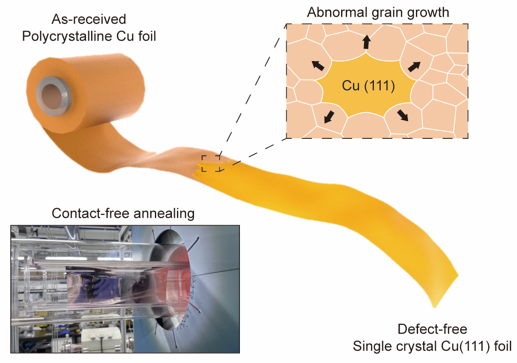
A research team led by Professor Lee Hyunwook from the Department of Energy and Chemical Engineering at UNIST (President Park Jongrae) significantly enhanced the lifespan and efficiency of anode-free lithium batteries by applying copper (111) single-crystal foil obtained through contactless heat treatment technology. This foil induces lithium to spread uniformly across the battery surface, preventing the formation of dendrites.
This makes it possible to realize an anode-free lithium battery with no risk of explosion.

The research team succeeded in suppressing dendrite formation inside the battery by inducing lithium to grow horizontally rather than vertically on copper (111) single-crystal foil. Dendrites are structures where lithium accumulates unevenly and grows in a tree-branch shape, which is a major cause of electrical short circuits and increases the risk of battery explosion.
The problem of dendrites forming during charging has long been a major obstacle to the commercialization of lithium metal batteries. The team, in collaboration with the IBS Center for Multidimensional Carbon Materials led by Rodney Ruoff (Distinguished Professor at UNIST), Professor Jin Sunghwan's group at Kangwon National University, and Professor Seo Donghwa's group at KAIST, confirmed that lithium can grow uniformly in a stable tetradecahedral crystal structure, thereby improving battery efficiency and safety.
By comparing lithium growth patterns on various copper foils, the team found that high-index crystal planes with irregularly arranged atoms cause dendrite formation. This presents an important direction for the development of next-generation metal substrates.
First author Kim Minho stated, "By fundamentally solving the problem of uneven lithium metal growth, this will serve as a catalyst for the commercialization of next-generation lithium batteries."
Professor Lee Hyunwook emphasized, "Previous lithium battery research was limited by focusing only on charging. In the future, when technology development considers both charging and discharging, the ultimate dream battery?anode-free lithium batteries?will become possible."
This research was supported by the UNIST Future-leading Specialized Project, the International Collaborative Research Project on Secondary Batteries of the Ministry of Science and ICT and the National Research Foundation of Korea, the Global TOP Strategy Research Group Support Project of the National Research Council of Science and Technology, and the IBS Institute for Basic Science Support Project.
The results were published as a cover article in the world-renowned journal Energy & Environmental Science on September 21.
© The Asia Business Daily(www.asiae.co.kr). All rights reserved.
![Clutching a Stolen Dior Bag, Saying "I Hate Being Poor but Real"... The Grotesque Con of a "Human Knockoff" [Slate]](https://cwcontent.asiae.co.kr/asiaresize/183/2026021902243444107_1771435474.jpg)
















