Government and Ruling Party Push for Amendment to Information and Communications Network Act
Impose Social Responsibility and Obligations on Platform Companies
Industry Expresses "Need More Time to Prepare" Opinion
The government plans to implement an AI-generated content labeling system targeting major online platform companies such as Naver and Kakao. Users will be required to go through a verification process to confirm whether photos or videos uploaded to Naver blogs or KakaoTalk chat windows are AI-generated content.
According to the government and IT industry on the 26th, the Korea Communications Commission is pushing for a legislative amendment to introduce the AI-generated content labeling system. The plan is to implement the system through the amendment of the Act on Promotion of Information and Communications Network Utilization and Information Protection (Information and Communications Network Act), which was introduced by Kim Jang-gyeom, a member of the People Power Party, at the end of last month.
The bill stipulates that information and communication service providers (platform operators) of a certain scale must indicate that content such as text, audio, images, and videos created using AI technology is "virtual information." Platform operators who fail to establish a method for labeling "AI-generated content" will be subject to fines.
Additionally, platform operators are required to make efforts to prevent the distribution of AI-generated content without virtual information labels by deleting or blocking access to such content, and to take measures such as warnings and revenue restrictions against users who violate these rules to prevent recurrence. It is also stipulated that no one may arbitrarily remove virtual information labels without justifiable reasons. However, the enforcement decree will specify content that does not require virtual information labeling, considering the scope and purpose of AI technology use.
The purpose of this is to prevent social repercussions caused by virtual information created using AI technology, such as fake news and deepfake videos, being mistaken for truth through laws and systems. The social responsibility of large online platforms, which serve as channels for the widespread dissemination of massive amounts of content, is expected to increase.
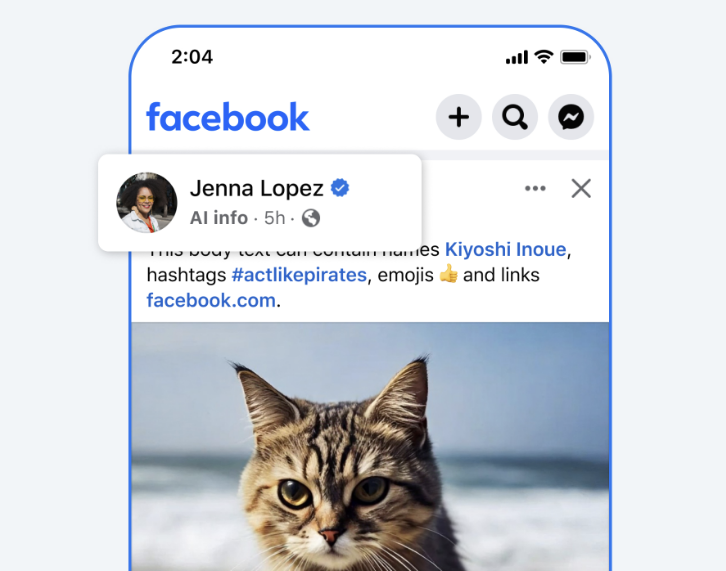 Meta, which operates social networking services (SNS) such as Facebook and Instagram, labels AI-generated posts with "AI info." [Source=Meta website]
Once this law is enacted, when users upload content to Naver bulletin boards or KakaoTalk chat windows, a prompt asking "Is this post generated by AI technology?" is expected to appear, requiring users to check a box. If the content is AI-generated, a label or explanation indicating that it was created by AI will be attached when shown to other users.
A representative from the Korea Communications Commission said, "We have held discussions on the AI-generated content labeling system with six major platform operators including Naver, Kakao, Google, Meta, X, and TikTok," adding, "The industry has requested sufficient time to prepare." He also noted, "We are considering that the AI-generated content labeling system should not infringe on freedom of expression or hinder AI technology and industry promotion."
Similar systems have already been introduced overseas. The Biden administration in the United States established a plan last October to mandate watermarking for AI-generated fake images and other content to enable identification. The European Union (EU) also included regulations in its Artificial Intelligence Act requiring watermarks on AI-generated content. Meta, which operates social networking services (SNS) such as Facebook and Instagram, labels AI-generated content with "AI info."
© The Asia Business Daily(www.asiae.co.kr). All rights reserved.
![Clutching a Stolen Dior Bag, Saying "I Hate Being Poor but Real"... The Grotesque Con of a "Human Knockoff" [Slate]](https://cwcontent.asiae.co.kr/asiaresize/183/2026021902243444107_1771435474.jpg)
















