"Need to establish local cooperation system for treatment at appropriate hospitals"
"Government provides various support but little felt on the ground"
"Hospitals' own efforts such as education for pediatric patients' guardians also necessary"
The chairman of the only children’s specialized hospital foundation in Korea suggested that establishing and supporting a regional network medical delivery system is necessary to solve the issue of pediatric open-run.
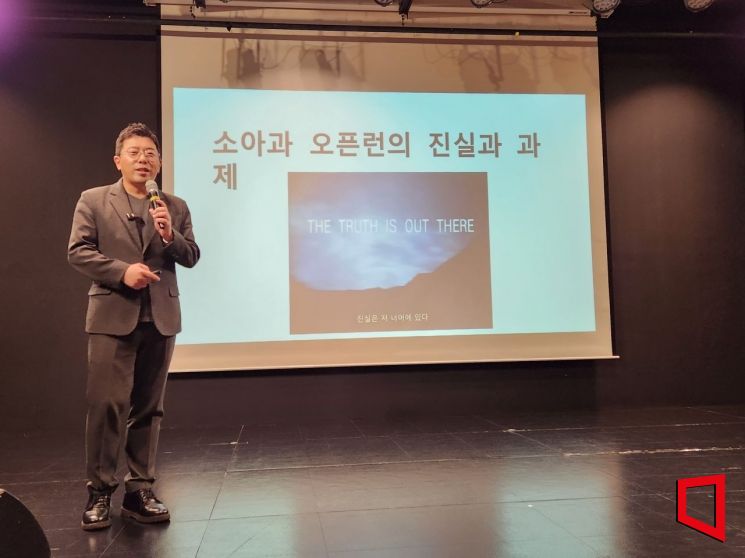 Jeong Seong-gwan, Chairman of Woori Children's Medical Foundation, is giving a presentation at 11:30 AM on the 25th at Seoul City Hall in Jung-gu, Seoul, during the lecture titled "The Truth About Open Run from the Perspective of Pediatricians," hosted by the Korea Medical Bio Journalists Association.
 /Photo by Choi Tae-won peaceful1@
On the 25th at 11:30 a.m., Jeong Seong-gwan, chairman of the Woori Children’s Medical Foundation, stated this during a lecture titled "The Truth of Open-Run from the Perspective of Pediatricians," hosted by the Korean Medical Bio Journalists Association at Seoul City Hall in Jung-gu, Seoul. The Woori Children’s Medical Foundation operates two Ministry of Health and Welfare-designated pediatric and adolescent specialized hospitals in Guro and Seongbuk, Seoul, respectively. Among the 109 specialized hospitals operating nationwide, only these two are pediatric and adolescent specialized hospitals.
Chairman Jeong said, "To eliminate open-run, the ongoing pilot project for a regional cooperation system for pediatric care is important," adding, "If a cooperative system within the region is established so that pediatric patients with moderate severity (between mild and severe) can receive treatment at appropriate facilities ranging from clinics to hospitals, the loading on each hospital can be significantly reduced."
He argued that if pediatric patients can be linked to various hospitals within the region according to the characteristics of each disease, hospitals would bear less burden and patients could receive prompt treatment. He explained that by cooperating within the region?from clinics handling mild cases to hospitals performing surgeries?a seamless system for pediatric patient care should be established.
In particular, he insisted that "secondary hospitals" should be able to perform the role of triage (emergency patient classification) to classify the severity of pediatric patients. Chairman Jeong said, "It is appropriate for tertiary general hospitals to focus on treating severe and emergency patients, but the problem is that patients or their guardians find it difficult to judge the severity themselves."
He continued, "Secondary hospitals should play the role of classifying severity, such as whether a patient only needs to visit a clinic, requires hospitalization here, or needs to be promptly transferred to a tertiary hospital. The government should also support secondary hospitals to fulfill this role," adding, "It is time to establish a regional medical cooperation system and provide bold support through selection and concentration."
He emphasized the need to increase the practicality of government support. He said, "Although the government provides various supports, there is not much that can be felt on the ground," and added, "If the government prepares realistic support measures, more than a hundred children’s hospitals nationwide can play a major role in the medical delivery system."
He further explained, "For example, to receive support related to nighttime medical care, one must practically stay up all night, and although labor costs for holiday medical care have increased by more than 30%, the support scale has only increased by about 10%," adding, "It is realistically difficult to expand nighttime and holiday medical care. Even if not through fees, overall system improvement is necessary."
He also suggested that hospitals need to make their own efforts, such as educating pediatric patients’ guardians. Chairman Jeong said, "Parents who have experienced their child having febrile seizures call 119 or visit the hospital every time their child has a fever. If they had received explanations about febrile seizures, they might not do so," and explained, "If related information is shared with the local community through SNS (social networking services) and other means to ease parents’ worries, it could also change medical utilization behavior."
© The Asia Business Daily(www.asiae.co.kr). All rights reserved.
![Clutching a Stolen Dior Bag, Saying "I Hate Being Poor but Real"... The Grotesque Con of a "Human Knockoff" [Slate]](https://cwcontent.asiae.co.kr/asiaresize/183/2026021902243444107_1771435474.jpg)















