Economic Deputy Prime Minister to Attend Kwanhun Forum on the 25th
Emphasizes Managing Domestic and External Risks and Future Reforms
"Need to Consider Public Burden of Utility Price Increases"
Maximize Support for Strategic Industries Including Semiconductors
As opinions emerge calling for an interest rate cut to revive domestic demand, Choi Sang-mok, Deputy Prime Minister for Economic Affairs and Minister of Strategy and Finance, said on the 25th, "I hope there will be a wise decision (by the Bank of Korea)."
At a Kwanhun Club invitation debate held at the Korea Press Center in Jung-gu, Seoul, Deputy Prime Minister Choi indirectly expressed expectations for a rate cut, saying, "The U.S. has implemented a big cut (a 0.5 percentage point cut in the base interest rate), and the Bank of Korea governor said that external constraints on rate decisions have been removed and that domestic conditions should be considered."
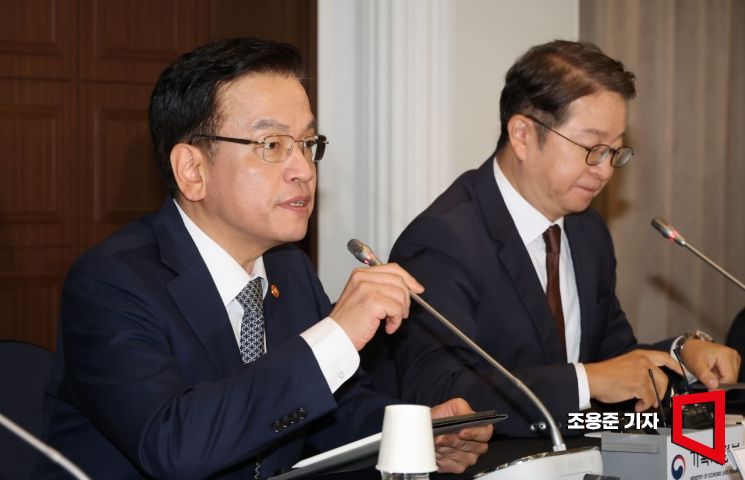 Choi Sang-mok, Deputy Prime Minister for Economic Affairs and Minister of Economy and Finance, is delivering the opening remarks at the Gwanhun Debate held on the 25th at the Press Center in Jung-gu, Seoul. Photo by Jo Yong-jun jun21@
When a journalist panel asked which is more important between reviving domestic demand and managing household debt, Deputy Prime Minister Choi replied, "As the Deputy Prime Minister for Economic Affairs, I think reviving domestic demand is a short-term priority." However, regarding the question of whether the Bank of Korea missed the opportunity to cut rates last month, he said, "I fully respect the Bank of Korea's interest rate decisions." On the growing issues of housing prices and household debt, he assessed them as "aftereffects following the global financial crisis and the complex crisis."
Regarding the recent increased pressure to raise public utility rates such as electricity, he stated, "Nothing has been decided yet." He argued, "It is the right direction to normalize accumulated debts of public institutions and such, but the speed and method should be carefully considered in light of the public burden." He also explained, "The electricity rate for the fourth quarter has not been decided yet and is under the cost determination process," adding, "We plan to make a comprehensive judgment considering various situations."
On the opinion that direct subsidies might be necessary in the semiconductor sector, where global competition has intensified, he said, "Our strategic industries, including semiconductors, are important, and if it becomes a national competition, the government will communicate with companies and provide maximum support." However, he added, "There is also a question of whether large corporations are the ones who most need direct subsidies," and noted, "The very establishment of a semiconductor cluster in the metropolitan area is a huge subsidy, and providing infrastructure to enable production on time is also a time subsidy."
When asked whether pursuing tax cuts and sound fiscal management amid ongoing tax revenue shortfalls is contradictory, he answered, "Our tax burden rate is not low compared to welfare expenditure on a global scale." He emphasized, "It is important to promote economic vitality to secure tax revenue," and added, "To maintain fiscal sustainability, it is the right approach to manage expenditure efficiency and promote economic activity through tax policies to secure tax revenue."
Regarding the introduction of a capital gains tax, he said, "The capital gains tax is related to the abolition of inheritance tax," and added, "It requires fundamental social consensus as well as research, so it is under review, but it is not the stage to discuss it yet." When asked if this meant it was premature, he replied, "There should be social consensus as well," and said, "Changing the inheritance tax to suit the times is a priority." He viewed the securities transaction tax as appropriate for gradual reduction and abolition as previously discussed.
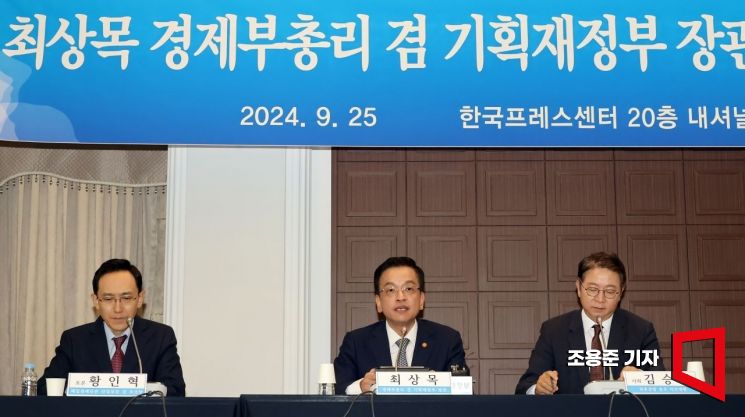 Choi Sang-mok, Deputy Prime Minister for Economic Affairs and Minister of Economy and Finance, is delivering opening remarks at the Kwanhoon Debate held on the 25th at the Press Center in Jung-gu, Seoul. Photo by Jo Yong-jun jun21@
Full Effort to Improve Perceived Economy... Measures to Protect General Shareholders in Mergers and Physical Divisions Prepared
Earlier, in his opening remarks, Deputy Prime Minister Choi said, "We will prioritize the recovery of the people's livelihood economy, thoroughly manage internal and external risks, and accelerate structural reforms for future generations." He continued, "We will do our utmost to ensure that the recovery of economic indicators leads to an improvement in the perceived economy felt by the public." He also emphasized, "We will firmly establish the price stabilization trend and accelerate domestic demand recovery."
To overcome the Korea discount, he reiterated the intention to "provide value-up tax incentives and promote the abolition of the financial investment income tax." He also said, "We will review measures to effectively protect general shareholders in cases of mergers and physical divisions."
Deputy Prime Minister Choi also announced, "We will produce visible results in the four major reforms of pensions, healthcare, education, and labor," and previewed, "We will actively promote the ‘Dynamic Economy Roadmap.’" In fostering strategic industries, he stated, "We will establish legal frameworks and nurture talent to create a growth foundation for the three major game changers: artificial intelligence (AI), bio, and quantum."
The government plans to soon announce measures to revitalize venture investment, private investment projects, and stabilize construction costs to boost investment and construction vitality. Communication with the National Assembly will also be strengthened for legislation to activate domestic demand, such as extending temporary investment tax credits and reducing individual consumption tax on old vehicles. In terms of household debt management, efforts will be made to stabilize the real estate market. The government will also closely monitor the U.S. presidential election, Middle East and Ukraine situations, and changes in global monetary policies.
© The Asia Business Daily(www.asiae.co.kr). All rights reserved.
![Clutching a Stolen Dior Bag, Saying "I Hate Being Poor but Real"... The Grotesque Con of a "Human Knockoff" [Slate]](https://cwcontent.asiae.co.kr/asiaresize/183/2026021902243444107_1771435474.jpg)

















