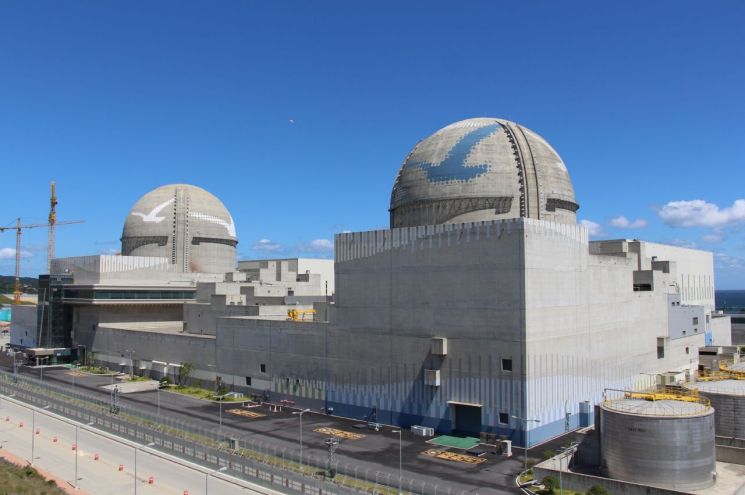
On the 25th, the Nuclear Safety and Security Commission announced that it conducted the "2024 National Radiation Disaster Prevention Joint Exercise" assuming a radiation leak accident at the Saewool Nuclear Power Plant located in Ulju-gun, Ulsan Metropolitan City, with the participation of over 2,300 people including officials from central government ministries, local governments, specialized agencies, operators, related local organizations, and residents.
This year's joint exercise assumed a major accident at Unit 2 of the Saewool Nuclear Power Plant caused by an earthquake (magnitude 8.6) occurring in the East Sea near Ulsan. Emergency response organizations such as the central and local radiation disaster countermeasure headquarters and the on-site radiation disaster command center were established and operated. Through on-site drills including evacuation of local residents, operation of shelters and field clinics, and environmental radiation surveys, the integrated national radiation disaster response system was inspected.
The exercise was conducted in conjunction with the Ministry of the Interior and Safety's "READY Korea" exercise to prepare for complex disasters such as large earthquakes and radiation leaks.
The NSSC headquarters established the Central Radiation Disaster Countermeasure Headquarters, which oversees radiation disaster response, and conducted decision-making drills regarding the declaration of radiation disasters and the review of special disaster area declarations. At the NSSC Ulju on-site radiation disaster command center, decision-making for resident protection (including resident evacuation guidance, indoor sheltering, distribution and administration instructions for thyroid protection drugs) and overall on-site accident management command drills were conducted.
Eight metropolitan and basic local governments surrounding the Saewool Nuclear Power Plant established regional radiation disaster countermeasure headquarters and inspected the implementation of resident protection measures. Ulsan Metropolitan City (Ulju-gun, Nam-gu, Jung-gu, Dong-gu) set up two shelters at locations including the Ulju Sports Complex and conducted resident evacuation drills with about 900 participants including local residents and students. Gyeongsangnam-do (Yangsan City) established a shelter at the indoor gymnasium of Yangsan Sports Complex and conducted resident evacuation drills with about 400 participants including local residents and students.
The Korea Institute of Nuclear Safety conducted drills using radiation survey equipment to detect radiation on land, sea, and air, and provided integrated results to supply necessary information for decisions on resident protection measures.
The Korea Institute of Radiological & Medical Sciences, in cooperation with radiation emergency medical hospitals such as Ulsan University Hospital, Gijang Hospital, and the Radiation Health Institute, set up a field clinic at the Saewool Nuclear Power Plant and conducted drills for radiation injury treatment, decontamination, and patient transport. Korea Hydro & Nuclear Power focused on on-site drills for nuclear power plant accident management, including radiation emergency declaration and dissemination, emergency power supply, and external injection of emergency cooling water.
Chairman Yoo Guk-hee stated, "To maintain a flawless national radiation disaster prevention system, radiation disaster prevention drills must be conducted as if in real situations," and added, "Through this exercise, we thoroughly inspected the collaboration and response system with related organizations to ensure prompt resident protection measures in the event of a radiation disaster."
© The Asia Business Daily(www.asiae.co.kr). All rights reserved.
![Clutching a Stolen Dior Bag, Saying "I Hate Being Poor but Real"... The Grotesque Con of a "Human Knockoff" [Slate]](https://cwcontent.asiae.co.kr/asiaresize/183/2026021902243444107_1771435474.jpg)















