An eco-friendly film made from sepia melanin extracted from cuttlefish biodegraded by about 97% within 85 days under composting conditions (temperature: 58°C, humidity: 50~60 RH%). Sepia melanin is a material attracting attention as a future electronic material and is expected to serve as a stepping stone to open new possibilities for eco-friendly electronic products.
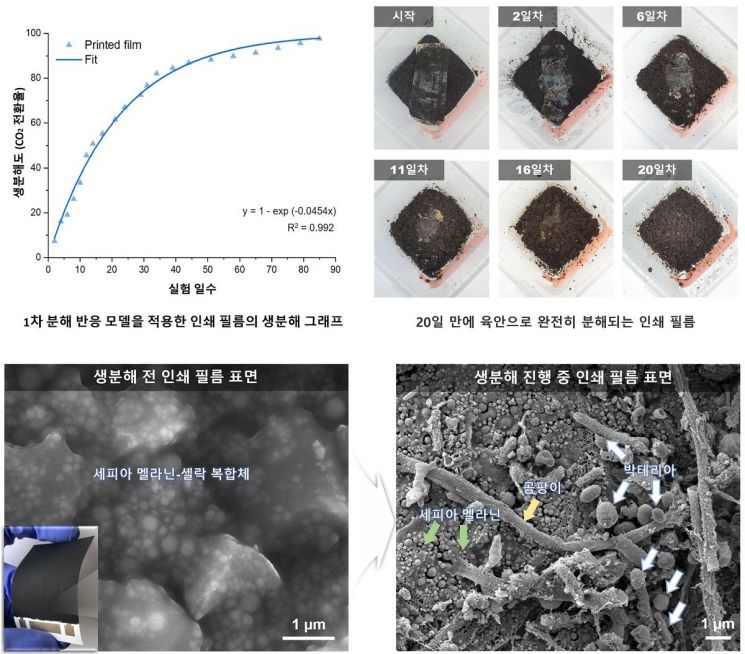 Analysis data of the biodegradation process of sepia melanin-based electrically active film. Provided by KAIST
KAIST announced on the 25th that Professor Jae-Wook Myung's research team from the Department of Civil and Environmental Engineering conducted an international joint study with Professor Clara Santato's team at ?cole Polytechnique de Montr?al and developed an electrically active film based on sepia melanin that is 'completely biodegradable.'
Electronic waste is generated worldwide at nearly 60 million tons annually, driven by the increasing demand for electronic products. However, only 17.4% of electronic waste is recycled, while the majority is landfilled or incinerated, contaminating ecosystems with heavy metals such as lead (Pb), cadmium (Cd), and harmful chemicals like polychlorinated biphenyls (PCB).
For the same reasons, there is a prevailing argument that management strategies for electronic waste should be established based on a circular life cycle perspective rather than a traditional linear approach. This situation calls for research on sustainable electronic materials and highlights the need to develop bio-based biodegradable organic electronic materials to prevent environmental pollution caused by electronic waste.
Biodegradable organic electronic materials are emerging as new materials that can transform the paradigm of electronic products (electronic waste). Organic electronic materials refer to substances characterized by electron conjugation in their chemical structures, such as melanin, tannin, emodin, lignin, and dopamine. Developing electronic materials based on abundant natural biological resources is expected to contribute to solving the depletion of critical resources.
In particular, sepia melanin, which can be extracted from cuttlefish, is noted as an important material in designing eco-friendly electronic products due to its biodegradability and low toxicity. However, it remains at the research stage.
In light of this situation, the joint research team implemented an electrically active film using sepia melanin and conducted studies to evaluate its electrical properties and sustainability (biodegradability and ecotoxicity).
The electrically active film is produced by manufacturing an ink composite of sepia melanin and printing it on paper with silver pattern electrodes using the flexographic printing method.

The joint research team also printed the silver electrode pattern on paper using flexography printing technology with a natural bio-based sepia melanin-shellac ink composite to realize a fully degradable electrically active film.
Subsequently, when analyzing the biodegradation process under composting conditions based on the degree of conversion of the printed film into carbon dioxide (CO2) (mineralization), it was confirmed that about 97% biodegradation occurred within 85 days.
The printed film was visually completely decomposed within 20 days, and scanning electron microscope analysis observed that bacteria were involved in the biodegradation of the printed film, with compost microbial communities forming on the surface.
Most importantly, to investigate whether the biodegradation products of the printed film exhibited ecotoxicity, germination experiments were conducted on two plant species, Lolium multiflorum and Tagetes erecta. The printed film and its individual components (sepia melanin, shellac, cellulose, etc.) showed minimal toxicity to the plants.
Analysis of electrical properties showed that the sepia melanin-shellac printed film exhibited an electrical conductivity of 10^-4 S/cm. Although this is lower than that of typical metals or high-performance electronic materials, considering its biodegradability and eco-friendly characteristics, the joint research team explained that it could be used as a competitive alternative in specific application fields such as environmental sensors, bio-devices, and disposable electronic products.
Professor Myung said, “This is the first case of realizing an electrically active film that is ‘completely biodegradable’ using bio-based materials like sepia melanin and shellac, which are not commonly used,” and added, “The joint research team plans to propose various alternatives for implementing sustainable electronic devices in follow-up studies.”
Meanwhile, this research was conducted with support from KAIST College of Engineering’s Master's and Doctoral Venture Research and Creative Challenge Project (C2 Research), the National Research Foundation of Korea’s Science and Technology Internationalization Project - Korean STEM Graduate Student Canada Training Program, among others.
The study involved Choi Se-hyung, a doctoral candidate from KAIST’s Department of Civil and Environmental Engineering, and Anthony Camus, a doctoral candidate from ?cole Polytechnique de Montr?al, as co-first authors. The research results were published on the 29th of last month in the international journal Communications Materials.
© The Asia Business Daily(www.asiae.co.kr). All rights reserved.
![Clutching a Stolen Dior Bag, Saying "I Hate Being Poor but Real"... The Grotesque Con of a "Human Knockoff" [Slate]](https://cwcontent.asiae.co.kr/asiaresize/183/2026021902243444107_1771435474.jpg)

















