Child Tax Credit and Tip Tax Exemption Are Common Ground with Harris
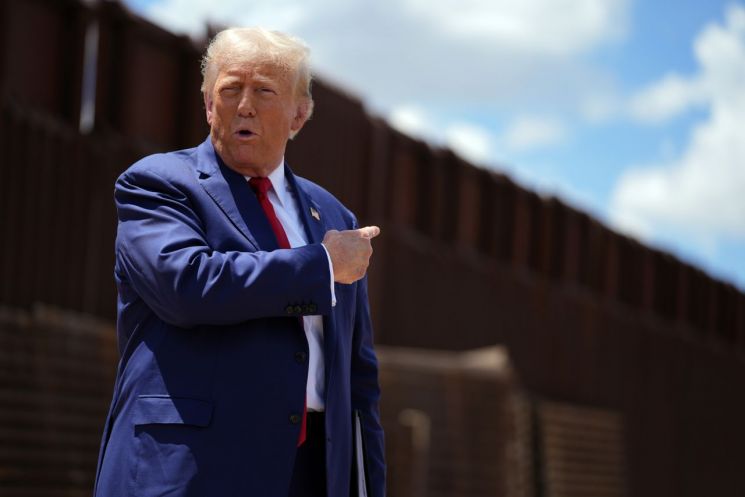
Former U.S. President and Republican presidential candidate Donald Trump has reportedly caused confusion even among his aides by excessively promising tax cuts.
Bloomberg News reported on the 23rd (local time) that "tip-earning workers, part-timers, and the elderly, as well as high-income residents in Democratic strongholds, are all set to become beneficiaries of Trump's tax cut promises," adding, "Even his advisors are uncertain about how many of these promises can actually be enacted into law."
According to the U.S. center-right think tank Tax Foundation, if former President Trump's promises are actually implemented, the total amount of tax reductions over the next 10 years would reach $11 trillion (approximately 1,460 trillion won). In particular, the permanent extension of the 2017 income and corporate tax cuts and the child tax credit account for more than half of this amount, at $4.3 trillion and $3 trillion respectively. Since tax cuts mean a reduction in government revenue, excessive cuts could lead to fiscal deficits.
Steven Moore, a senior fellow at the Heritage Foundation and known as an unofficial economic advisor to Trump, commented, "It seems Trump is thinking about how to win the hearts of more working-class Americans," adding, "Some of his promises are good ideas, but others are not."
Trump is not the only one playing the tax cut card ahead of the U.S. presidential election in November. Democratic vice presidential candidate Kamala Harris has also launched a platform called the "Opportunity Economy," focusing on protecting the middle class, with promises such as $25,000 support for new homebuyers and a tenfold increase in the new small business tax credit (from $5,000 to $50,000). It is also well known that she borrowed Trump's "tip tax exemption" promise.
Both candidates are particularly focusing on the child tax credit to win middle-class votes. The Harris campaign promised a $6,000 tax credit for newborns (approximately 8.03 million won) and an annual $3,600 tax credit for children under six years old. They also pledged that families could receive a $3,600 tax credit per child every year until the child turns 17. The Trump campaign vowed to make the annual child tax credit $5,000 per child without income limits.
The United States introduced the child tax credit in 1997 to reduce the child-rearing cost burden on middle-class parents. Initially, the policy provided a $400 tax credit per child under 17, but after tax law revisions during Trump's first term, the credit level has increased to $2,000 (approximately 2.67 million won). Last year alone, $122 billion (approximately 163.4 trillion won) was spent on child tax credit support, making it a policy with a significant fiscal burden, but skepticism and criticism regarding its effectiveness persist in academia.
Erika York, senior economist at the Tax Foundation, criticized, "Sound tax policy and economic principles are no longer in the driver's seat," adding, "The reason why only clear and appealing words are heard at campaign events is because politics is in control."
Bloomberg pointed out, "Trump claims that economic growth stimulated by tax cuts and up to $2.8 trillion in additional tariff revenue can offset the cost of the tax cuts, but there is no concrete method or explanation yet."
Meanwhile, the Penn Wharton Budget Model (PWBM), a bipartisan research group at the University of Pennsylvania's Wharton School, announced in a report last month that Trump's budget plan would expand the federal deficit by $5.8 trillion over the next 10 years. The largest portion of this deficit, $4 trillion, is attributed to the permanent extension of tax cuts. In the case of Vice President Harris, the expansion of the child tax credit and earned income tax credit is expected to cause a $2.1 trillion deficit, but about half of the cost is predicted to be offset by an increase in the corporate tax rate. However, the corporate tax increase requires congressional approval, which remains a variable.
© The Asia Business Daily(www.asiae.co.kr). All rights reserved.
![Clutching a Stolen Dior Bag, Saying "I Hate Being Poor but Real"... The Grotesque Con of a "Human Knockoff" [Slate]](https://cwcontent.asiae.co.kr/asiaresize/183/2026021902243444107_1771435474.jpg)















