Yang Heewon President Reveals at Automotive Engineering Society Forum
"Diversifying Hybrid Systems to Prepare for Chasm"
Hyundai Motor Group is reportedly considering a hybrid system based on a 3.5 turbo engine as part of diversifying its hybrid systems. In addition, it is developing hydrogen direct injection engines along with small- and mid-sized hybrid vehicles primarily targeted for emerging markets.
Yang Heewon, President of Hyundai Motor's Research and Development Division, stated at the Korea Society of Automotive Engineers Leaders Forum on the 24th, "We expect the electric vehicle chasm (temporary demand slowdown) to last more than five years, so we will introduce next-generation hybrids to strengthen competitiveness." He added, "Starting with the Palisade to be launched in the first half of next year, we have plans for rear-wheel drive (FR) hybrids and subsequently for the 3.5 (turbo engine-based hybrid)."
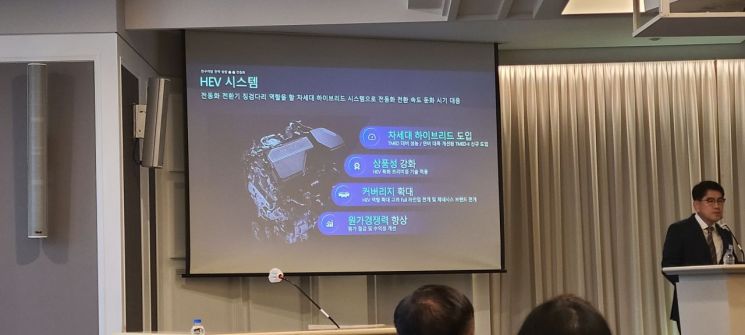 Yang Heewon, Head of Research and Development at Hyundai Motor Group, is presenting at the Leaders Forum hosted by the Society of Automotive Engineers on the 24th.
 [Photo by Choi Daeyeol]
The main hybrid models Hyundai and Kia have released so far are based on 2.0 and 2.4-liter gasoline engines and 1.6-liter turbo engines. There are also liquefied petroleum gas (LPG) hybrids. Additionally, 2.5-liter turbo engine-based hybrids will be applied to mid- to large-sized passenger cars, multipurpose vehicles (MPVs), and small commercial vehicles such as minivans.
Rear-wheel drive hybrids, mainly for high-end models like Genesis, are being developed based on the 2.5-liter turbo engine. The 3.5-liter turbo engine, used in high-end vehicles such as the G90, is expected to be used in high-performance hybrids.
Yang said, "In emerging markets like India, there is a need to maximize price competitiveness, so we are developing technology to integrate small engine hybrid systems." He added, "In Brazil, we are researching flex-fuel (FF) vehicles that can use biofuels and internal combustion engines powered by hydrogen."
Regarding extended-range electric vehicles (EREVs) to be launched mainly in North America and China, Yang revealed that unlike most manufacturers who use three motors, Hyundai is developing models with two motors. EREVs introduced by Chinese companies typically use two drive motors and one generator motor. Hyundai’s system operates with one motor that integrates generation and drive functions and one drive motor. In North America, these will be offered in mid- to large-sized SUVs, while in China, they will be offered in the compact segment.
Yang predicted that the cell-to-vehicle (CTV) method will be widely used to improve battery performance. This method skips the module or pack stages by directly installing battery cells, the basic battery units, into the vehicle. Looking at the mid- to long-term increase in electric vehicle demand, Hyundai is developing affordable ternary (NCM) batteries to enhance price competitiveness, while expecting solid-state batteries to be commercialized starting in 2030.
Regarding battery management systems (BMS), which have gained attention due to electric vehicle fires, it is expected that beyond notifying customers when temperatures exceed certain thresholds, the system will also be able to directly alert fire authorities.
Recognizing the importance of reflecting customer experience in new vehicle development, Hyundai plans to establish a UX (user experience) studio base in India. The existing UX studio in Korea will be expanded and unveiled next year, and studios in China and the United States will also be expanded next year.
Yang stated, "We need to shift our perspective from worrying about what technology to develop to how to improve customers' pain points." He added, "From the viewpoint of customer value, we plan to explore how technology can be utilized, integrate various technologies to create synergy, and enhance value."
© The Asia Business Daily(www.asiae.co.kr). All rights reserved.
![Clutching a Stolen Dior Bag, Saying "I Hate Being Poor but Real"... The Grotesque Con of a "Human Knockoff" [Slate]](https://cwcontent.asiae.co.kr/asiaresize/183/2026021902243444107_1771435474.jpg)
















