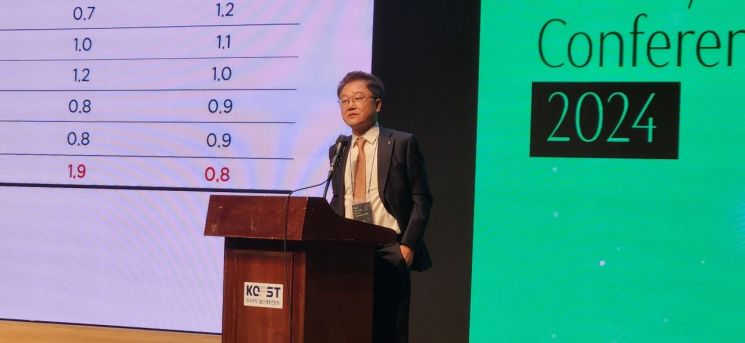
 Kang Seok-hoon, Chairman of KDB Industrial Bank, is delivering the keynote speech at the 'KABC 2024' seminar hosted by SNE Research on the 24th. Photo by Jung Dong-hoon
Kang Seok-hoon, Chairman of KDB Industrial Bank, stated on the 24th, "We are determined to actively support the electric vehicle and battery industries, as their success or failure will determine the future of the Korean economy." While anticipating that the electric vehicle chasm (temporary demand stagnation in a growing industry) will continue for some time, he expressed the policy of not sparing investments at the national policy bank level.
On the same day, Kang delivered the keynote speech at the ‘KABC 2024’ seminar hosted by SNE Research, saying, "Amid the crisis of zero growth, our economy and the Industrial Bank have been almost ‘all-in’ on the electric vehicle and battery industries over the past five years."
Since 2019, the Industrial Bank has invested more than 1 trillion won annually in the battery industry, with about 15 trillion won invested directly and indirectly over the past five years. However, Kang predicted that the electric vehicle chasm would not end easily. He said, "The chasm will not be easily overcome even if the U.S. lowers interest rates or expands charging infrastructure," and added, "The most important factor to overcome the chasm is price competitiveness, but the price gap between Chinese and Korean batteries is widening."
Kang pointed out that the Chinese battery industry, which is increasing its market share of inexpensive LFP (Lithium Iron Phosphate) batteries based on raw material and material competitiveness, should be watched carefully. He emphasized, "It is necessary to develop solid-state batteries, which have emerged as the next-generation battery alternative, and the future solutions of our battery companies depend on developing future-type batteries like solid-state batteries," adding, "In the trend of excluding China from supply chains, we must actively cooperate with countries like Indonesia, which require collaboration with Korea."
SNE Research has revised downward the market size of batteries for electric vehicles due to the impact of the chasm. By 2035, the market size for electric vehicle batteries is projected to be 4,395 GWh, which is 862 GWh lower than previously estimated. Due to the expansion of the Chinese electric vehicle market, China's battery market share is expected to increase from 54% in 2023 to 57% in 2030, but the Chinese share is forecasted to decline thereafter. Kim Kwang-joo, CEO of SNE Research, predicted, "After 2030, short-term supply shortages may occur in some regions."
CEO Kim emphasized that overcoming the chasm requires the development of prismatic LFP (Lithium Iron Phosphate) batteries with price competitiveness and next-generation batteries with improved safety. Along with this, active policy support from the government is also necessary. Kim stated, "From 2012 to 2022, the government expenditure budgets of Korea and China differ by 7 to 8 times, purchase subsidies by 11 times, and research and development (R&D) support by 8 times," adding, "More investment is required in purchase subsidies, infrastructure, and R&D support, and it is time for national-level policies to induce the transition to electric vehicles."
© The Asia Business Daily(www.asiae.co.kr). All rights reserved.

















