Revision and Implementation of Multi-Family Housing Review Standards
Entrance Distance Separation and Fireproof Wall Installation Required
From now on, the standards for installing electric vehicle charging zones will be strengthened in newly built apartments and other multi-family housing in Yongin-si, Gyeonggi-do.
Yongin City announced on the 24th that it will revise and implement the "Multi-family Housing Review Standards," focusing on strengthening the installation standards for electric vehicle charging zones to protect citizens' safety and property from damage caused by electric vehicle fires. The revised review standards will apply to complexes that submit business plan approval applications after the announcement date, which was the 9th of this month.
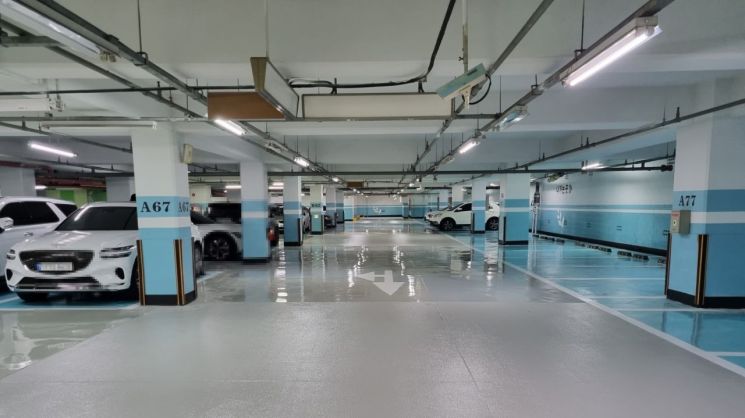 An underground parking lot within an apartment complex in Yongin-si, Gyeonggi-do. The city has revised the multi-family housing review standards to strengthen the criteria for electric vehicle charging facilities in new apartment complexes.
 [Photo by Yongin-si]
According to the revised standards, electric vehicle charging zones installed above ground must be located at least 10 meters away from buildings. They must be at least 20 meters away from facilities for children and the elderly such as playgrounds, kindergartens, and senior centers, as well as from places storing combustible or flammable materials. Fire trucks must be able to easily access the charging zones, and a canopy made of non-combustible material with open sides must be installed above.
The standards for charging facilities and dedicated parking zones installed in underground parking lots will be stricter. They must be located at least 10 meters away from main entrances, evacuation routes, combustible or flammable materials, electrical rooms, mechanical rooms, and generator rooms, and be connected to the outside through vehicle entrances and ventilation openings to allow smooth smoke discharge. Fire-resistant walls with a fire resistance rating of at least one hour must be erected at the boundaries of the charging zones. The charging zones must maintain a distance of 5 to 10 meters from indoor fire hydrants, and fire detectors and thermal imaging CCTV must be installed above.
The review standards also reflect regulations for installing solar power facilities in accordance with the government's zero-energy building mandate plan. When designing multi-family housing, solar power facilities must be installed on at least 50% of the building area of idle spaces such as rooftops of residential buildings or roofs of auxiliary and welfare facilities. This includes standards for installing solar-powered streetlights to support energy self-sufficiency in multi-family housing.
Additionally, the new standards require the installation of automatic water barriers or flood prevention curbs at underground entrances to prevent rainwater from flowing into underground parking lots. Backflow prevention valves must be installed on drainage outlets in underground spaces to prevent rainwater backflow, and underground rainwater storage tanks for rainwater reuse must also be installed.
A city official stated, "We have strengthened the review standards to respond swiftly to rapidly changing climate conditions and energy transitions and to create a sustainable multi-family housing culture. We will carefully review from the design stage of multi-family housing so that citizens can enjoy a safer and more comfortable living environment."
© The Asia Business Daily(www.asiae.co.kr). All rights reserved.

















