Fed Officials United on Rising Employment Risks
Kashkari Expects "Smaller Steps"
Bostic Emphasizes Indicators... Opens Door to Big or Small Cuts
Neel Kashkari, President of the Minneapolis Federal Reserve Bank, forecasted last week that the pace of monetary easing would slow down following the Federal Reserve's (Fed) 'big cut' (0.5 percentage point interest rate reduction). On the other hand, Raphael Bostic, President of the Atlanta Fed, suggested that the pace of future rate cuts is not yet determined and will depend on upcoming economic indicators.
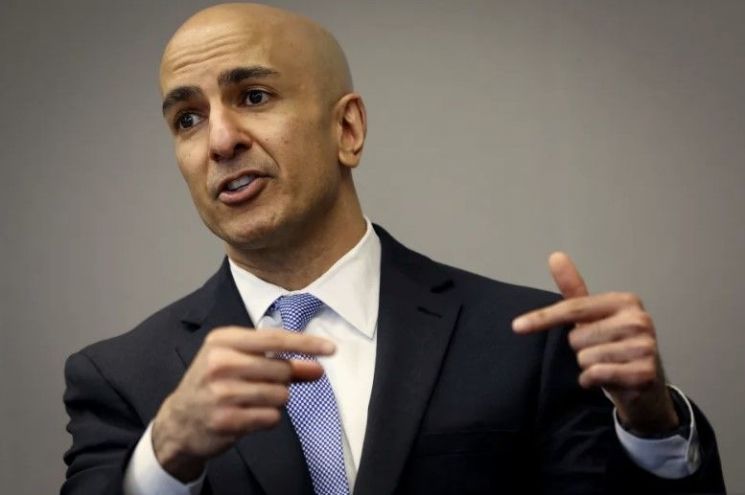
In an interview with CNBC on the 23rd (local time), President Kashkari stated, "Unless the data changes substantially, I expect to take smaller steps to balance things." He predicted that the Fed's rate cut at the next Federal Open Market Committee (FOMC) regular meeting in November is more likely to be 0.25% rather than 0.5%.
Regarding the background of the big cut on the 18th, he confirmed that it was due to the Fed's judgment that its policy needed to be recalibrated from price stability to a focus on employment. He explained, "Even after the 50 basis point (1bp=0.01 percentage point) cut, we are still in a restrictive position, so it was comfortable to take a big first step."
President Kashkari evaluated, "The labor market is currently strong and healthy, and we want to maintain that going forward," adding, "Many recent inflation indicators are on a path back to 2%, which is very positive."
However, President Kashkari will only have speaking rights at the FOMC until 2026 and will not have voting rights on monetary policy decisions.
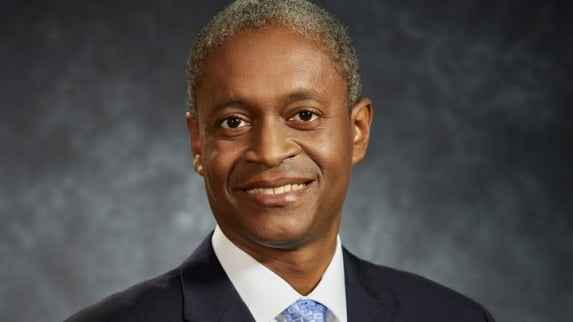
President Bostic, who holds voting rights at this year's FOMC, also forecasted that the labor market, which has raised recession concerns due to the Fed's big cut, will become more active. However, he indicated that the pace of future rate cuts is not fixed, leaving open the possibility of both big cuts and small cuts (0.25 percentage point rate cuts).
At an event hosted by the European Economic and Financial Center on the same day, President Bostic said, "Due to concerns about inflation, last week we could have stayed with a relatively small first move, that is, a 25 basis point cut. But that would have denied the increased uncertainty about the labor market trajectory." He added, "Progress on inflation and cooling of the labor market have appeared much faster than expected in early summer," and stated, "At this moment, I imagine monetary policy normalization happening faster than what was considered appropriate a few months ago."
He viewed inflation as having made "considerable progress," while the risk of failing to meet employment commitments has increased. However, he diagnosed that the labor market "has not yet turned red."
He emphasized, "The Fed is in a good position," and that the big cut has expanded the Fed's flexibility in monetary policy. He suggested that if inflation stagnates or rebounds, the pace of rate cuts could slow or stop, and if the labor market cools, the pace of cuts could accelerate.
Currently, the interest rate futures market is evenly split between expectations of a 25 basis point cut and a 50 basis point cut for the Fed's next rate reduction. According to the Chicago Mercantile Exchange (CME) FedWatch, the federal funds futures market on this day reflected a 53.1% probability of a 0.25 percentage point rate cut and a 46.9% probability of a 0.5 percentage point cut at the November FOMC regular meeting.
© The Asia Business Daily(www.asiae.co.kr). All rights reserved.
![Clutching a Stolen Dior Bag, Saying "I Hate Being Poor but Real"... The Grotesque Con of a "Human Knockoff" [Slate]](https://cwcontent.asiae.co.kr/asiaresize/183/2026021902243444107_1771435474.jpg)

















