On the 23rd, former Prime Minister Yoshihiko Noda was elected as the new leader of Japan's largest opposition party, the Constitutional Democratic Party.
In the runoff election held at an extraordinary party convention in Tokyo on the same day, former Prime Minister Noda won with 232 points, defeating former leader Yukio Edano, who received 180 points.
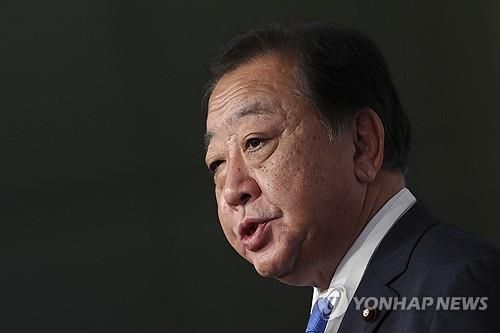 Former Japanese Prime Minister Yoshihiko Noda, elected as the new leader of the Constitutional Democratic Party on the 23rd
With the term of current leader Genta Izumi expiring, a total of four candidates ran in this election: former Prime Minister Noda, former leader Edano, current leader Izumi, and Representative Harumi Yoshida.
In the first round of voting, which involved party members, supporters, and local assembly members, no candidate among the four secured a majority.
Consequently, a runoff vote was held between the top two candidates, former Prime Minister Noda and former leader Edano, involving members of the National Diet, prospective candidates for the general election, and delegates from prefectural assemblies, resulting in Noda's final victory.
The Constitutional Democratic Party currently holds 99 out of 465 seats in the House of Representatives (lower house) and 38 out of 245 seats in the House of Councillors (upper house), making it the second-largest party after the Liberal Democratic Party.
New party leader Noda, a nine-term member of the House of Representatives, served as the last prime minister during the Democratic Party administration from September 2011 to December 2012.
After debating with then-Liberal Democratic Party leader Shinzo Abe, who was the party president at the time, Noda dissolved the House of Representatives, and in the election held later that year, the Democratic Party suffered a crushing defeat, handing over power to the Liberal Democratic Party.
At that time, the Liberal Democratic Party and Komeito agreed on comprehensive reforms of social security and taxation, deciding to raise the consumption tax rate from 5% to 10% in two stages, a move widely cited as one of the main reasons for the Democratic Party's defeat.
New leader Noda is expected to demonstrate leadership in facing the new Liberal Democratic Party president to be elected in the party's leadership election on the 27th, who will succeed Prime Minister Fumio Kishida.
This is because there is speculation about the dissolution of the House of Representatives and the possibility of an early general election following the Liberal Democratic Party leadership election.
Expressing his feelings upon election, Noda said, "I am sincerely determined to bring about a change in government," adding, "The fight starts today. I want everyone to unite and move toward 'Defeat the Liberal Democratic Party.'"
Earlier, targeting the ruling Liberal Democratic Party, which has faced public criticism over factional 'slush fund scandals,' he expressed his intention to implement fundamental political reforms such as reducing the number of Diet members and banning hereditary succession.
New leader Noda plans to pursue opposition party unity to achieve a change in government. When announcing his candidacy last month, he stated, "I have reaffirmed my determination to become prime minister again," expressing his ambition to lead efforts to expand the party's influence and deepen cooperative relations with other opposition parties.
Noda plans to finalize the structure of the new Constitutional Democratic Party executive team by the morning of the 24th.
Meanwhile, according to a recent public opinion poll by Yomiuri Shimbun this month, the Liberal Democratic Party had the highest party support rate at 31%, followed by the Constitutional Democratic Party at 5%, Nippon Ishin no Kai at 3%, and Komeito and the Communist Party each at 2%. Except for the Liberal Democratic Party, all other parties had single-digit support rates, which were low. Respondents who indicated no party support accounted for 48%.
© The Asia Business Daily(www.asiae.co.kr). All rights reserved.
![Clutching a Stolen Dior Bag, Saying "I Hate Being Poor but Real"... The Grotesque Con of a "Human Knockoff" [Slate]](https://cwcontent.asiae.co.kr/asiaresize/183/2026021902243444107_1771435474.jpg)















