Uijeongbu-si Decides to Postpone Operation of 'Sinpyeonghwa-ro Bus-Only Lane' Due to Increased Traffic Congestion
Plan to Allow General Vehicle Traffic from February to April Next Year... Entire 8.6km Section to Operate as BRT
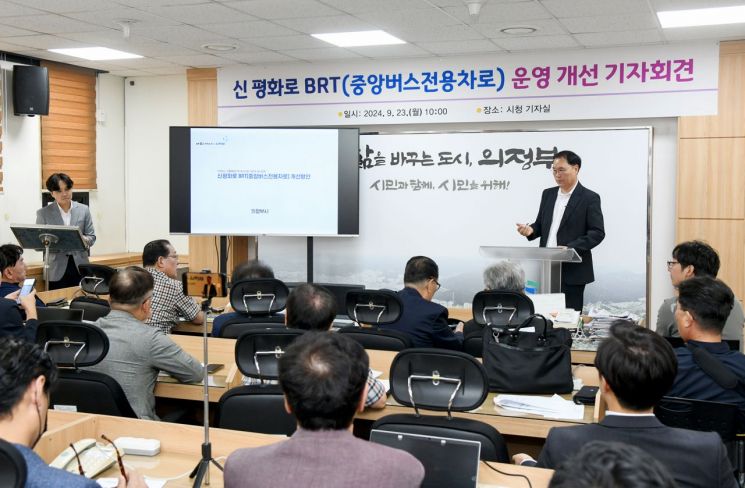 Park Chunsu, Director of the Transportation Bureau of Uijeongbu City, held a press conference on the 23rd to announce the 'Improvement Plan for the Operation of the Shinpyeonghwa-ro Central Bus-Only Lane.'
 Uijeongbu City in Gyeonggi Province has decided to temporarily suspend the operation of the "central bus-only lane" on Sinpyeonghwa-ro, which has faced criticism for worsening traffic congestion, and plans to operate the entire planned section as a "Bus Rapid Transit" (BRT) system in the future.
On the 23rd, Park Chunsu, Director of the Uijeongbu City Transportation Bureau, held a press conference and announced the "Sinpyeonghwa-ro Central Bus-Only Lane Operation Improvement Plan," outlining these details.
Sinpyeonghwa-ro serves as an alternative bypass road for the northern section of National Route 3 in Gyeonggi Province, passing through the northern and eastern parts of Uijeongbu City, including Minrak-dong and Yonghyeon-dong, and connecting to Dongil-ro, making it a major road within the region.
The central bus-only lane on this road is part of the Bus Rapid Transit (BRT) system under the Ministry of Land, Infrastructure and Transport (Metropolitan Area Transport Committee). However, due to geometric road structure issues, only a portion of the planned total length (8.6 km), specifically 4.4 km including Sinpyeonghwa-ro, has been in operation since October 2018. Although the entire planned length (8.6 km) should be operated as a central bus-only lane as part of the BRT system, it is currently impossible due to the road's geometric constraints.
Because the bus-only lane operation section is short, it has not only been inefficient but also caused increased congestion due to frequent lane changes at the start and end points of the bus-only lane and traffic jams resulting from dedicating one lane exclusively to buses.
In response, Uijeongbu City analyzed the structural problems that increase traffic congestion and accident risks. They found that during weekday peak hours (7-8 a.m.) at the start and end points, 1 general traffic lane toward Seoul carries 1,886 vehicles, whereas only 28 buses pass through the single central bus-only lane during the same period, indicating inefficient operation.
Accordingly, Uijeongbu City plans to first reinforce some safety facilities in the section, then temporarily suspend the operation of the central bus-only lane, and from around February to April next year, allow general vehicles to use the central bus-only lane. The city predicts that although bus travel speeds may slow somewhat, the improvement in general vehicle speeds will resolve lane usage imbalance issues, reducing social costs by approximately 7 billion KRW annually.
Subsequently, after completing the entire BRT facilities within the section, the city intends to operate the entire planned section (8.6 km), including the currently partially operated central bus-only lane (4.4 km), as a Bus Rapid Transit (BRT) system.
Uijeongbu City expects that once this plan is completed, bus services comparable to rail transit can be provided from Minrak 2-gyo in Minrak 2 District to Dobongsan Station Transfer Center. However, challenges such as overcoming the physical characteristics of Howon Overpass and negotiating with the Seoul Regional Land Management Office, the road authority for Sinpyeonghwa-ro, are anticipated.
Park Chunsu, Director of the Uijeongbu City Transportation Bureau, stated, "Through improving the operation of Sinpyeonghwa-ro, the traffic environment for residents in the Songsan and Singok areas will significantly improve compared to now," and added, "We will continue to do our best to make Uijeongbu a city with convenient transportation."
© The Asia Business Daily(www.asiae.co.kr). All rights reserved.
![Clutching a Stolen Dior Bag, Saying "I Hate Being Poor but Real"... The Grotesque Con of a "Human Knockoff" [Slate]](https://cwcontent.asiae.co.kr/asiaresize/183/2026021902243444107_1771435474.jpg)















