Leaving Dog Waste Unattended After Defecation
Secondary Highway Accidents Have a Fatality Rate 7 Times Higher
A story about a driver who stopped a cargo truck on the highway shoulder and allowed their pet dog to relieve itself has come to light, drawing public criticism. According to a report submitted by Mr. A to Yonhap News on the 23rd, at around 7:18 a.m. that day, a 1-ton cargo truck driver stopped on the shoulder of the Yeongdong Expressway near the Singal Junction in Yongin City, Gyeonggi Province. The video shows the truck driver taking a medium-sized dog on a leash onto the road to relieve itself after stopping. The highway shoulder is on a five-lane one-way road, where large cargo trucks and other vehicles pass by at high speeds.
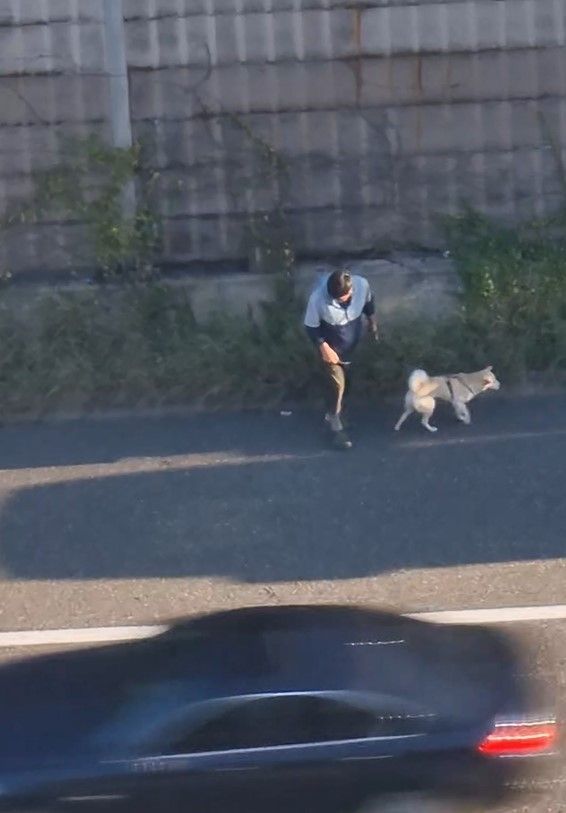 A story about a driver who stopped a cargo truck on the highway shoulder to let their pet dog relieve itself has come to light, causing public outrage. According to a report submitted by Mr. A to Yonhap News on the 23rd, at around 7:18 a.m. that day, a 1-ton cargo truck driver stopped on the shoulder of the Yeongdong Expressway near the Singal Junction in Yongin-si, Gyeonggi Province.
 [Photo by a reader]
After the dog finished relieving itself, the driver appears to check the spot but then moves back to the vehicle without any cleanup and places the dog on the passenger seat. Mr. A explained in a phone call with Yonhap News that the driver left the scene without any aftercare. Mr. A said, "The highway shoulder is designed for unavoidable situations such as vehicle breakdowns or accidents, so allowing a pet to relieve itself there seems inappropriate," adding, "What if the dog suddenly runs onto the road? That could lead to a major accident."
Meanwhile, the number of deaths caused by secondary accidents on highways, such as those occurring on shoulders, has averaged 27 per year over the past three years. Secondary accidents, which are said to be more dangerous than primary accidents, have a fatality rate nearly seven times higher than general traffic accidents. The fatality rate for secondary highway accidents reaches 56%, meaning more than half of those involved lose their lives.
Secondary accidents on highways mainly occur during the process of handling the initial accident. It is not uncommon for accidents to happen when people stay on the roadside to determine fault between vehicles, signal to oncoming traffic, or step onto the road to set up warning triangles. Sitting inside the car because of cold weather is also dangerous. To prevent secondary accidents, the first priority is to move the vehicle to the shoulder.
If moving the vehicle is difficult, turn on the hazard lights and open the trunk wide to alert vehicles behind you. At this time, regardless of how cold the weather is, the driver and passengers should not stay inside the car but must get out and evacuate beyond the guardrail. Once in a safe place, contact the Korea Expressway Corporation’s call center or your insurance company for assistance with vehicle breakdowns or accident handling. If the vehicle stops inside a tunnel, it should be parked on the shoulder or emergency parking area inside the tunnel, and evacuation should be carried out as quickly as possible. In this case, it is safer for the driver and passengers to move onto the elevated utility duct rather than the narrow shoulder.
© The Asia Business Daily(www.asiae.co.kr). All rights reserved.
![Clutching a Stolen Dior Bag, Saying "I Hate Being Poor but Real"... The Grotesque Con of a "Human Knockoff" [Slate]](https://cwcontent.asiae.co.kr/asiaresize/183/2026021902243444107_1771435474.jpg)
















