Damage to Girl Statues Hard to Punish Under Current Law
110 Out of 152 Have No Related Ordinances
Amid ongoing incidents of vandalism, threats, and mockery targeting the 'Statues of Peace,' it has been revealed that more than seven out of ten of the 10 statues lack ordinances or designated management authorities. As acts of desecration and insults toward the statues continue recently, calls are growing to address this blind spot. According to the 'Domestic Status of Statues of Peace' data submitted by the Ministry of Gender Equality and Family to Assemblyman Kim Seon-min of the Party for National Innovation on the 23rd, 72.4% (110 out of 152) of the statues installed nationwide do not have related ordinances in place.
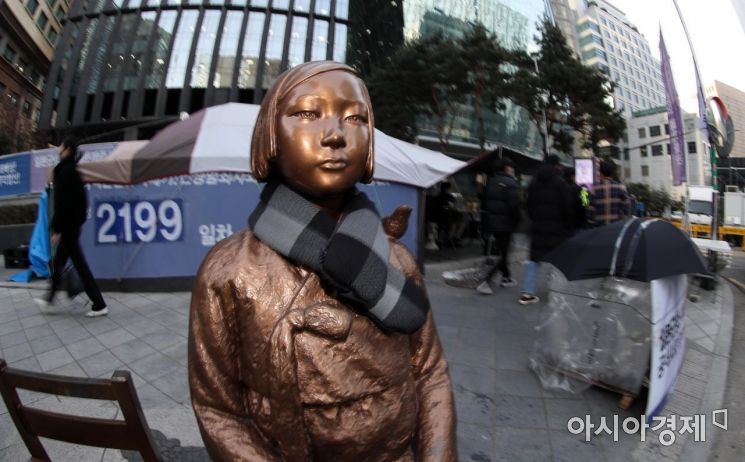 Amid repeated incidents of damage, threats, or ridicule directed at the "Statue of Peace," it has been revealed that more than 7 out of 10 statues lack ordinances or managing authorities.
 [Photo by Hyunmin Kim kimhyun81@]
By region, Gyeonggi Province had 77.8% (28 out of 36), Seoul 63.6% (14 out of 22) without ordinances. Jeonnam had 87.5% (14 out of 16), Gyeongbuk 85.7% (6 out of 7), Jeonbuk 84.6% (11 out of 13), Gwangju 50% (3 out of 6), and Gyeongnam 27.2% (3 out of 11) lacking related ordinances. Daejeon and Daegu, each with three statues, and Ulsan and Incheon, each with one statue, had no related ordinances at all.
Statues Neglected Without Management Authorities Due to Varied Ordinance Contents
Even statues erected within the same local government can be governed by different ordinances. For example, the statue installed near Times Square in Yeongdeungpo-gu, Seoul, in October 2019 is based on the 'Ordinance Supporting the Commemoration Projects for Victims of Japanese Military Sexual Slavery,' whereas the statue installed in front of the Japanese Embassy in Jongno-gu, Seoul, in December 2011 is based on the 'Public Design Promotion Ordinance.' Among these, five statues have been left unattended without management authorities because their founding bodies dissolved or were neglected by local governments. This situation makes it difficult to impose clear penalties for neglect or vandalism of the statues.
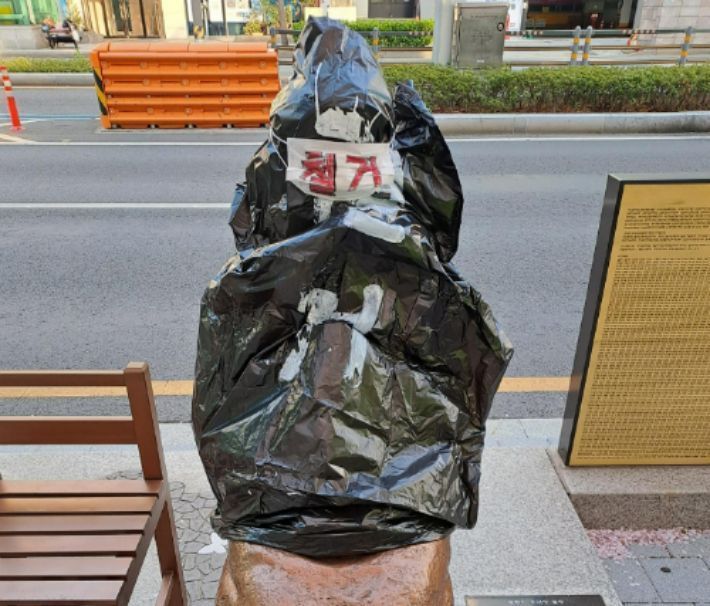 Last March, the head of a civic group covered the statue of a girl inside Eunpyeong Peace Park in Seoul with a plastic bag labeled "Demolition" and placed a sign that read "Eyesore." [Photo by Yonhap News]
Recently, acts of vandalism against the statues have been repeated. Earlier this month, a statue at the Gyeongnam Provincial Office of Education was found with signs written in Korean saying 'Eyesore' and 'Stop the Comfort Women Fraud Now,' along with a Japanese sign stating 'The Statue of Peace is a Propaganda Tool for the Comfort Women Fraud.' In March and April, the statue at Eunpyeong Peace Park in Seoul was covered with a mask labeled 'Demolition' or wrapped in black plastic bags. Additionally, a man in his 30s wrapped the Statue of Peace in front of the Japanese Consulate in Busan with a black plastic bag, sparking public outrage. Moreover, a photo showing sushi placed next to a statue and a person holding beer near their mouth was posted on an online community, prompting criticism from civic groups.
Despite continuous acts of terror against the statues, bills prohibiting vandalism and penalizing offenders were introduced consecutively last month but remain pending. Assemblyman Kim stated, "Out of 152 statues nationwide, a staggering 110 are not explicitly protected or managed," and emphasized, "Along with legally punishing acts of terror, local governments must establish systems to protect and manage the statues."
© The Asia Business Daily(www.asiae.co.kr). All rights reserved.
![Clutching a Stolen Dior Bag, Saying "I Hate Being Poor but Real"... The Grotesque Con of a "Human Knockoff" [Slate]](https://cwcontent.asiae.co.kr/asiaresize/183/2026021902243444107_1771435474.jpg)
















