Concerns Over Disadvantages for 1975 and 1985 Birth Cohorts in 'Age Group Change Section' Due to Differential Charges Between Generations
It has been predicted that if the reform plan to raise the National Pension insurance premium rate from the existing 9% to 13% while applying different increase speeds between generations is implemented, those at the age boundary between generations could bear up to an additional 1.5 million KRW in insurance premiums.

On the 22nd, Kim Seon-min, a member of the Innovation Party on the National Assembly's Health and Welfare Committee, announced that this fact was confirmed by analyzing the "Pension Reform Promotion Plan" announced by the Ministry of Health and Welfare.
The previously announced government pension reform promotion plan included raising the premium rate from 9% to 13%, with older generations experiencing faster increases. Subscribers in their 50s next year will see an increase of 1 percentage point annually, those in their 40s by 0.5 percentage points, those in their 30s by 0.33 percentage points, and those in their 20s by 0.25 percentage points.
It will take 4 years for those in their 50s, 8 years for those in their 40s, 12 years for those in their 30s, and 16 years for those in their 20s to reach a premium rate of 13%. By 2040, all generations will have a premium rate of 13%. This takes into account that younger generations have longer payment periods remaining and higher premium burdens. As a result, there is a difference in the additional burden caused by premium increases for those at the boundary ages, such as those born in 1975 and 1976, who separate the 40s and 50s.
A person born in 1975, the youngest in their 50s (assuming a monthly income of 3 million KRW), will have to pay an additional 12.24 million KRW until the maximum subscription age of 59, while a person born in 1976, the oldest in their 40s, will only have to pay an additional 10.8 million KRW. Thus, the 1975-born person grouped in their 50s will pay 1.44 million KRW more due to being one year older. This phenomenon also occurred for those born in 1985, the youngest in their 40s, and those born in 1995, the youngest in their 30s. The 1985-born will pay 1.52 million KRW more than the 1986-born, and the 1995-born will pay 1.36 million KRW more than the 1996-born.
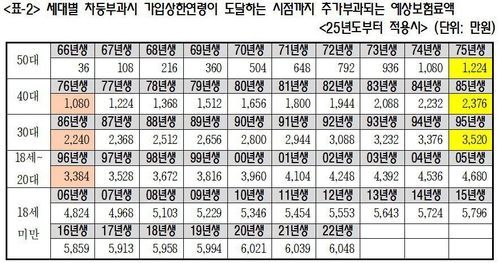
Representative Kim said, "Due to the artificially segmented 'differential charging between generations,' a 10-year difference results in the same premium rate being applied, but being born a day or a month earlier causes additional premiums exceeding one million KRW." He added, "We will strive to improve the shortcomings of the pension reform plan during the National Assembly's discussion process."
© The Asia Business Daily(www.asiae.co.kr). All rights reserved.
![Clutching a Stolen Dior Bag, Saying "I Hate Being Poor but Real"... The Grotesque Con of a "Human Knockoff" [Slate]](https://cwcontent.asiae.co.kr/asiaresize/183/2026021902243444107_1771435474.jpg)
















