'Digital Administrative Service Enhancement Measures' Review Meeting
Information System Grades Divided into 4 Levels for Separate Management
'Disability Grade' Newly Established... Standard Operating Procedures to Be Developed
Going forward, even if a first-grade information system failure occurs, the government will establish an integrated management system for inspection, recovery, and guidance to ensure that public services continue without interruption. In particular, to prevent failures in public services such as local administrative computer services in advance, a 'Crisis Management Standard Manual' including crisis stage criteria and step-by-step crisis management activities will be prepared.
On the afternoon of the 20th, the Ministry of the Interior and Safety held the 8th inspection meeting on the 'Measures to Enhance Public Trust in Digital Administrative Services' to discuss these plans and proceed with detailed policy formulation.
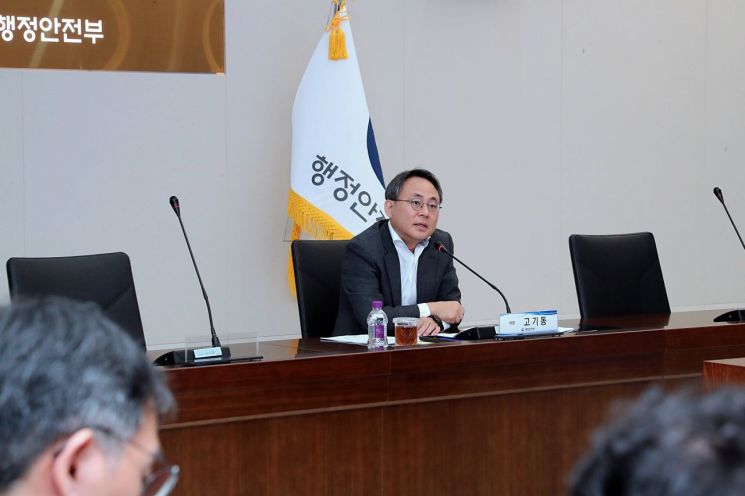 Deputy Minister of the Ministry of the Interior and Safety, Go Gi-dong, is delivering opening remarks at the "Digital Administrative Service Public Trust Enhancement Measures Review Meeting" held on the morning of the 20th at the Central Hall of the Government Sejong Complex, Do-um-ro, Sejong City.
 [Photo by Ministry of the Interior and Safety]
Earlier, the government announced a comprehensive plan consisting of 26 tasks last January to prevent failures in public services such as local administrative computer services and to respond quickly in case of failures. This meeting, chaired by Vice Minister Ko Gi-dong, was organized to review the changes in the field over the past eight months of implementing the comprehensive plan and to promote policies more swiftly in the future.
At the meeting, it was confirmed that detailed plans, including immediate tasks to strengthen failure prevention and response capabilities, mid- to long-term tasks to resolve accumulated issues, and legal revisions, are currently being implemented.
The policy direction was also presented. The government plans to fully review the 'Information System Grades,' which serve as standards for information system management and budget investment, considering factors such as ▲business impact ▲number of users ▲service spread, and manage them by dividing into four grades. Additionally, a new 'Failure Grade' will be established to manage failures differentially according to their severity. To ensure systematic operation of information systems without failures, eight preventive inspection items across three areas?daily inspection, special inspection, and structural diagnosis?as well as eight standard operating procedures including failure management and change management have been prepared.
To prevent information system failures from remaining a blind spot in disaster management, the revision of the 'Enforcement Decree of the Disaster and Safety Act' has already been completed. If large-scale damage occurs due to an information system failure, the disaster management authority (the institution managing the failed system) can establish and operate a Central Accident Response Headquarters to manage the situation, thus preparing an institutional response foundation. The 'Cyber Failure Support Team,' formed in January within the National Information Resources Service under the Ministry of the Interior and Safety, supports failure recovery activities such as cause analysis for information systems not housed in the National Information Resources Service and provides specialized technical support by sector.
In the future, the Ministry of the Interior and Safety plans to establish a 'Business Continuity Plan' within the year to ensure that even if a failure occurs in a first-grade information system, public services can continue without interruption through ▲alternative method guidance ▲manual reception ▲retroactive processing. Vice Minister Ko Gi-dong stated, "It is important to strengthen inspections so that necessary procedures and standards for failure prevention and response operate properly in the field, and to immediately supplement and improve any shortcomings." He added, "We will faithfully implement the measures to further enhance stability and prevent any inconvenience to the public caused by information system failures."
© The Asia Business Daily(www.asiae.co.kr). All rights reserved.

















