Eco-Friendly Ship Technology Unveiled: 'World's First Fossil Fuel-Free Vessel'
Affiliates Hanwha Engine and Hanwha Power Systems Showcase Synergy
Hanwha Ocean unveiled a next-generation carbon-free vessel equipped with advanced eco-friendly technologies at a global forum, taking concrete steps toward its vision for maritime decarbonization.
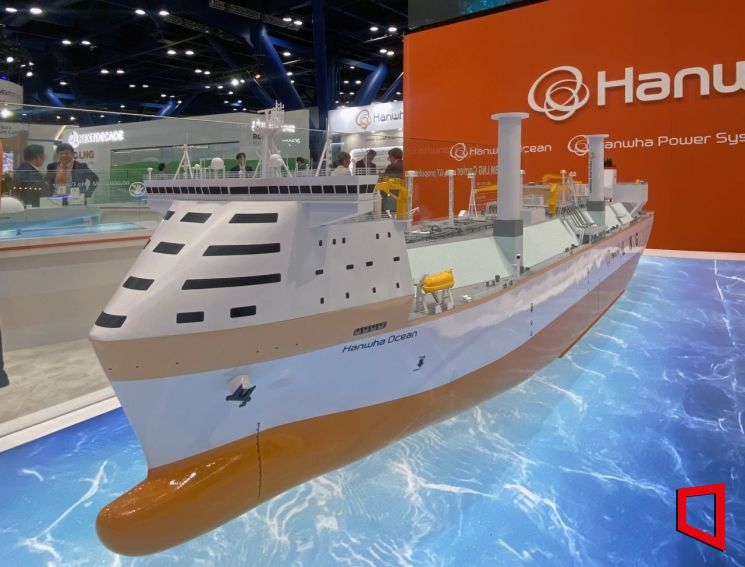 Hanwha Ocean exhibited a model of the industry's first 'Next-Generation Carbon-Free Propulsion LNG Carrier' at Gastech 2024. Hanwha Ocean's cutting-edge eco-friendly and digital solutions will be installed.
Hanwha Ocean hosted the "LNGC User Forum" for shipowners and classification societies at "Gastech 2024," which is being held in Houston, USA.
At this forum, Hanwha Ocean introduced "Ocean 1," a next-generation carbon-free LNG carrier equipped with various eco-friendly and digital solutions. This marks the first time the specific technologies of the "world's first fossil fuel-free vessel," announced at the Davos Forum in Switzerland last January, have been presented, positioning it as the best alternative in the Net-Zero era.
The LNGC User Forum was organized to promote Hanwha Ocean's LNG carrier technology competitiveness and enhance its order-winning capabilities to major LNG carrier shipping companies and leading global classification societies. More than 100 key stakeholders from the global shipbuilding and shipping industries attended the event.
The gas carrier unveiled by Hanwha Ocean at the forum adopts an ammonia gas turbine-based electric propulsion system, enabling completely carbon-free operation without fossil fuels. It is also capable of dual-fuel operation with LNG, which is widely used as marine fuel today, and has the flexibility to incorporate fuel cell and battery technologies in the future.
Dual-fuel refers to "mixed combustion," meaning the generation of electricity by burning a mixture of LNG and ammonia.
The presentation also introduced a plan to use high manganese steel LNG fuel tanks, MCTIB (High Manganese Steel Cargo Tank Independent Type-B), as cargo holds for LNG carriers. MCTIB has already been applied as fuel tanks for very large crude oil carriers and container ships built by Hanwha Ocean. Using MCTIB as a cargo hold is expected to dramatically reduce boil-off gas (BOG), thereby improving transport efficiency.
Hanwha Ocean also presented its vision for the commercialization of autonomous ships. Fully autonomous vessels require unmanned operation and unmanned cargo loading and unloading technologies. The forum also showcased supporting technologies such as control systems, navigation systems, smart ship solutions, and digital twin technology.
Plans to create synergy through collaboration between Hanwha Engine and Hanwha Power Systems were also introduced.
The remote engine monitoring system presented by Hanwha Engine is capable of detecting engine anomalies and notifying users of component replacement intervals. When integrated with Hanwha Ocean's smart ship solutions in the future, it will also provide the ability to monitor engine status in real time from shore.
Hanwha Power Systems introduced an eco-friendly solution to replace fossil fuel engines currently in operation on ships with ammonia gas turbines. This attracted the attention of shipowners who need to operate existing vessels economically while meeting carbon emission regulations, especially when building new ships is burdensome.
A Hanwha Ocean representative stated, "The carbon-free LNG carrier unveiled at this forum is an innovative eco-friendly solution that will lead the industry," adding, "We will further strengthen collaboration with our affiliates to solidify our position as a global ocean solution provider leading maritime decarbonization."
© The Asia Business Daily(www.asiae.co.kr). All rights reserved.
![Clutching a Stolen Dior Bag, Saying "I Hate Being Poor but Real"... The Grotesque Con of a "Human Knockoff" [Slate]](https://cwcontent.asiae.co.kr/asiaresize/183/2026021902243444107_1771435474.jpg)















